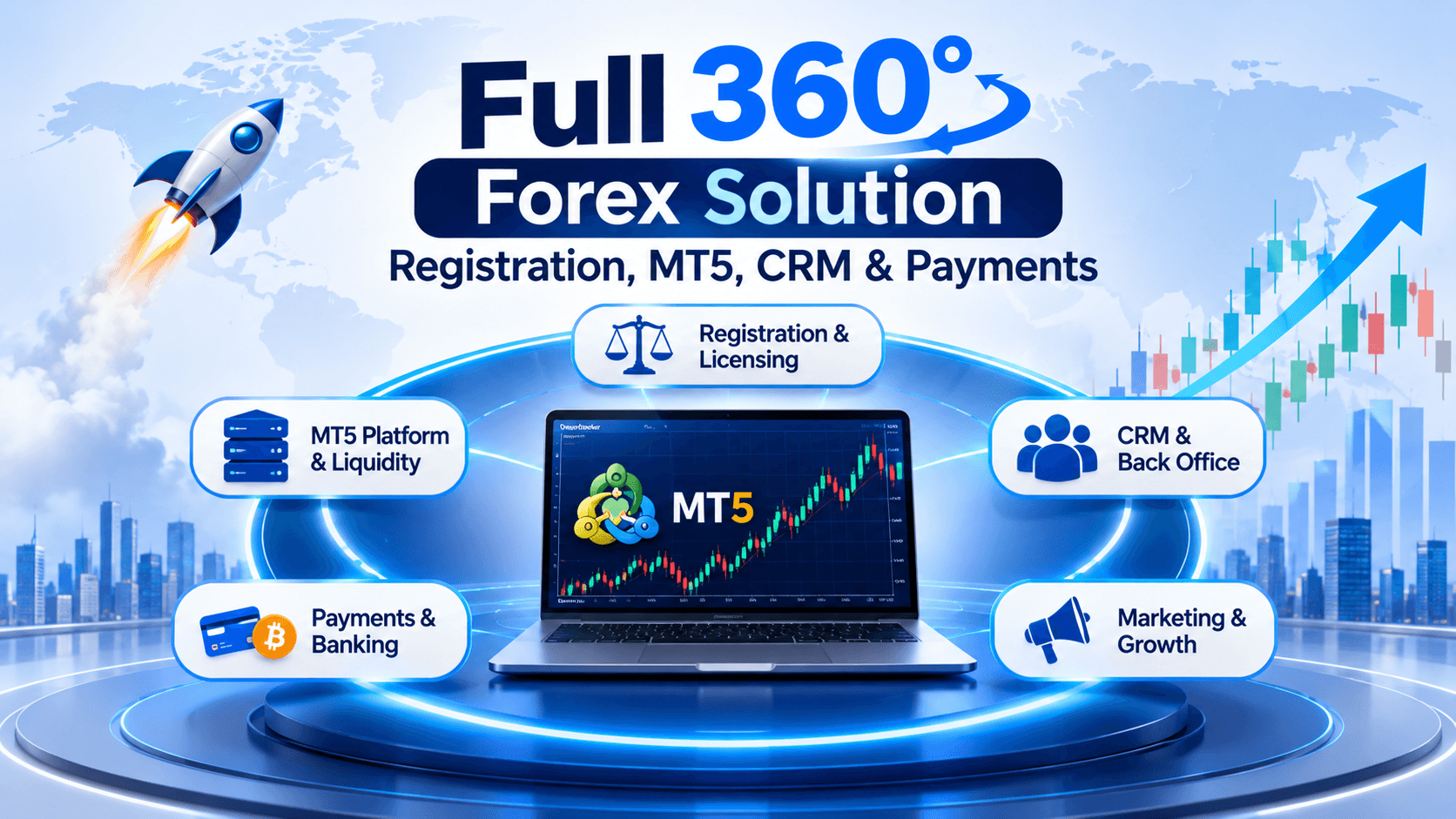
"Full 360° solution" is a phrase every brokerage-setup provider uses, and it can mean very different things. For some it means a platform and a logo. For others it means a company, a licence route, a trading stack, payments, and a growth plan that all work together.
This guide explains what a genuinely complete brokerage setup covers, how the five layers connect, what "turnkey" usually includes and leaves out, and the questions to ask any provider before you sign.
A note on transparency: FX Launch Pad wrote this, and we offer a full-stack setup service, so we're a provider. Apply the checklist in this guide to us as well. It's general information, not legal advice, and where we describe our own packages we use the details on our website.
The Five Layers of a Brokerage
A brokerage is five systems that have to behave as one. Most launch problems happen in the gaps between them.
Layer | What it covers | Why it matters | Go deeper |
1. Registration and licensing | Company formation, licence route, directors, compliance framework | Decides which markets you can serve and what you're allowed to do | |
2. MT5 platform and liquidity | MT5 setup, servers, liquidity bridge, liquidity providers | Where trades are priced, executed, and risk-managed | |
3. CRM and back office | Client onboarding, KYC, accounts, IB and affiliate tracking, reporting | The system your compliance records and partner payouts live in | |
4. Payments and banking | Bank and EMI accounts, payment gateways, crypto rails | Whether clients can fund and withdraw reliably | |
5. Website, marketing, and growth | Website and app, SEO, ads, email, partner marketing | How clients find you, and what you're allowed to say |
Three things cut across all five: compliance, risk management, and security. They aren't a sixth layer. They're how each layer is built.
How the Layers Connect
The layers depend on each other in a particular order, and sequencing is where most of the value in a "360°" approach comes from.
- Markets and licence come first: Your authorization decides which countries you can serve. That in turn decides which payment methods, ad platforms, and marketing claims are available to you. See our Google Ads compliance guide for why.
- Your business model comes next: A-book, B-book, or hybrid shapes your capital, your platform configuration, and your risk rules.
- Platform and liquidity follow the model: The bridge and MT5 settings implement your execution and risk decisions.
- The CRM connects the platform to everything else: KYC status, account creation, balances, and partner commissions all flow through it.
- Payments feed the CRM, which feeds the platform: A deposit should reach a client's balance only after a confirmed payment and a passed KYC check.
- Marketing sends people into that funnel: so it must reflect your licence, your markets, and your onboarding capacity.
When these are bought separately, each step is a handoff between vendors. When they're built together, the handoffs are designed and tested. That's the real difference between a collection of tools and a complete setup.
FX Launch Pad's Setup Options
Here are the three setup models currently shown on our website. Prices are "from" figures, and scope should always be confirmed in writing.
Offshore setup | Regulated setup | Mauritius (premium regulated) | |
Setup cost | $10,000 | $40,000 | $55,000 |
Jurisdiction | St. Lucia / St. Vincent | A standard regulated jurisdiction | Mauritius |
Regulatory status | Non-regulated | Regulated | Fully regulated |
Setup timeline | 20–25 working days | 45–50 working days | 90–100 working days |
Company formation | Included | Included | Included |
Local directors | Not required | As per the jurisdiction | 2 directors included |
Bank account setup | Available | Available | Included |
Annual renewal | Low | $30,000 | As per compliance |
Monthly operational cost | Minimal | Moderate | $3,500 |
Best for | Quick market entry | Growing brokerages | Global expansion, institutional setup |
Two clarifications that matter:
- An offshore setup is a company structure, not a regulatory licence: That has consequences for banking, advertising eligibility, and which markets you can approach.
- The setup timeline is for the company and licence route: A fully operational brokerage also needs banking, payments, platform testing, and compliance in place. Those run in parallel but usually extend the total.
Around these options, our service lines cover company setup, trading infrastructure (MT5, servers, bridge, and liquidity), financial systems (bank account opening, payment gateways, and crypto payment setup), technology (CRM, back office, and IB and affiliate tools), and growth services (lead generation, digital marketing, and funnel setup).
The process runs in four steps: consultation and planning, setup and infrastructure, integration and testing, then launch and scale. You can see an example of the technology side in our BestMarkets case study, which covers an MT5-connected broker CRM and automated IB commissions.
What "Turnkey" Usually Includes, and What It Doesn't
Industry guides describing turnkey packages are consistent about where the gaps are. Most are written by providers, so treat them as indicative.
Typically included | Often excluded or variable |
Trading platform, usually a white label on the provider's infrastructure | The regulatory licence itself, and regulator fees |
Liquidity bridge and a first liquidity provider connection | Negotiated liquidity pricing and a second provider for redundancy |
CRM and client portal, often the provider's product with your branding | Custom onboarding flows, data export rights, design ownership |
One or two payment provider integrations | Banking and EMI account opening, and ongoing payment reserves |
Website template and hosting | Marketing, lead generation, and compliance staffing |
Contract wording matters: "Licence assistance" means help with the application. "Licence included" would mean the licence is part of what you're buying, and no provider can simply deliver that, since regulators grant licences to the applicant, not the provider. Ask for the exact meaning in writing.
Who Is Responsible for What
A provider builds and connects the infrastructure. You run a regulated business. Be clear about the line.
As our website states, FX Launch Pad is a technology and infrastructure provider. It doesn't provide financial advisory, brokerage execution, or investment services, and it doesn't hold or manage client funds. In practice, with any provider, these remain yours:
- Being the authorized or registered entity and meeting its ongoing obligations
- Compliance leadership: the compliance officer, the MLRO, and the decisions they make
- Client funds and records: safeguarding and reconciliation
- Risk decisions: your book model, limits, and hedging
- Marketing claims: including those made by your partners and IBs
- Your liquidity and banking relationships: which should be in your company's name
- Support and complaint handling for your clients
A good provider helps you do these well. It doesn't take them over, and you should be cautious of any who say it will.
Costs Beyond the Setup Fee
The setup fee is the visible part. Plan for the rest.
Cost | Type | Notes |
Setup package | One-time | The figures above |
Regulatory capital | Held | Set by your regulator and model |
Licence and annual renewal | Recurring | Our regulated option lists $30,000 a year |
Monthly operations | Recurring | Our Mauritius option lists $3,500 a month |
Platform and liquidity | Recurring, volume-linked | Costs often rise with volume. See our MT5 cost guide. |
Payment provider fees and reserves | Recurring | Negotiate terms in writing |
KYC and AML tooling | Recurring, per check | Model at higher volume |
Compliance, audit, and staff | Recurring | Often the largest long-term cost |
Marketing and partner payouts | Recurring | Budget separately from setup |
Ten Questions to Ask Any 360° Provider
- What exactly does "licence" mean in your package? Assistance, application, or something else?
- Whose name are the liquidity, bank, and payment agreements in? They should be yours.
- How is the MT5 platform provided? Through a licensed provider, or your own server licence, and who operates and secures it?
- Who owns the CRM data, and can I export it? What are the exit terms?
- Can I test the integrated stack before launch? Ask for a sandbox and end-to-end test evidence.
- How many payment providers are included, and what are the reserve terms?
- What compliance deliverables do you provide, and what remains my responsibility?
- What happens after launch? Support scope, response times, and costs.
- Which components do you build, and which do you resell? Ask for the list.
- Can I speak to clients, and can I verify them? Check regulator registers yourself, not only the provider's documents.
Red flags: guaranteed approval, "licence included" with no detail, launch promises measured in days for a regulated, banked operation, pressure to sign quickly, vague scope, and reluctance to name who holds the contracts.
On timing in particular: promises of a complete launch in a couple of weeks usually describe platform delivery, not a licensed, banked, operating brokerage. Ask what exactly is live on that date.
Common Mistakes
- Buying each layer separately, then discovering nobody owns the handoffs
- Choosing a licence before deciding which markets to serve
- Configuring the platform before deciding the book model
- Treating the offshore company structure as a licence
- Assuming "turnkey" covers banking, compliance staff, and marketing
- Launching marketing before licensing and onboarding are ready
- Putting liquidity and bank agreements in the provider's name
- Choosing on setup price and ignoring running costs
- Skipping end-to-end testing.
What's New in 2026
- MT5 is the realistic platform for new brokers: since MetaQuotes stopped issuing new MT4 licences in 2022.
- Card-network monitoring has tightened: which affects payment providers' tolerance. See our payment guide.
- EU AML rules are taking shape: ahead of 2027, and operational-resilience rules such as DORA already apply to EU firms.
- Regulators are watching marketing and partner promotion closely
- Search is shifting toward AI answers: which rewards accurate, well-sourced content.
Related Reading
- How Long Does It Really Take to Launch a Forex Brokerage?
- Top Mistakes New Forex Brokers Make When Setting Up Their Platform
- Offshore vs Regulated Forex License — Which Fits Your Budget?
- Scaling Your Forex Brokerage from Startup to Enterprise
About FX Launch Pad
We offer a managed, full-stack brokerage setup, from company formation through platform, payments, CRM, and growth services. We'd rather you ask the hard questions in this guide than discover the answers after you've signed. The first consultation is meant to map your markets, model, and budget to the right structure, and to be clear about what we do and what remains yours.
If you'd like a launch roadmap for your situation, book a free consultation and we'll go through it with you.
Frequently Asked Questions
Q-1 What is a full 360° forex brokerage solution?
Ans- A setup that covers the company and licence route, the MT5 platform and liquidity, the CRM and back office, payments and banking, and the website and marketing, designed and tested to work together. What a specific provider includes varies, so always get the scope in writing.
Q-2 Does a turnkey package include the licence?
Ans- Usually it includes licence assistance, such as application preparation, not the licence itself, because regulators grant licences to the applicant. Check the exact contract wording.
Q-3 Can I launch a brokerage in 15 or 30 days?
Ans- You can often get a platform, CRM, and website built in about a month. A licensed, banked, operating brokerage generally takes longer, depending on your jurisdiction, because licensing and bank onboarding run on regulators' and banks' timelines.
Q-4 Do I need technical knowledge to run a brokerage?
Ans- You don't need to code, and a managed provider handles the infrastructure. But you do need to understand your responsibilities: compliance, risk decisions, and the choices that drive configuration. Those can't be outsourced.
Q-5 Can a brokerage accept both fiat and crypto payments?
Ans- Yes, both can be integrated, but each adds compliance and reconciliation requirements, and what's permitted depends on your licence and markets.