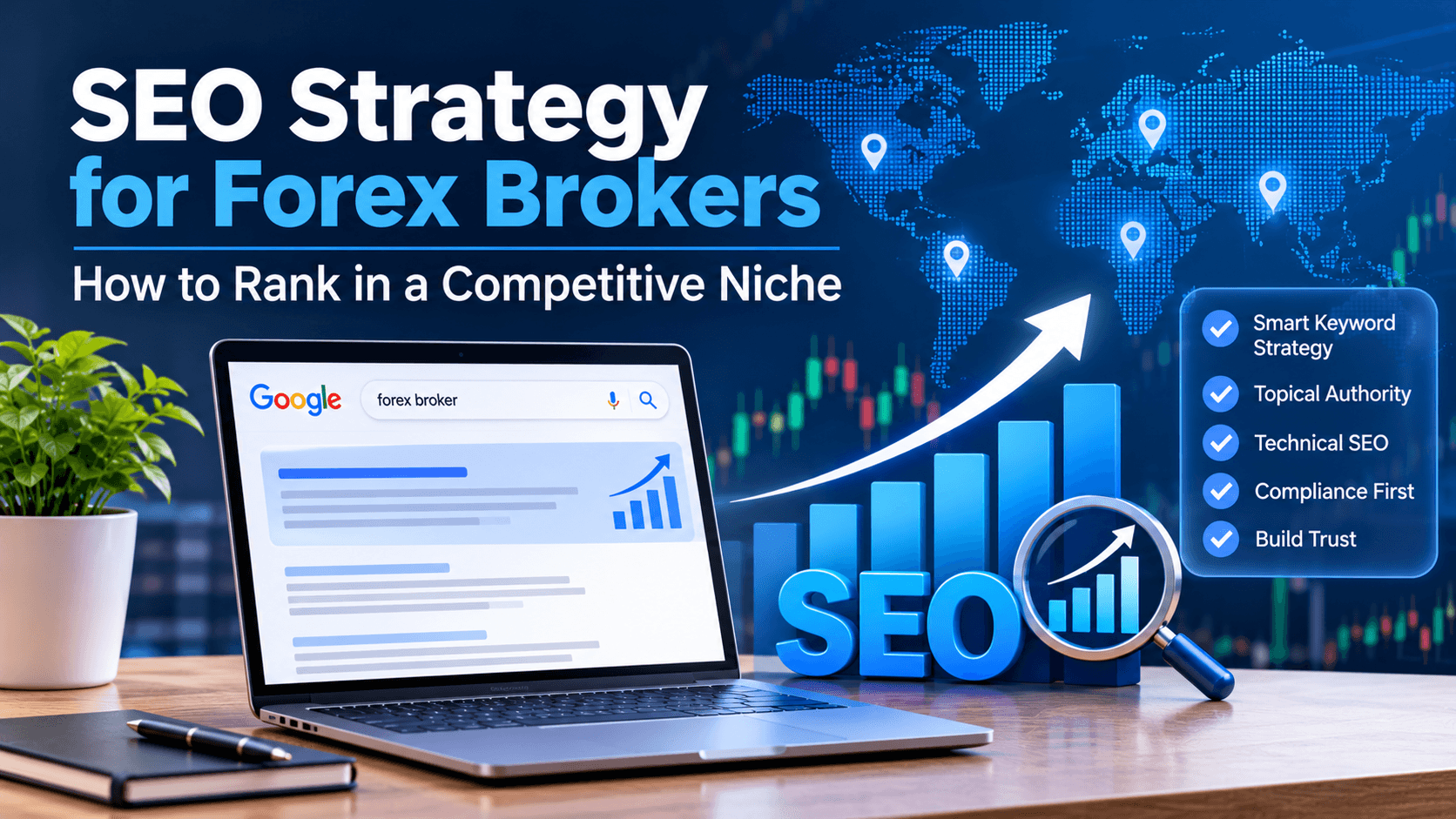
Search results for the most valuable forex terms are crowded. The top positions for queries like "best forex broker" are typically held by large comparison and review sites and by brokers that invested in SEO years ago. A new broker website starting from zero authority won't displace them by publishing more articles.
That doesn't mean SEO is pointless. It means the strategy has to be different: choose the queries you can actually win, build authority where incumbents are weak, defend your own brand's search results, and be realistic about timelines. On top of that, 2026 brought a run of Google updates and a growing AI layer on the results page that affect which clicks arrive at all.
This guide is the competitive-strategy layer. For the basics, see our digital marketing guide, for E-E-A-T and editorial workflow see our content marketing guide, and for regional structure and hreflang see our local SEO guide. It's general information, not legal advice.
The Reality Check: Who Holds the Results
Forex is a "Your Money or Your Life" (YMYL) category, which Google judges against its strictest quality standards. Agency analyses of broker search results consistently find that high-value commercial terms are dominated by two groups: comparison and review affiliates, and a handful of established brokers.
That shapes what's realistic:
Query type | Example | Who typically ranks | Realistic approach for a broker |
Head commercial terms | "best forex broker" | Large comparison sites and big brands | Don't lead with these. Revisit once authority exists. |
Product and feature terms | "MT5 broker", "ECN broker" | Mix of brokers and reviewers | Target specific, well-differentiated pages |
Comparisons | "Broker A vs Broker B", "alternatives" | Affiliates, some brokers | Fair, accurate comparison pages |
Cost, funding, and withdrawal | "forex broker withdrawal time" | Mixed | Strong opportunity, because answers can come from your own real data |
Regulation and jurisdiction | "what does a [regulator] licence cover" | Law firms, consultants, affiliates | Strong opportunity if you have genuine expertise |
Education | "what is margin" | Large educational sites | Selective, supporting role |
Brand queries | "[your brand] review", "[your brand] scam" | Affiliates, forums, you | Defend deliberately |
Region-specific | "regulated broker in [country]" | Often less contested | Only where your licence allows you to serve |
Most sources put the time to material organic traffic for a new content programme at 12–24 months. Early wins usually come from long-tail and region-specific queries.
Step 1: Choose Winnable Battles
Build your keyword plan around intent and winnability, not search volume.
Score each cluster on:
- Intent: how close is the searcher to opening an account?
- Winnability: how strong are the pages ranking, and how thin are they?
- Advantage: do you have something incumbents can't easily copy?
- Eligibility: are you allowed to serve this audience? A cluster for a market your licence doesn't cover is a liability. See our Google Ads compliance guide for why eligibility comes first.
Clusters worth building:
- Regulation and jurisdiction explainers
- Platform and product pages (execution, account types, platforms)
- Costs, funding, and withdrawals (fees, payment methods, timing)
- Comparison and alternatives pages
- Education that supports the others
- Brand defence pages
Step 2: Find Gaps Incumbents Can't Easily Fill
Review the top results for each target query. Note the page types, how current they are, what evidence they use, and who wrote them. Then ask what a licensed broker can credibly offer that a review affiliate can't.
Gap | Why it works |
First-hand operational facts | Real withdrawal processes, account opening steps, platform behaviour, and support routes, published accurately and with compliance review |
Accurate regulatory detail | Jurisdiction guides built from regulators' own sources, kept current |
Original data | Anonymised, methodology-backed statistics you can compile and others will cite |
Named expertise | Authors with real credentials and bios |
Freshness | Visible "last reviewed" dates and genuine updates |
Honest comparisons | Fair, verifiable, and clear about your own interest |
The same principle appears in our guides to the regulatory landscape, such as CySEC, Cayman, and BVI. Depth and accuracy are what competitors with templated content can't match.
Step 3: Build Topical Authority With Hubs and Spokes
Search engines reward sites that cover a subject completely and link it together sensibly.
Example structure:
- Hub: "Forex broker regulation by jurisdiction"
- Spokes: one guide per regulator, a licence-comparison page, and explainers on capital rules, timelines, and renewals
- Links: every spoke links to the hub and to relevant siblings, and the hub links out to all spokes
Practices that help:
- Use descriptive, consistent internal anchor text
- Keep one primary page per topic, instead of several thin pages that compete
- Update cornerstone pages on a schedule, and prune or merge weak ones
- Keep your entity details (name, regulator, address) identical across the site, schema, and profiles
Step 4: Defend Your Branded Search Results
Searches for "[your brand] review," "[your brand] scam," and "is [your brand] legit" happen whether or not you take part. If the only results are affiliate pages and old forum threads, you've given up your own brand search results.
What to do:
- Publish a factual regulation and safety page that links to your regulator's public register entry
- Provide clear pages on fees, withdrawals, and complaints
- Make sure honest reviews exist on independent platforms, earned naturally and never bought or incentivised
- Respond professionally to criticism
- Add Organization schema and consistent profile links
- Brief your affiliates and IBs on what they may say about your brand.
Step 5: Earn Authority Without Taking Risks
Links still matter in competitive niches, but low-quality tactics create more risk than value in a YMYL category.
Approaches that work and hold up:
- Digital PR around data you own: such as anonymised trends, surveys, and regulatory analysis
- Expert commentary and contributed articles: in finance and trade publications
- Useful tools: such as margin, pip-value, and position-size calculators
- Listings with regulators, associations, and genuine industry directories
- Webinars and events with credible partners
Avoid:
- Buying links, link networks, or private blog networks
- Renting out sections of your domain to third-party content designed to borrow your authority. Google's "site reputation abuse" policy targets this.
- Mass-produced, lightly edited AI articles, which Google's spam policies on scaled content abuse target
- Paid placements without proper disclosure and link attributes
Step 6: Get the Technical Foundations Right
- Indexation and crawlability: make sure important pages are indexed, and low-value ones aren't
- Core Web Vitals: loading within 2.5 seconds, interaction response within 200 milliseconds, and layout shift under 0.1.
- JavaScript rendering: check that key content is visible to search engines
- Structured data: Organization, Article with author details, and breadcrumbs, validated and consistent
- Regional setup: correct URL structure and hreflang, with no forced automatic redirects.
- Security and speed on mobile, where much trading traffic arrives
Ranking in an AI-Shaped Results Page
The results page changed, and click data was contested.
- Seer Interactive: analysed 3,119 informational queries across 42 organisations and found organic click-through fell 61% (from 1.76% to 0.61%) on queries where an AI Overview appeared. It also found brands cited within the overview earned about 35% more organic clicks than uncited brands on the same queries.
- Pew Research: found users clicked a result on 8% of visits that showed an AI summary, versus 15% without one.
- Google disputes: the broader click-loss claim and says total organic clicks remain relatively stable, with higher click quality.
Estimates vary widely by study, query type, and time period, so treat any single figure with care. The direction is consistent: informational queries lose clicks, and being cited matters.
What to do:
- Write answer-first sections that can be quoted
- Back claims with dated, primary sources
- Publish original information others cite
- Track citation share in AI answers alongside rankings
- Focus on commercial and brand queries, where AI answers cut clicks less, as well as informational ones
What Changed in Google's 2026 Updates
Google rolled out a heavy schedule of updates in 2026. As reported by several trackers: a Discover-only update on 5 February, a spam update on 24–25 March, a core update from 27 March to 8 April, and another core update from 21 May to 2 June, with further spam updates reported over the summer.
Across analyses, the common findings were:
- YMYL categories such as finance moved most.
- Thin, templated, or lightly edited AI content did worse.
- Affiliate and aggregator-style sites were hit hard, according to several analyses.
- Pages with clear expertise, accurate sourcing, and original value held up better.
The practical lesson: don't chase specific updates. Build content a cautious reviewer would trust, and keep it current.
Compliance Guardrails for SEO
SEO pages are financial promotions. Build the same rules into your editorial process as in the rest of your marketing:
- Risk warnings and licence details that match each region
- No guaranteed-return or "risk-free" claims
- Comparison pages that are truthful, verifiable, and fair to competitors
- Only the products and promotions your regulator permits
- No pages that invite sign-ups from markets you can't serve
- Compliance review before publication.
What to Measure
Metric | Why it matters |
Non-brand impressions and clicks by cluster | Shows authority growing where you chose to compete |
Rankings by intent, not just position | A first-page result on a high-intent query matters more than many low-intent ones |
AI citation share | Visibility where clicks don't happen |
Branded search volume | A sign that trust is building |
Organic registrations, KYC completions, and first deposits | Connects SEO to revenue |
Quality of new links | Relevance and trust, not count |
Indexation and Core Web Vitals | Technical health |
Compliance exceptions | Pages needing correction should trend down |
A Realistic Timeline
Period | Focus | What to expect |
Months 0–3 | Technical fixes, intent map, entity and compliance setup, first cluster | Indexation and baseline data |
Months 3–6 | Publish the hub and spokes, brand defence pages, first PR | Early long-tail and region-specific visibility |
Months 6–12 | Comparison pages, original data, links, refreshes | Growing non-brand traffic and first conversions |
Months 12–24 | Compete for broader commercial terms | Material, compounding organic traffic |
Common Mistakes
- Targeting head terms before building authority
- Choosing keywords by volume, not intent and winnability
- Building pages for markets you can't legally serve
- Publishing templated or lightly edited AI content at scale
- Ignoring your branded search results
- Buying links or renting out domain authority
- Chasing each algorithm update
- Treating SEO as a three-month campaign
- Skipping compliance review.
Related Reading
- Digital Marketing Strategies for Forex Brokers – Grow Your Brokerage Globally
- Content Marketing for Forex Brokerages: What Actually Works
- Local SEO for Forex Brokers Targeting Specific Regions
- Email Marketing Funnels for Forex Broker Client Retention
About FX Launch Pad
When a founder asks about SEO, we start with two questions: which markets does the licence allow, and what can the company say that competitors can't? A broker with accurate regulatory knowledge and genuine operational detail has an advantage that templated content can't copy. We help founders build that foundation alongside licensing and technology, so the website supports the business and matches what the licence permits.
If you're planning an SEO strategy and want it checked against your licence and target markets, book a free consultation and we'll go through it with you.
Frequently Asked Questions
Q-1 Can a new forex broker rank for "best forex broker"?
Ans- Rarely at first. Those terms are typically held by large comparison sites and long-established brokers. New brokers usually win earlier on long-tail, regulation, funding and withdrawal, comparison, and region-specific queries, and revisit head terms once authority exists.
Q-2 How long does SEO take for a forex broker?
Ans- Most sources put material organic traffic at 12–24 months for a new content programme, with early gains on long-tail and regional queries within the first six to twelve months.
Q-3 Do AI Overviews hurt broker SEO?
Ans- They reduce clicks on many informational queries. Seer Interactive measured a 61% organic click-through decline on such queries, while Google disputes the broader claim. Brands cited in AI answers fared better, so aim to be a source, and track citations as well as rankings.
Q-4 Should a forex broker target competitor brand keywords?
Ans- Only through fair, accurate comparison and alternatives pages. Avoid misleading claims about competitors, and make clear it's your own comparison.
Q-5 Which SEO tactics are risky for forex sites?
Ans- Buying links, link networks, hosting third-party content that exploits your domain's authority, mass-produced low-quality AI content, and any claim or page that breaches promotion rules or targets markets you can't serve.