A broker has the most control over their email channel. Now you have the control of the list, when it happens, and you can track what happens next. It's also the place where retention marketing goes wrong in this industry the most!
The problem is that most retail customers lose money on leveraged products, which is why. According to ESMA's 2018 analysis, 74-89% of retail CFD accounts had net losses, while ASIC reported that 68% of retail CFD clients had a net loss during 2023-24. A retention program designed to just hold on to those customers that are depositing and trading is targeting the wrong customers and regulators are watching.
This guide constructs a lifecycle e-mail programme to help with retention in the course of service, education, and transparency. It tackles the funnel stages, sequences, compliance guardrails, 2024–2025 deliverability rules, and metrics to keep an eye on. It is in no way a legal opinion or advice.
For the wider content picture, see our content marketing guide.
What "Retention" Should Mean
Healthy retention | Retention to avoid |
Clients who understand the product and the risks, and choose to stay | Pushing clients to trade or deposit more |
Fast, clear service on KYC, payments, and withdrawals | Urgency, pressure, or "last chance" language |
Education on risk management and platform tools | Incentives that recreate banned bonuses |
Honest check-ins with dormant clients, with easy opt-out | Repeatedly targeting inactive clients who've gone quiet |
Metrics based on client outcomes and satisfaction | Metrics based only on volume and deposits |
Operator guidance consistently reports that most clients are lost in the first weeks and months after the first deposit, which is why early-life support has the most impact. The right response is to help clients succeed and understand the risks, not to maximize activity.
In the UK, the FCA's Consumer Duty expects firms to deliver good outcomes for retail customers, and similar client-outcome principles apply in other regimes. Build that into the programme from the start.
The Lifecycle Funnel
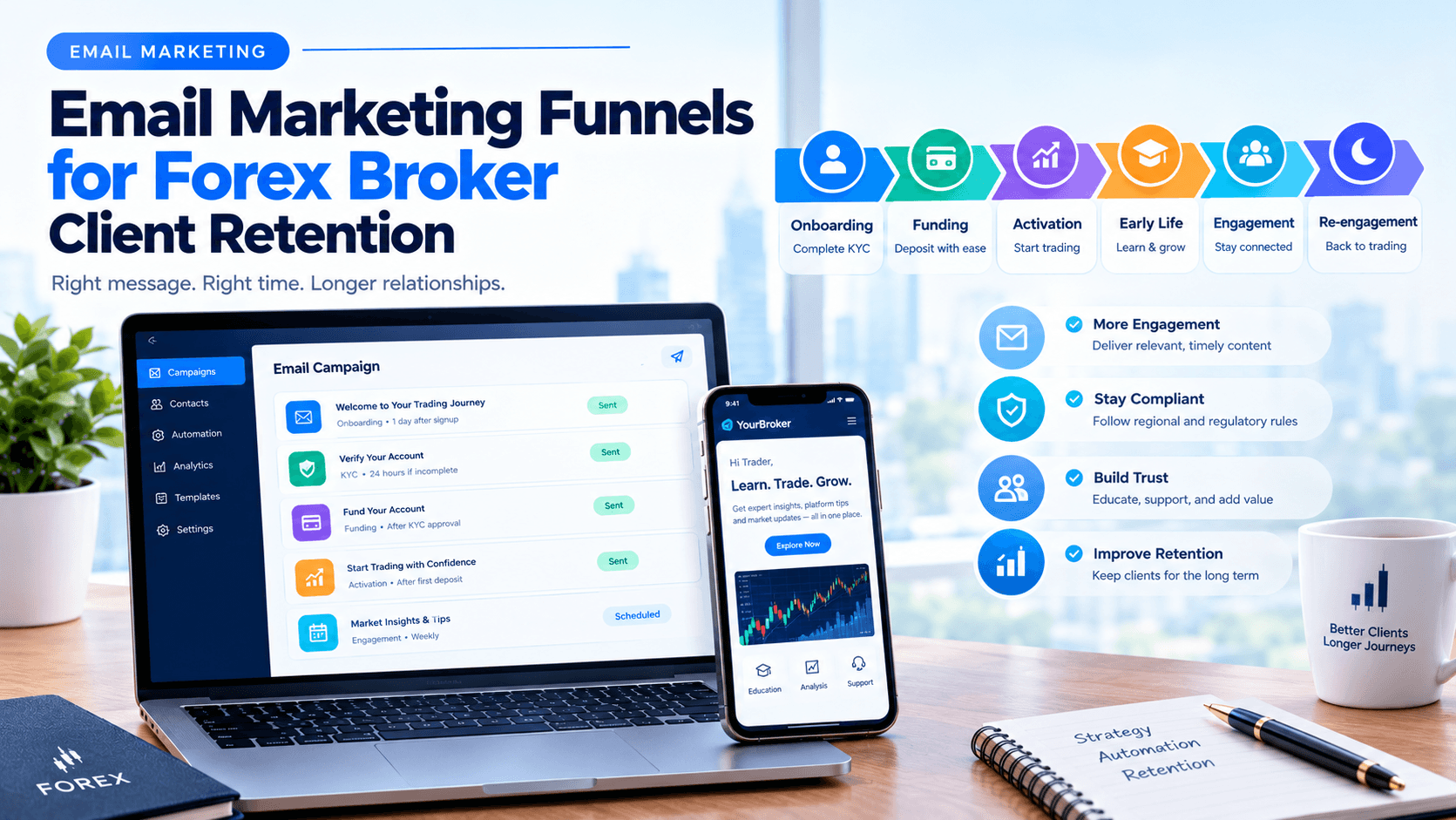
A broker's lifecycle runs from registration through to a mature relationship. Each stage has a different job.
Stage | Goal | Typical emails | Trigger |
1. Registered, not verified | Help the client finish KYC | Welcome, what documents are needed, how to upload from a phone | Registration |
2. Verified, not funded | Help the client fund when ready | Payment methods, fees and timing, support contact | KYC approved |
3. Funded, not trading | Help the client start with confidence | Platform walkthrough, demo-to-live guidance, risk education | First deposit |
4. Early life (first 90 days) | Build understanding and trust | Risk management series, platform tips, statement explainers | Days after first trade |
5. Engaged | Keep the relationship useful | Educational newsletter, platform updates, webinars | Ongoing activity |
6. Dormant | Check in and offer help | Service-focused check-in, feedback survey | Inactivity period you define |
Use your CRM to trigger these automatically from real events, such as KYC status, deposits, and last login. See our CRM feature checklist, KYC automation guide, and payment integration guide.
Sequence Blueprints
Onboarding: from registration to verified
- Immediately: welcome message, what happens next, what documents are needed
- After 24 hours if KYC is incomplete: a short help message with upload tips and a support link
- After 3 days: a reminder that offers help, such as live chat, rather than pressure
- Always: explain clearly why a document was rejected, since silent rejection makes clients assume the broker is broken
Funding: from verified to first deposit
- Payment methods available in the client's region, with realistic timing and fees
- Clear information on withdrawals, so clients know how the process works before they deposit
- No pressure to deposit, and no minimum-deposit urgency
Activation: from funded to first trade
- A platform walkthrough and a guide to order types
- Demo-to-live guidance, including how live execution differs from demo
- Risk education before the first trade, including position sizing and stop-loss use
- The required risk warning, shown prominently
Early life: the first 90 days
A short educational series, spaced out, covering:
- Risk and money management
- How margin, leverage, and stop-out work
- How to read statements and fees
- Where to find support and complaint routes
- Tools that help clients stay in control, such as alerts and limits
Engaged: the ongoing relationship
- A regular educational newsletter with factual market and platform content
- Product and platform updates
- Webinar invitations
- Service announcements
Dormant: a check-in, not a chase
- A service-focused message asking if the client needs help
- A short feedback survey asking why they went quiet
- An easy way to opt out of further contact
- A cap on how often you contact inactive clients
Win-back: only where appropriate
If you run win-back messages at all:
- Send only to clients who have consented, or who fit your regulator's rules for existing clients
- Keep content balanced and include the required risk warning
- Don't use incentives that would amount to a banned bonus. Retail CFD bonuses are prohibited in the EU and UK, as we cover in our CySEC guide.
- Don't use urgency or pressure language
- Respect opt-outs immediately, and stop after a defined number of attempts
- Consider whether the client may be vulnerable or may have lost significantly
Compliance Guardrails
Consent. The rules differ by region:
- UK (PECR and UK GDPR): consent is required to email individuals, with a narrow "soft opt-in" for your own existing customers. The ICO says it applies only if the client bought, or negotiated to buy, a similar product from you, and you gave them a simple way to opt out both when you collected their details and in every message. It doesn't apply to prospects or bought-in lists. Corporate subscribers can be emailed without consent, though data-protection duties still apply.
- EU: the ePrivacy rules and GDPR require valid consent, with a similar soft opt-in exception in many member states. Details vary by country.
- Canada (CASL): an express opt-in law with a narrow, time-limited implied-consent exception.
- US: the CAN-SPAM Act generally works on an opt-out basis, with requirements for clear identification, a valid physical address, and a working unsubscribe.
Don't send an email asking for consent to people who haven't given it, since that email can itself count as marketing. Keep records of when, how, and to what each person consented.
Financial promotion rules: Marketing emails are promotions.
- Show risk warnings prominently, not in tiny footer text
- No guaranteed-return or "risk-free" claims
- No banned incentives
- Use jurisdiction-specific wording and product details
- Keep copies of promotions and consent logs, for the period your regulator requires
Separate your streams.
- Service and regulatory notices (statements, margin or stop-out notices, changes to terms) are not marketing, and clients shouldn't be able to unsubscribe from the ones you're required to send
- Marketing needs consent, an unsubscribe, and compliance review
Partners and IBs. If IBs email your clients, you're responsible for what they send.
See our IB network guide.
AI-written content. Fact-check and compliance-review every message, as we explain in our content marketing guide.
Deliverability: The Rules That Now Apply
Mailbox providers tightened their requirements in 2024 and 2025. Gmail and Yahoo began enforcing in February 2024, and Microsoft followed for Outlook.com, Hotmail, and Live.com in May 2025.
For senders of roughly 5,000 or more emails a day to personal accounts, these rules require:
- SPF and DKIM: on your sending domain, plus DMARC (at least p=none), with your From domain aligned to SPF or DKIM
- Spam complaint rate below 0.3%: with providers recommending well below 0.1%
- One-click unsubscribe (RFC 8058): on marketing mail, which Gmail and Yahoo require and Microsoft recommends, with opt-outs honoured within two days
Three practical points:
- Authentication matters for all your email, including transactional
- The thresholds are measured across your whole domain, so poor marketing performance can affect delivery of your KYC and statement emails
- Consider separate sending subdomains for marketing and transactional mail, and set up authentication before any change to your sending domain.
Measure What Matters
Metric | Why it matters |
KYC completion rate and time to verify | The first friction point |
First-deposit conversion among KYC-complete clients | The core activation measure |
Second-deposit rate | A stronger indicator of genuine retention than the first deposit, according to operator guidance |
30- and 90-day activity by cohort | Shows early-life retention |
Lapse rate | Active clients going quiet, by period |
Unsubscribe and complaint rates | Signals whether messaging is welcome |
Support tickets and complaint trends | Shows whether clients understand the product |
Client satisfaction | A check that retention isn't coming at clients' expense |
Open rates are unreliable now because mail privacy features inflate them, so prioritize clicks, replies, and downstream behaviour. Benchmarks vary widely between brokers and are often published by vendors, so set your own baselines instead of chasing quoted averages.
A 90-Day Plan
Days 1–30: Foundations
- Define lifecycle stages and triggers in your CRM
- Set up SPF, DKIM, DMARC, and one-click unsubscribe
- Record consent properly and map rules by jurisdiction
- Write the onboarding and activation sequences with compliance sign-off
Days 31–60: Launch core sequences
- Go live with onboarding, funding, activation, and early-life education
- Separate service notices from marketing
- Track the metrics above by cohort
Days 61–90: Refine
- Add the dormant check-in and, if appropriate, a limited win-back
- Review complaints, unsubscribes, and satisfaction
- Adjust cadence and content
Common Mistakes
- Treating retention as keeping clients trading
- Using urgency or incentives that regulators treat as pressure or banned bonuses
- Emailing prospects or old contacts without valid consent
- Mixing regulatory notices into marketing, or the reverse
- Sending marketing from the same domain and stream as KYC and statements without monitoring complaints
- Ignoring one-click unsubscribe and complaint rates
- Chasing open rates
- Letting partners send unapproved emails to your clients
- Measuring success only by deposits and volume
What's New in 2026
- Bulk-sender rules are fully in force: at Gmail, Yahoo, and Microsoft, with permanent rejection for non-compliant senders.
- Domain-wide reputation: makes marketing performance a risk to critical client emails.
- Regulators are focused on client outcomes: so retention tactics that rely on pressure or incentives draw scrutiny.
- Loss-rate data is public: including ASIC's 2023–24 figures, which strengthens the case for education-led programmes.
- AI personalization is growing: and it needs the same compliance review as any other promotion.
Related Reading
- Content Marketing for Forex Brokerages: What Actually Works
- Key Features Every Forex CRM Should Have Before You Choose One
- Forex Broker Compliance Checklist – KYC, AML, and Data Security
- Forex Broker Website Design: Best Practices for Conversions
About FX Launch Pad
When we help a broker design a lifecycle email, we start with the CRM events and the consent records, because a sequence is only as good as the data and permissions behind it. We also ask what the programme is meant to achieve. We'd rather build one that helps clients understand the product and stay in control than one that pushes them to trade more.
If you're planning lifecycle email and want it built around your CRM, consent rules, and licence, book a free consultation and we'll go through it with you.
Frequently Asked Questions
Q-1 Can forex brokers email their existing clients without consent?
Ans- This will vary from area to area. A narrow "soft opt-in" could be used for your own customers for similar products, where there was a clear method of opting out when their information was collected and in every communication. Other markets may have other rules, so be sure to check on each.
Q-2 Can I offer bonuses to win back dormant clients?
Ans- Not for retail CFD clients in countries where CFD is illegal, such as the EU and UK. Incentives (where allowed) require compliant balanced presentations also. Review the rules of your regulator and don't use tactics of urgency.
Q-3 What do Gmail, Yahoo, and Outlook now require from senders?
Ans- If you've got a spam complaint rate of under 0.3%, you're sending one-click unsubscribe on marketing mail (which Microsoft suggests, but isn't a strict requirement), and you're using SPF, DKIM, and DMARC with alignment, you should be in the ballpark for about 5,000 or more emails a day. Gmail and Yahoo started in February 2024 and May 2025, respectively, and Microsoft in May 2025.
Q-4 Are statements and margin notices marketing emails?
Ans- No. These are service or regulatory communications and should be sent on their own, not in combination with marketing content. Marketing emails should have opt-in, opt-out, and compliance checks.
Q-5 Which retention metric matters most?
Ans- The second-deposit rate is a better indicator of actual retention than the first deposit rate, according to the operator. It's perfect when used in tandem with 30-day activity, complaints, and client satisfaction, which will help you distinguish healthy retention from pressure.