This is the question we get asked more than any other in early consultations, and it's usually framed the wrong way. Founders come in asking "which one is better," when the real question is which one matches your budget, your target clients, and how fast you actually need to be live. We've set up brokerages on both ends of this spectrum, and the honest answer is that budget alone often decides for you the trick is understanding exactly what you're trading away at each price point.
Quick Correction Before We Start
If you've been researching this online, you've probably seen a widely repeated claim that offshore licenses are the "high-cost, high-prestige" option and regulated licenses are the "cheap, fast" route.
That's backwards, and it's worth flagging because it's a common mix-up in older or poorly edited articles. In reality: offshore is the fast, low-cost entry point; regulated jurisdictions cost more and take longer, in exchange for real oversight and stronger banking relationships. Keep that the right way round, because it changes how you should read everything else in this comparison.
What "Offshore" Actually Means
An offshore setup — typically St. Lucia or St. Vincent & the Grenadines — gets you a company that's positioned to run a brokerage, without the compliance weight of a licensed regulator standing behind it. It's the fastest, cheapest way to get from idea to operating brokerage, and for a lot of founders testing a market for the first time, that speed is the entire point.
What you get:
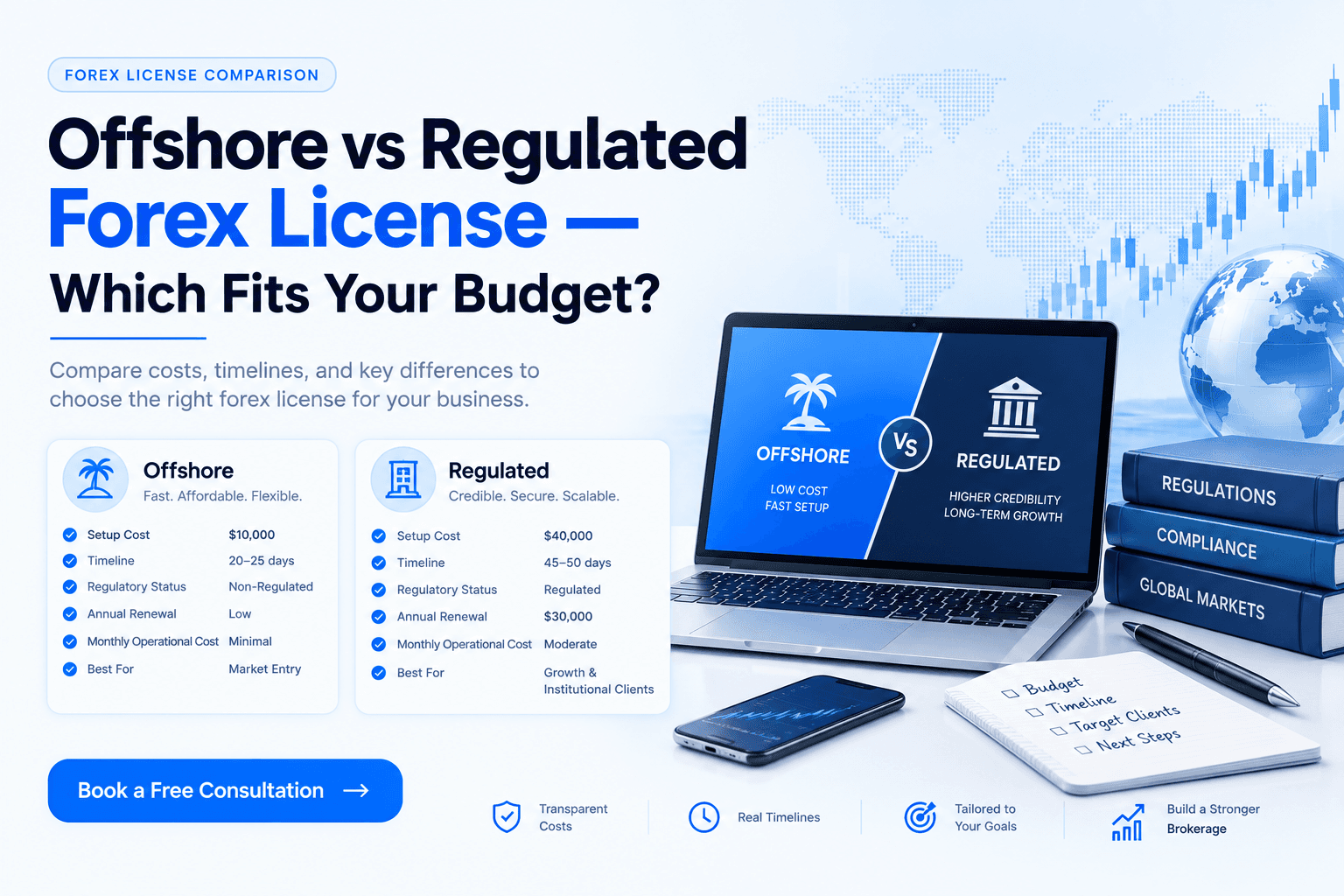
- Setup cost: $10,000
- Timeline: 20–25 working days
- Regulatory status: Non-regulated
- Local directors: Not required
- Compliance structure: Minimal
- Annual renewal: Low
- Monthly operational cost: Minimal
What you're trading away: credibility with institutional clients, deeper banking relationships, and the trust signal a real regulator's name provides. Payment providers and banks treat non-regulated entities with more caution, and larger IBs bringing serious volume often want to see a licensed structure before committing.
What "Regulated" Actually Means
A standard regulated setup moves you into an actual licensing framework — a real regulator overseeing your compliance, reporting, and conduct. This is the tier most growing brokerages land in once they've validated demand and need the credibility to scale.
What you get:
- Setup cost: $40,000
- Timeline: 45–50 working days
- Regulatory status: Regulated
- Local directors: Required, per jurisdiction rules
- Compliance structure: Standard
- Annual renewal: $30,000
- Monthly operational cost: Moderate
That annual renewal figure is the number most first-time founders don't budget for. A regulated license isn't a one-time cost — it's an ongoing commitment, and $30,000 a year in renewal is a real recurring line item you need cash flow to support, not just the initial $40,000 to get licensed.
Where Most Founders Get the Decision Wrong
The mistake we see most isn't picking offshore or regulated; it's picking based on the initial setup cost alone and ignoring the total cost of ownership. A founder comparing $10,000 against $40,000 naturally leans offshore, without factoring in that the offshore path's cheaper ceiling might cap them out of the institutional clients and stronger banking relationships they'll want in year two. Conversely, we've seen founders overcommit to a regulated setup before they've validated that there's real demand for their brokerage at all, paying for compliance infrastructure a market-testing business doesn't need yet.
The honest framework: if you're validating a market, testing positioning, or working with a tight initial budget, offshore is the rational choice you can always upgrade jurisdiction once volume proves the model. If you already have a client base, an IB network ready to convert, or investors who need to see real oversight, the regulated tier's higher cost is what actually protects the business you're building.
A Practical Way to Decide
Ask yourself three questions:
- Do I have proof of demand already, or am I testing whether this market wants my brokerage? Proof of demand justifies the regulated tier's cost; testing a hypothesis doesn't.
- Can my cash flow absorb a $30,000 annual renewal on top of setup costs, or would that renewal be a strain in year one? If it's a strain, offshore buys you time to build revenue first.
- Who are my actual target clients: retail traders in emerging markets who care mainly about execution and payments, or IBs and institutional clients who'll ask about your regulatory status before sending volume?
If your answers point toward "not yet" on demand and cash flow, offshore is the smarter first move, not a lesser one. Plenty of brokerages start offshore, prove the model, and migrate to a regulated or Mauritius-tier structure once the numbers justify it. Starting regulated doesn't buy you a better outcome if the business underneath it isn't there yet.
Not sure which tier actually fits your budget and target market?
Book a free consultation and we'll map out the right structure based on where your business actually is today, not just where you want it to end up.
Frequently Asked Questions
Q-1 Is an offshore forex license legal?
Yes. Offshore licenses like St. Lucia or St. Vincent registrations are legitimate business structures used by many operating brokerages. They're not illegal — they simply carry lighter regulatory oversight than a licensed regulated jurisdiction, which affects banking access and client trust rather than legality.
Q-2 How much does a regulated forex license cost compared to offshore?
An offshore setup typically costs around $10,000 with a 20–25 working day timeline. A standard regulated setup costs around $40,000 with a 45–50 working day timeline, plus an ongoing annual renewal of roughly $30,000.
Q-3 Can I upgrade from an offshore license to a regulated one later?
Yes. It's a common path — many operators start offshore to validate demand and control costs, then transition to a regulated or Mauritius-tier structure once trading volume and client base justify the additional investment.
Q-4 Which license type is better for attracting institutional clients?
A regulated setup, generally. Institutional clients and larger IBs typically want to see real regulatory oversight and stronger banking relationships before committing serious volume, which a non-regulated offshore entity can't offer to the same degree.
Q-5 Do offshore licenses have lower ongoing costs than regulated ones?
Yes. Offshore setups carry minimal monthly operational costs and low annual renewal fees, while regulated setups carry moderate monthly costs plus a substantial annual renewal — commonly around $30,000 — that needs to be budgeted for well beyond the initial setup fee.