Brokerages rarely fail to scale because they can't get more clients. They fail because the business that worked for a hundred clients quietly stops working at a thousand, and nobody notices which part broke first.
Scaling a brokerage is a series of operational and architectural decisions, not a marketing campaign. This guide covers what changes at each stage, the five constraints that decide how far you can grow, and how to build the organization, technology, and controls to match. It's general information, not legal or financial advice. For growth through partners specifically, see our IB scaling guide. This post covers the rest of the business.
The Core Idea: Two Kinds of Scaling
Most scaling problems come from mixing up two different constraints:
- Transaction scaling is technical: handling more orders, prices, deposits, and data without slowing down or failing
- Client scaling is organizational: onboarding, compliance, support, and risk growing with your client base
Technology can usually be scaled by adding capacity. Compliance and operations can't. Doubling your clients rarely halves your compliance cost per client, because more clients means more reviews, more monitoring alerts, more complaints, and more edge cases, and each one needs a person or a well-designed process.
Founders who plan only for the technical side find out about the organizational side when queues build up.
The Four Stages: Defined by What Breaks
Stages are better defined by what breaks than by client counts, because the numbers vary widely by business model.
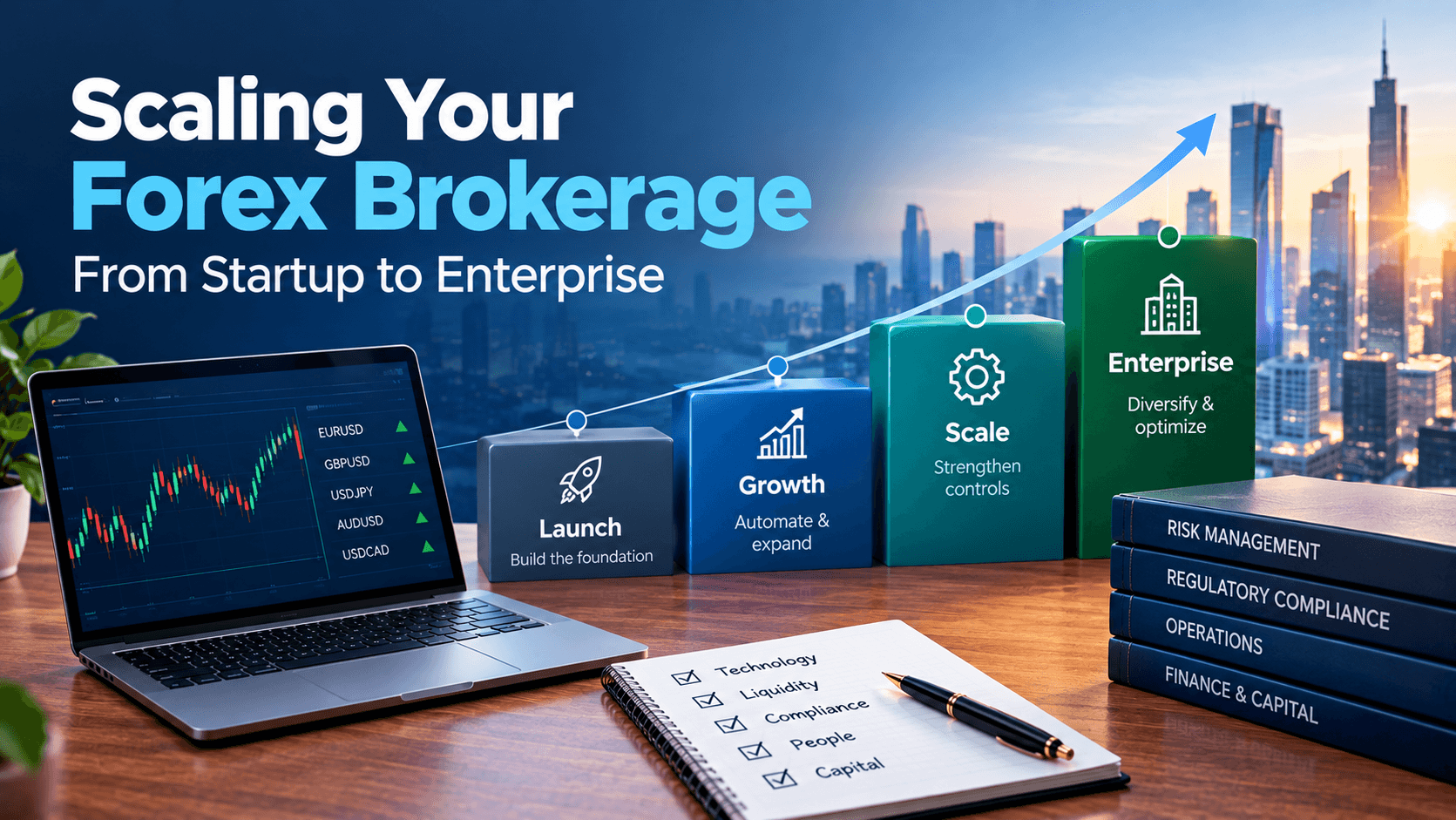
Stage | Typical setup | What breaks first | What to put in place |
Launch | One entity, white-label platform, small team | Little, if records are clean | Clean KYC records, documented processes, a CRM that logs everything |
Growth | More clients, first partners, more markets | Manual onboarding, reconciliation, and support queues | Automation, a second liquidity provider, a named risk owner, and dedicated compliance |
Scale | Several markets and products, a partner network | Single points of failure, thin risk oversight, and compliance workflows that don't fit each market | A risk function, jurisdiction-specific workflows, disaster recovery, and monitoring |
Enterprise | Multiple entities and brands, institutional counterparties | Governance, assurance, and vendor dependency | Group governance, independent assurance, and formal third-party risk management |
You don't need enterprise controls at launch. But you do need to avoid decisions that make them impossible later.
Five Constraints That Decide Your Ceiling
1. Technology and capacity
- Design for peaks, not averages: Volume spikes during news events and volatility, exactly when failures cost the most.
- Monitor everything: latency, order rejections, bridge health, payment callbacks, and server load, with alerts to a person who can act.
- Plan disaster recovery and continuity: what happens if your platform, bridge, CRM, or payment provider fails, and how long can you operate without it?
- Test under stress: before real volume arrives.
2. Liquidity and risk
- Size liquidity for stress, not for normal days: Depth and spreads behave differently under volatility.
- Avoid concentration: Relying on one liquidity provider is a single point of failure.
See our bridge integration guide. - Build a real risk function: As client numbers grow, internalizing order flow needs documented exposure limits, real-time monitoring, and clear authority to hedge. The early-stage habit of checking exposure by hand stops working.
- Share risk controls across products: If you add crypto, indices, or other assets, they should share risk management, reporting, and the client lifecycle, not run as separate silos.
3. Compliance and operations
- Automate what can be automated: and keep humans for judgment.
See our KYC automation guide. - Run different workflows for different jurisdictions from one system: If your CRM can't, every new market needs a separate system or manual workarounds, which multiply workload and audit exposure.
See our CRM feature checklist. - Staff the compliance function properly: A resident compliance officer and MLRO, plus support as volume grows, are not optional extras.
- Track backlogs: Open KYC reviews, unresolved alerts, and complaint ageing are early warning signs.
4. People and organization
A common minimum structure for a regulated brokerage includes leadership, a head of compliance, operations, a risk officer, support, and marketing. As you scale, add:
Role | Why it matters at scale |
Head of compliance / MLRO | Regulators expect an accountable, qualified owner |
Risk officer or desk | Exposure and execution quality need daily ownership |
Finance and treasury | Client-money reconciliation, liquidity funding, and capital |
IT and security | Uptime, incident response, and vendor management |
Partner or IB manager | Oversight of the network. See our IB network guide. |
Customer operations lead | Support quality and complaint handling |
The goal is to reduce dependence on the founder. A business that needs you for every decision can't scale, and it's worth less if you ever sell. See our exit strategy guide.
5. Finance and capital
- Regulatory capital needs grow with the business: Watch capital adequacy as volumes and exposures rise.
- Reconcile client money daily: Errors scale with volume.
- Model unit economics: revenue per active client, acquisition cost and payback, and what each partner costs.
- Budget compliance and technology as growth costs: not overheads to minimize.
- Watch payment-provider terms: reserves, limits, and chargeback ratios change as volume grows. See our payment integration guide.
Expanding to New Markets and Entities
Many established brokers run more than one entity, for example, an offshore entity alongside a regulated one, to serve different regions. Our 2026 regulatory trends guide covers why this became common.
Principles for doing it well:
- Authorization follows the market: Each entity can serve only the markets its authorization allows. See our guides to Seychelles, Mauritius, and BVI.
- Start with a foundation you can build on: not a dead end.
- Keep client-entity clarity: Clients should know which entity they contract with, and your records must match.
- Align marketing to each entity's permissions. See our Google Ads compliance guide.
- Plan group governance: who approves what, how risk is aggregated, and how compliance reports upward.
Technology Architecture for Growth
A scalable brokerage connects these layers rather than bolting them on:
Trading platform → liquidity and bridge → CRM and back office → payments → KYC and AML → risk management → client portal → APIs → reporting and analytics
What to look for as you scale:
- Real-time data between layers, not delayed reports
- Open, documented APIs, so you can add or replace components
- Multi-brand and multi-entity support if you plan several brands
- Pricing that you've modelled at two to three times your volume
- Audit trails across the whole stack
See our guide to platform setup mistakes for the integration problems that get more expensive with scale.
Resilience: What Enterprise-Level Looks Like
As you grow, banks, partners, regulators, and acquirers expect more evidence that your operations are resilient.
The EU example: DORA: The Digital Operational Resilience Act has applied since 17 January 2025 and covers EU financial entities including investment firms, plus their ICT third-party providers. Its five pillars are:
- ICT risk management
- Incident management and reporting
- Digital resilience testing
- Third-party ICT risk management
- Information sharing
For a broker, the practical effect is that platform, CRM, bridge, and payment vendors become formally managed third-party dependencies, with written contracts covering oversight, security, audit, and termination, and that serious technology incidents must be reported within set deadlines. Reports suggest the initial supervisory tolerance period has ended, so it's an active expectation, not a future one.
If you're not EU-regulated: you still benefit from the same disciplines. Banks and partners increasingly ask for evidence of continuity planning, incident response, and vendor oversight.
Metrics That Matter at Each Stage
Area | Metric |
Growth | Active clients, revenue per active client, funded-account conversion, acquisition cost and payback |
Operations | Time to verify a client, withdrawal processing time, support response time, KYC backlog |
Risk | Exposure versus limits, execution quality, liquidity provider concentration |
Payments | Failed-payment rate, chargeback ratio, reconciliation breaks |
Partners | Partner concentration, payout accuracy, promotional breaches |
Resilience | Uptime, incident count and time to resolve, recovery test results |
Compliance | Open alerts, complaint ageing, audit findings |
Common Scaling Mistakes
- Planning for technical capacity but not compliance and operations
- Sizing liquidity for normal days only
- Staying on a single liquidity provider or payment provider
- Letting the founder remain the bottleneck
- Choosing systems that can't run different workflows per market
- Adding products without shared risk controls
- Growing partners faster than monitoring
- Treating vendors as suppliers, not dependencies
A Practical Scaling Roadmap
- Audit the current stage: list what breaks first and which processes still depend on individuals
- Fix records and processes first, because everything else sits on them
- Add redundancy: a second liquidity provider and a fallback payment path
- Stand up a risk function with documented limits and monitoring
- Hire ahead of the need in compliance, risk, and operations
- Choose systems that support multiple markets before you enter them
- Build resilience: disaster recovery, monitoring, incident response, and vendor contracts
- Add entities and markets deliberately, each with its own authorization
- Report the metrics above monthly and review them as a team
What's New in 2026
- DORA is now in force for EU firms, making technology resilience and third-party oversight an active compliance requirement.
- Multi-asset and round-the-clock models are expanding, which raises the importance of shared risk and settlement infrastructure.
- Card-network monitoring has tightened, which affects payment providers' tolerance as volumes grow. See our payment guide.
- Regulators are watching partners and promoters closely, so network growth needs documented oversight.
- Consolidation continues, which rewards firms with clean records and resilient operations.
Related Reading
- Top Mistakes New Forex Brokers Make When Setting Up Their Platform
- Forex Brokerage Exit Strategy: Selling or Merging Your Business
- 2026 Regulatory Trends Every New Forex Broker Should Know
About FX Launch Pad
Most scaling problems we see were visible early. A process that depended on one person, a single liquidity provider, a CRM that couldn't handle a second market. We plan for the next stage during setup, so the platform, records, and structure you build at launch don't have to be replaced when you grow.
If you're planning a launch or a growth phase and want to check where your operation will break first, book a free consultation and we'll go through it with you.
Frequently Asked Questions
Q-1 What breaks first when a forex brokerage grows?
Ans- Usually manual processes: onboarding, reconciliation, support queues, and compliance reviews. Technology can often be scaled by adding capacity, but compliance and operations grow roughly with client numbers and need people and well-designed processes.
Q-2 When should a broker add a second liquidity provider?
Ans- Earlier than most expect. Relying on one provider is a single point of failure, so most brokers add a second once they have real volume, and size liquidity for volatile conditions, not average days.
Q-3 Does scaling a brokerage require more than one licence?
Ans- Often, as you enter new markets. Each entity can serve only the markets its authorization allows, so many brokers run an offshore or mid-tier entity alongside a regulated one. Check the rules for each market you target.
Q-4 What is DORA and does it affect forex brokers?
Ans- The Digital Operational Resilience Act is an EU regulation that has been in force since 17 January 2025. It covers EU financial entities, including investment firms, and requires ICT risk management, incident reporting, resilience testing, and oversight of technology providers.
Q-5 How many staff does a growing brokerage need?
Ans- It depends on jurisdiction and model. A common minimum includes leadership, a head of compliance, operations, a risk officer, support, and marketing. As you scale, add finance and treasury, IT security, partner management, and a larger compliance and support function.