Google Ads can be one of the best high-intent channels for a forex brokerage. It's also one of the easiest ways to lose an ad account.
We see the same pattern often. A founder launches campaigns, ads get disapproved, the account is suspended, and the question becomes "what did we do wrong?" Usually the answer is that nothing in the ads was the problem. The business wasn't eligible to advertise in the countries it targeted.
This guide explains how Google treats forex advertising, what eligibility actually requires, and how to avoid the common suspension triggers. Google's policies change often, so confirm details on Google's official policy pages before you act. This is general information, not legal advice. For the wider channel mix.
See our Digital marketing guide.
What Google Restricts
Google groups CFDs, rolling spot forex, and financial spread betting under its "complex speculative financial products" policy. This isn't a blanket ban, and it isn't open to everyone.
Product | Google's position |
CFDs, rolling spot forex, spread betting | Allowed only for certified advertisers, country by country |
Binary options and similar products | Not allowed |
Affiliates and aggregators of these products | Restricted. Rules vary by country, so check the current policy page. |
Unleveraged products and long-term investing | Generally outside this policy, per analyses of the policy wording. Other financial rules still apply. |
Rules for cryptocurrency advertising are separate, with their own certification requirements.
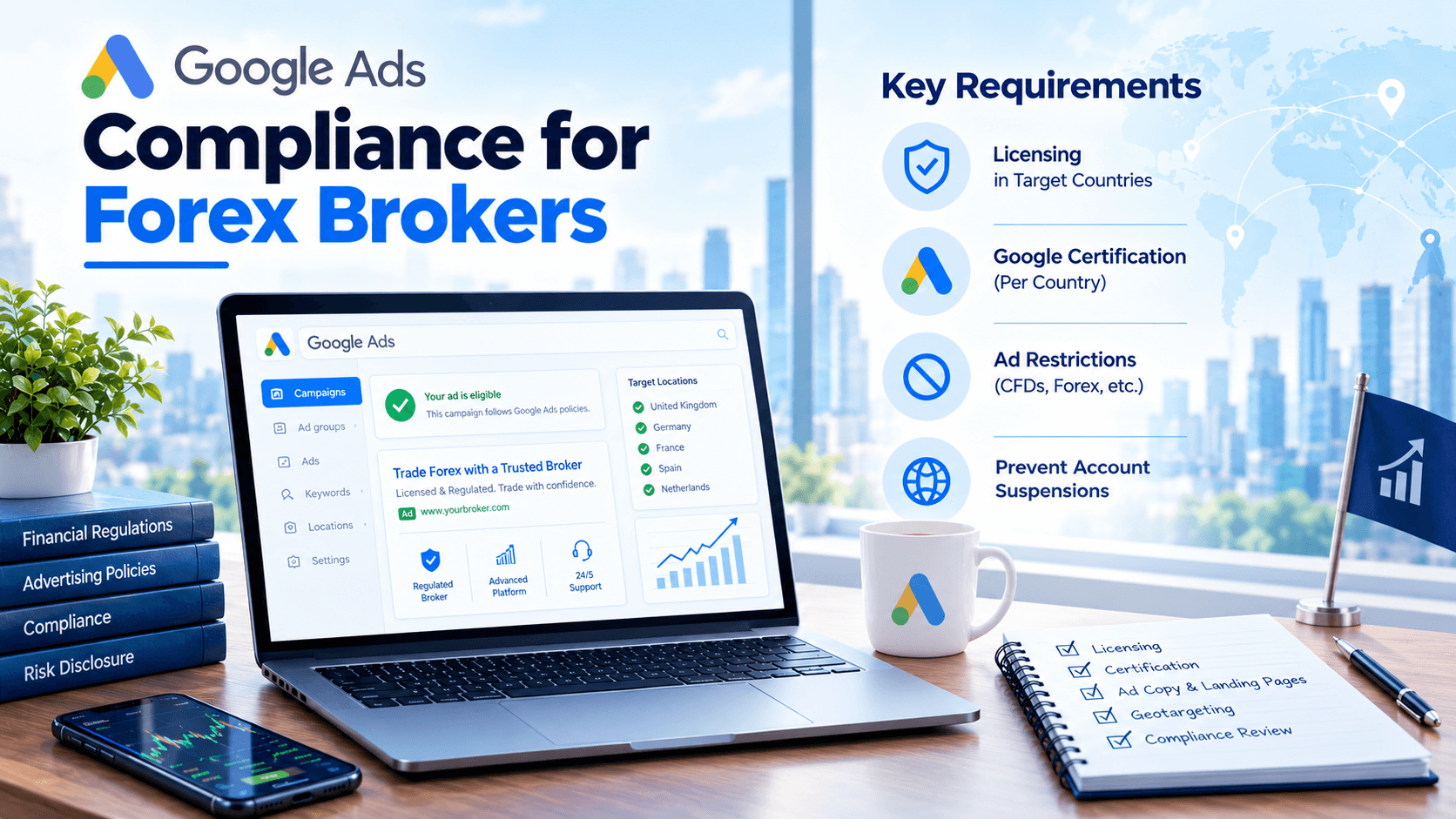
The Core Rule: Licensed in the Country You Target
To advertise these products in a country, Google generally requires two things:
- You are licensed by the financial regulator in that country: Google's policy pages list examples, such as the FCA for the United Kingdom, the Securities and Futures Commission for Hong Kong, the Israel Securities Authority for Israel, and Taiwan's Securities and Futures Bureau.
- You complete Google's certification for that country: which is only available in certain countries.
The approval is per country, not global. Being certified for one market doesn't cover another.
What This Means If You Hold an Offshore License
This is the point most founders miss, and it connects to everything we've written about licensing.
An offshore license from jurisdictions such as St. Vincent, Vanuatu, or Seychelles is a legitimate basis for operating in many markets. But Google's test is whether you're licensed by the regulator of the country you're targeting. A license from a different country generally doesn't satisfy that test.
In practice, an offshore-licensed broker may have no eligible country for Google Ads certification, or a very short list. That isn't a campaign problem you can fix with better ad copy. It's a licensing-and-market question that should be decided before you budget for paid search.
For the underlying issue, see what a license does and doesn't cover and the risks of soliciting clients without proper authorization.
The Approval Process, Step by Step
- Map your licenses to countries: List where you're licensed locally and where you want to advertise. Remove any where the two don't match.
- Check certification availability: Confirm on Google's policy page that certification exists for each country.
- Complete advertiser verification and the certification application for each eligible country, using your licensed entity's details.
- Match the entity everywhere. The advertiser name, billing, landing page, and license records should all point to the same legal entity.
- Set geotargeting to certified countries only.
- Prepare compliant landing pages and ads (see below).
- Launch small and monitor disapprovals before scaling spend.
Landing Page and Ad Copy Checklist
Practices that reduce disapprovals and protect you with regulators:
- Your regulator's name and your license number, displayed clearly
- Risk warnings that are visible and match your regulator's requirements
- Your legal entity name, address, and contact details
- Clear terms, fees, and conditions, with no hidden costs
- A working, accurate site, with no placeholder pages or broken links
- Content that matches what the ad says
And avoid:
- Guaranteed profits, "risk-free" claims, or income promises
- Pressure and urgency language that downplays risk
- Claims about regulation your license details don't support
- Different entities or brands on the ad, landing page, and billing
Why Accounts Get Suspended
Trigger | What to do |
Targeting a country you aren't certified for | Restrict geotargeting. Don't rely on "global" settings. |
Entity mismatch across ad account, site, and license | Align every record to the licensed entity |
Unsupported regulation claims on landing pages | Show license details, or remove the claim |
Missing or weak risk warnings | Add them to the page and ads |
Affiliates and partners running ads on your brand | Set written ad rules and monitor them |
Attempts to get around enforcement such as new accounts, cloaking, or misleading redirects | Don't. Google treats circumvention as a serious violation, and it can lead to permanent bans. |
If Your Account Is Suspended
- Read the exact violation notice: Fix what it names.
- Fix the root cause first: whether that's the targeting, entity details, or landing page, then appeal with a clear explanation.
- Don't open new accounts to work around a suspension: It usually makes things worse.
- Check your licensing facts before appealing: If the real issue is that you aren't licensed in the targeted country, an appeal won't succeed. The fix is to change your target markets or licensing.
Your IBs and Affiliates Count Too
If IBs or affiliates advertise your brand on Google, their ads can create problems for you, including claims you wouldn't approve and campaigns targeting countries you can't serve. Google also restricts affiliates and aggregators of these products in many cases.
Put in writing what partners may and may not do: approved claims, approved countries, and whether they may bid on your brand name. Track it in your partner system.
Our IB scaling guide covers the infrastructure for this.
What's New in 2026
- In-account certification: reports describe Google rolling out an in-account certification application in February 2026 that includes complex speculative financial products alongside crypto categories. Confirm how it works for your account.
- Per-country rules keep shifting. Google's list of eligible countries and local license requirements gets updated. Check it before each campaign.
- Broader regulatory attention. Regulators are watching how brokers advertise, so ad compliance and licensing compliance now overlap.
See our 2026 regulatory trends guide.
Quick Self-Audit
- [ ] I have a local license for every country I want to advertise in
- [ ] I've confirmed Google certification is available for each of those countries
- [ ] Advertiser, billing, landing page, and license all use the same legal entity
- [ ] Geotargeting is limited to certified countries
- [ ] Landing pages show license details and risk warnings
- [ ] Ads contain no guaranteed-return or "risk-free" claims
- [ ] Partners have written ad rules, and I monitor their campaigns
- [ ] I have a plan if the account is suspended.
Related Reading
- Digital Marketing Strategies for Forex Brokers – Grow Your Brokerage Globally
- Content Marketing for Forex Brokerages: What Actually Works
- Can You Run a Forex Brokerage Without a License? The Real Risks
- Offshore vs Regulated Forex License — Which Fits Your Budget?
About FX Launch Pad
The question we hear after "can we run Google Ads?" is usually "which license do we need to?" Because the answer starts with licensing, we ask founders to pick their target markets before they plan campaigns, and to match their license to those markets. It's a much cheaper conversation to have before launch than after a suspension.
If you're planning your licensing and want to know which advertising channels you'll realistically be able to use, book a free consultation and we'll go through it with you.
Frequently Asked Questions
Q-1 Can forex brokers advertise on Google Ads?
Ans- Yes, but only if certified. Google restricts CFDs, rolling spot forex, and spread betting, and generally requires you to be licensed by the financial regulator in each country you target and to complete Q-1 Google's certification for that country.
Q-2 Does an offshore license qualify me for Google Ads certification?
Ans- Generally not, because Google's test is whether you're licensed by the regulator of the country you're targeting. An offshore license may leave you with few or no eligible countries. Check Google's current policy pages.
Q-3 Are binary options allowed on Google Ads?
Ans- No. Google doesn't allow ads for binary options and similar products.
Q-4 Why was my forex Google Ads account suspended?
Ans- Common causes are targeting countries you aren't certified for, entity mismatches, unsupported regulation claims, missing risk warnings, partner ads you didn't control, or attempts to work around enforcement.
Q-5 Can affiliates run Google Ads for my brokerage?
Ans- Google restricts affiliates and aggregators of these products, with rules that vary by country. Even where partners can advertise, put approved claims and target countries in writing and monitor their campaigns.