Choosing a payment gateway is one decision. Integrating it correctly is another, and it's where most of the expensive mistakes happen.
A badly integrated gateway can credit a deposit twice, credit one that never settled, lose track of a withdrawal, or push your chargeback ratio toward a card-network penalty. None of those problems comes from the gateway brand. They come from how the gateway, your CRM, and your trading platform are connected.
We cover which gateways to consider in our guide to payment gateways for global brokers and settlement speed in our fiat and crypto guide. This post covers the technical and operational side: what happens before, during, and after you connect. It's general information, not legal or financial advice.
The Flow You're Building
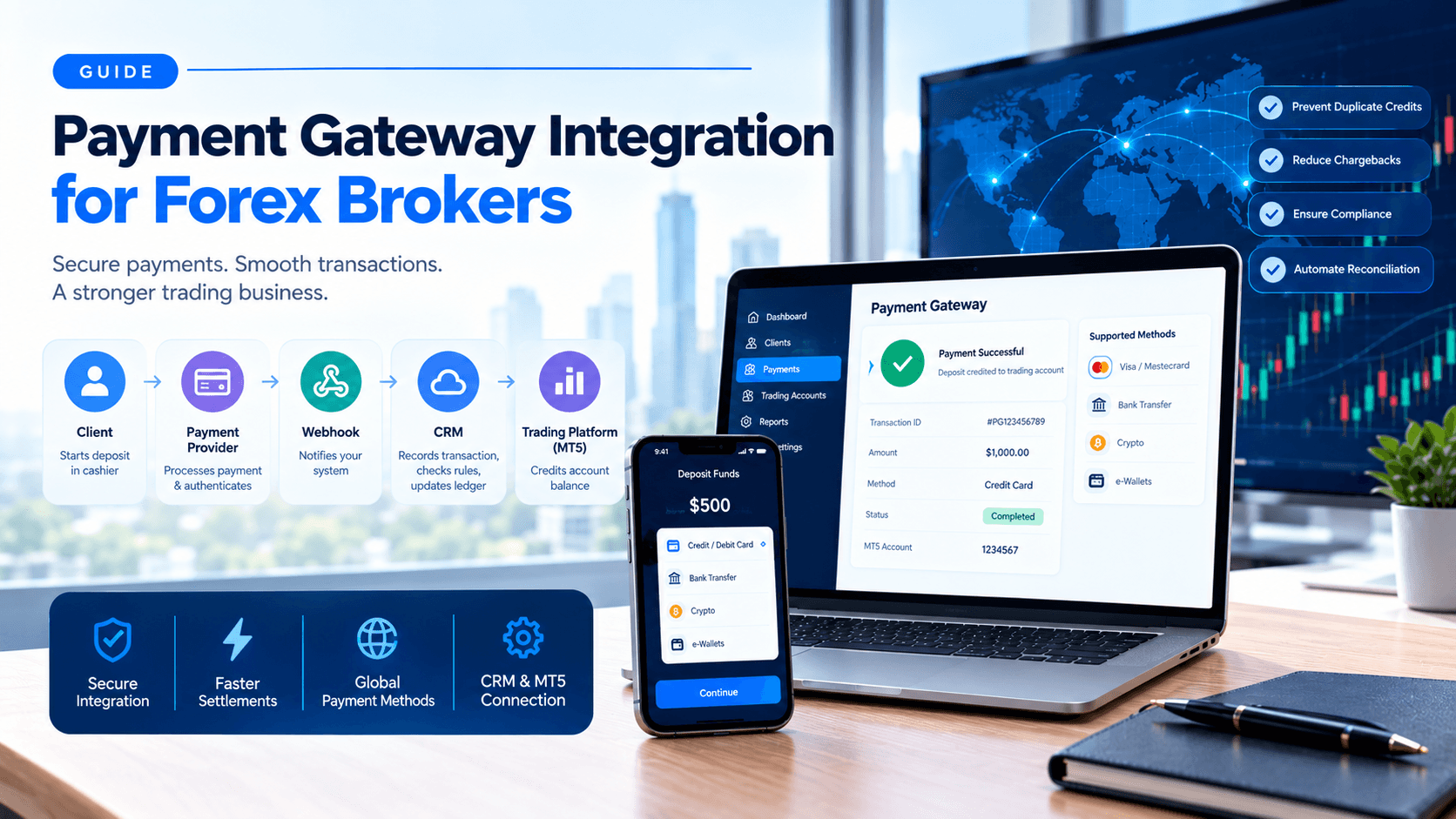
A typical deposit travels through five systems:
- Client starts a deposit in the cashier
- Payment provider takes the payment and authenticates it
- Webhook notifies your system of the result
- CRM records the transaction, checks status and rules, and updates the ledger
- Trading platform (MT5) credits the account balance
Every handoff is a place where something can go wrong. A good integration makes each handoff explicit, logged, and safe to repeat.
Step 1: Get Through Underwriting First
Forex brokers are classified in a high-risk merchant category (MCC 6211), so providers underwrite you carefully before you can process anything. Expect them to ask for:
What they ask for | Why |
Company documents and ownership details | To verify who they're dealing with |
License or regulatory status | To confirm you're authorized for your markets |
Website review | To check disclosures, terms, refund policy, and claims |
Projected volumes and payment mix | To size risk and set limits |
Chargeback and refund policies | To judge how disputes will be handled |
Banking details and processing history | To confirm financial standing |
What to negotiate and get in writing:
- Processing limits and how they can change
- Reserve terms, if any, and how reserves are released
- Settlement timing and currencies
- Fees, including for chargebacks, refunds, and currency conversion
- Termination terms and notice periods
Underwriting reviews your website too, so your site, license details, and legal pages should be ready first.
See our Website design guide.
Step 2: Pick the Integration Model
Model | How it works | Trade-offs |
Hosted payment page | Client is redirected to the provider's page | Fastest to launch and reduces your card-data security scope, with less control over the experience |
Embedded / iframe | Provider's fields sit inside your page | Better experience, still limits sensitive data on your servers |
Direct API | You build the payment flow yourself | Most control, but the heaviest security and compliance burden |
CRM-native connector | Your CRM provides a ready-made connection | Quickest path if the provider is supported. Check how deep the connection goes. |
For most new brokers, a hosted or embedded model plus a CRM connector is the practical choice. Build direct API integrations only when you have the security team to support them.
Step 3: Design the Payment State Machine
This is the heart of integration. Every payment moves through states, and your system should only credit funds at the right one.
Typical states: initiated, pending, authorized, settled or confirmed, credited, failed, refunded, disputed.
Rules that prevent most losses:
- Credit only on a confirmed final status from the provider's server-to-server notification: Never credit because the client landed on a "success" page. Redirect pages can be faked, interrupted, or reloaded.
- Make every operation idempotent: If a webhook arrives twice, the second one must not be credited again. Use a unique transaction reference and check it before acting.
- Verify webhook signatures: so only your provider can trigger a credit.
- Handle out-of-order and delayed messages: A "completed" notice may arrive before "pending."
- Handle partial and mismatched amounts: with an explicit rule, not a guess.
- Log every state change: with a timestamp, so you can explain any transaction later.
- Retry safely: with limits, rather than hammering a failing endpoint.
Step 4: Treat Withdrawals as Higher Risk Than Deposits
A mistaken deposit credit can be reversed. A mistaken payout usually can't.
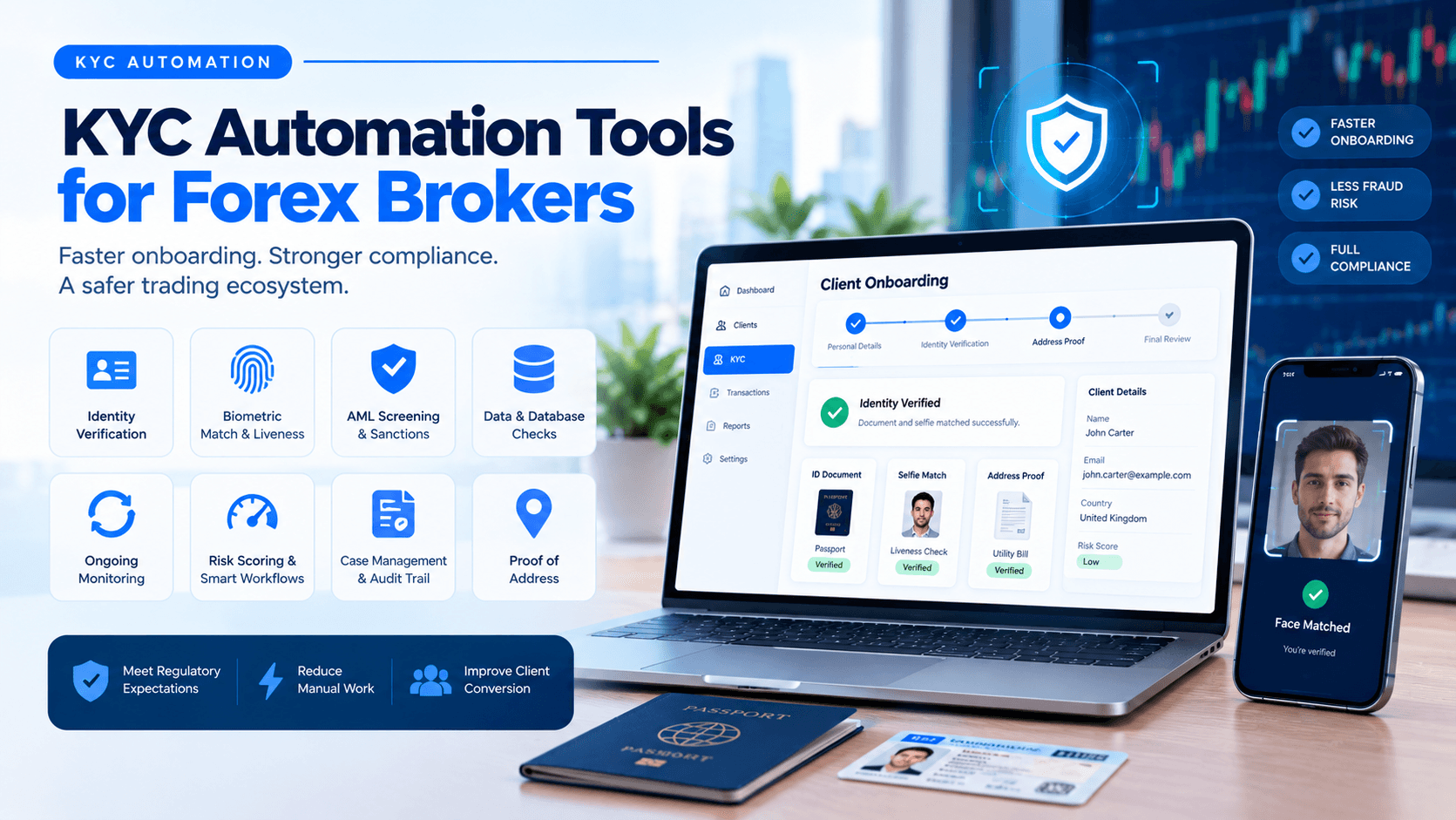
- Gate payouts on KYC and compliance status: Only verified clients can withdraw.
See our KYC automation guide. - Return funds to the source where possible: Paying back to the method used to deposit is a common AML practice. Check what your regulator expects.
- Match payer and client names: to prevent third-party payments.
- Use approval workflows: such as a second approver above set thresholds.
- Check for unusual patterns: before release: rapid deposit and withdrawal cycles, new devices, and changed bank details.
- Reconcile payouts against provider reports every day.
Step 5: Reconcile Every Day
Three records should always agree: your CRM ledger, the trading platform balances, and the provider's settlement reports. Reconciliation compares them and flags differences.
- Automate the matching using the transaction reference
- Investigate unmatched items the same day
- Track pending, settled, and failed items separately
- Reconcile fees and currency conversion, not only the principal
Teams that reconcile manually in spreadsheets tend to find problems weeks later, when they're harder to trace. This is another reason to choose a CRM with solid payment tooling.
See our CRM feature checklist.
Step 6: Watch Your Chargeback Ratios
For card payments, the card networks monitor how often payments are disputed. These thresholds tightened in 2026, so they matter more than they used to.
- Visa VAMP: Visa's monitoring program replaced its earlier dispute and fraud programs. Reports indicate the merchant "Excessive" threshold dropped from 2.2% to 1.5% on 1 April 2026 in most regions, applied once a merchant also reaches a minimum monthly count of fraud and dispute events, with per-transaction fines (reported at $8) while a merchant is over the line. The ratio combines fraud reports and disputes, so one transaction can count twice. Some regions use different thresholds.
- Mastercard ECM: the Excessive Chargeback program flags merchants at 100 or more chargebacks in a month and a ratio of 1.5% or higher, with a more severe tier at 300 and 3%.
- Your provider's limits are tighter: Acquirers face their own thresholds, so they may restrict or drop merchants well before the network's lines.
These figures are drawn from processor and industry sources and vary by region, so confirm them with your acquirer.
Why forex is exposed: clients who lose money sometimes dispute the deposit that funded their losses. That's a "friendly fraud" risk.
What helps:
- A clear billing descriptor clients recognize
- Strong authentication such as 3-D Secure, which can shift liability for some fraud disputes but not for disputes about the service itself
- A dispute evidence pack ready to send: KYC record, terms acceptance, IP and device logs, deposit confirmation, and platform activity
- Dispute and fraud alert services, where your provider supports them
- Tracking your ratio weekly, not after a warning
Your CRM's audit trail is what makes the evidence pack possible.
Security and Compliance Scope
- PCI DSS: the card industry's security standard. Version 4.0's remaining requirements became mandatory on 31 March 2025. Hosted and embedded models can reduce the amount of card data you handle, and with it your scope.
- Strong customer authentication: in the EEA and UK, card payments generally require 3-D Secure authentication under PSD2 rules.
- Data protection: payment and identity data should be encrypted and access-controlled.
See our compliance checklist. - AML monitoring: feed payment data into your monitoring so unusual patterns are flagged.
Test Before You Go Live
In the provider's sandbox, run:
- Successful, failed, and cancelled payments
- A duplicate webhook, to confirm no double credit
- A delayed or out-of-order webhook
- A mismatched amount and a partial payment
- A refund and a chargeback
- A withdrawal approval, rejection, and failure
- A provider outage, to confirm clients see a clear message and nothing breaks
- Reconciliation against a sample settlement file
Then run a small live test with real, low-value transactions before opening to clients.
Common Mistakes
- Crediting on a success redirect instead of a confirmed webhook
- No idempotency, causing double credits
- A single provider with no fallback
- Manual reconciliation
- Treating withdrawals like deposits
- Ignoring chargeback ratios until a warning arrives
- Signing without written terms on reserves, limits, and termination
- Launching before the website and legal pages are ready for underwriting
For the wider pattern, see our guide to platform setup mistakes.
What's New in 2026
- Tighter card-network thresholds: with Visa's merchant threshold reported to have dropped to 1.5% on 1 April 2026
- More scrutiny of dispute and fraud signals: because Visa's ratio combines both
- Stablecoin and instant payment rails are growing alongside cards, which adds new states and confirmation rules to model
- Real-time and open-banking payments are increasingly used for deposits and payouts where available
- Providers expect cleaner dispute data, so a strong audit trail matters more
Quick Checklist
- [ ] Underwriting documents and website ready
- [ ] Terms on limits, reserves, fees, and termination in writing
- [ ] Integration model chosen, with security scope understood
- [ ] Credit only on verified server-to-server confirmations
- [ ] Idempotency and signature checks in place
- [ ] Withdrawals gated by KYC, source matching, and approvals
- [ ] Daily three-way reconciliation
- [ ] Chargeback ratio tracked weekly, with an evidence pack ready
- [ ] Sandbox tests completed, plus a live low-value test
- [ ] A fallback provider planned.
Related Reading
- Best Payment Gateways for Forex Brokers Accepting Global Clients
- Best Forex Payment Gateway Solutions (Fiat + Crypto) for Smooth Transactions
- Key Features Every Forex CRM Should Have Before You Choose One
- KYC Automation Tools for Forex Client Onboarding
About FX Launch Pad
When a payment problem reaches us, the gateway is rarely the cause. It's usually a handoff nobody tested: a duplicate callback, a payout without a check, or a reconciliation gap found weeks later. We build and test the full path together, from the cashier through the CRM to the platform balance, including the failure cases, before real client money moves through it.
If you're connecting a payment provider and want the whole flow tested before launch, book a free consultation and we'll go through it with you.
Frequently Asked Questions
Q-1 How do you integrate a payment gateway with a forex CRM and MT5?
Ans- The gateway notifies your CRM through a server-to-server webhook. The CRM verifies it, checks for duplicates, records it in the ledger, and then credits the trading account balance. Funds should only be credited on a confirmed final status, never on a client-side redirect.
Q-2 Why do forex brokers need high-risk payment providers?
Ans- Brokers are classified under merchant category code 6211, which providers treat as high risk. Standard processors often decline or restrict them, so brokers use providers that underwrite the category.
Q-3 What chargeback ratio should a forex broker stay under?
Ans- Visa's merchant "Excessive" threshold was reported to drop to 1.5% on 1 April 2026 in most regions, and Mastercard's program flags 1.5% with at least 100 chargebacks a month. Your provider's limits are often tighter, so aim well below these lines and confirm them with your acquirer.
Q-4 How do I prevent double credits on deposits?
Ans- Make operations idempotent. Use a unique transaction reference, check it before crediting, and verify webhook signatures, so a repeated notification can't be credited twice.
Q-5 Should withdrawals go back to the original payment method?
Ans- Returning funds to the source is a common AML practice, and many regulators and providers expect it. Confirm the requirement for your license and markets.