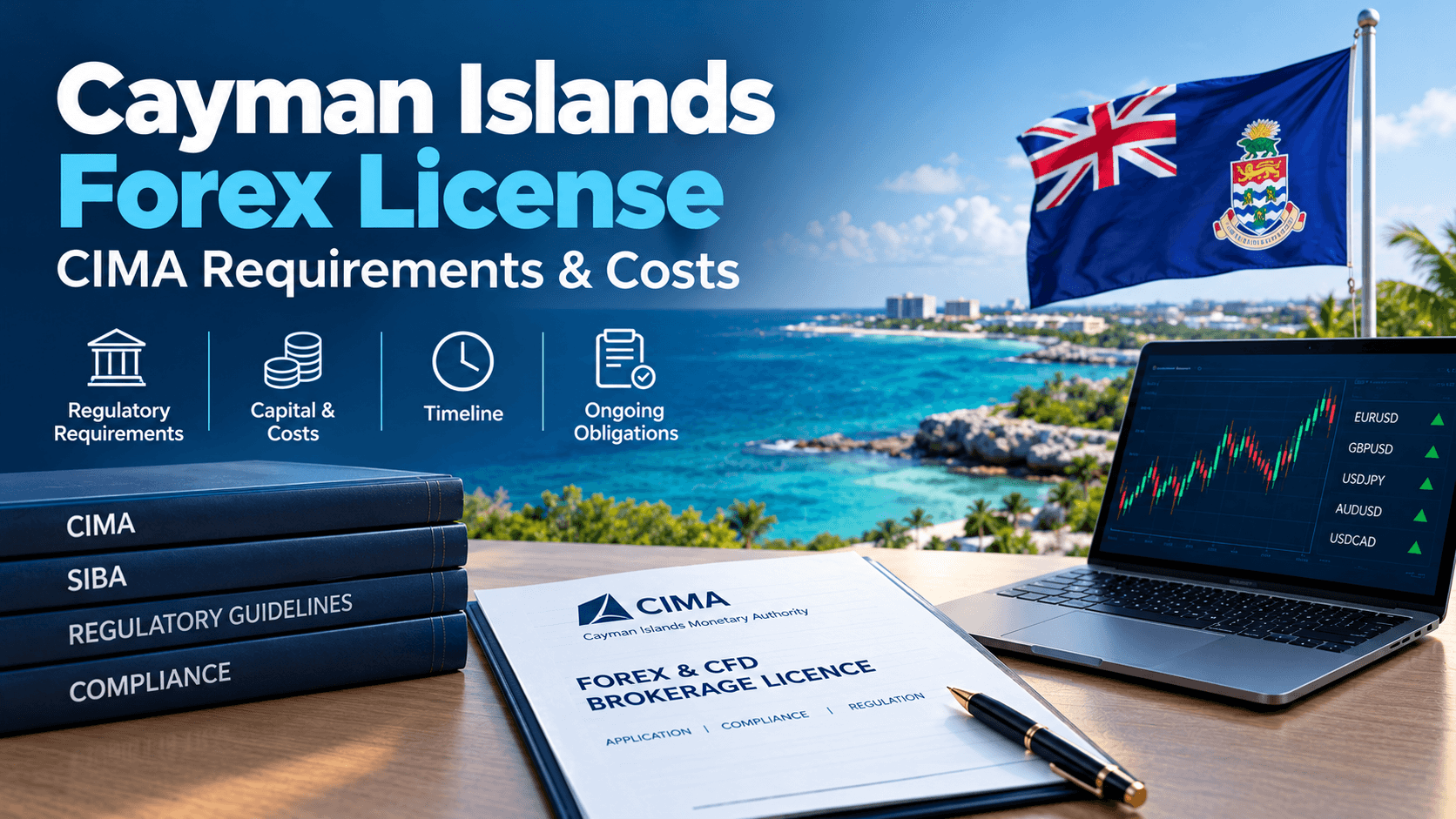
The Cayman Islands is best known as a funds jurisdiction, and many founders assume it works like the lighter offshore options. It doesn't. A Cayman licence is a full regulatory authorization from a serious regulator, with the capital, people, and substance that go with it.
This guide explains what the licence actually is, what the 2025 law change did, what the published capital and cost figures mean, and where Cayman fits against BVI, Seychelles, and Mauritius. It's general information, not legal advice. Confirm scope and fees with the Cayman Islands Monetary Authority (CIMA) or Cayman counsel, because requirements are assessed case by case.
What a Cayman "Forex License" Actually Is
CIMA licenses forex and CFD brokerage models under the Securities Investment Business Act (SIBA). There's no separate "forex licence" category by that name. Licensing overviews generally treat forex and CFD dealing as securities investment business under SIBA, whether you deal as agent or principal. The exact classification depends on the products you offer, so confirm yours with CIMA.
A few clarifications:
- Licence versus registration: Cayman has two statuses: a full licence and a lighter "registered person" status for certain limited activities. A retail forex or CFD brokerage should assume it needs the full licence unless CIMA confirms otherwise.
- "Most prestigious offshore licence" is marketing language: Consultancies often use it. What's concrete is that CIMA is a well-regarded regulator with demanding standards.
- A Cayman company isn't a Cayman licence: Incorporating an exempted company doesn't authorize you to carry on securities investment business.
What Changed in 2025
An update many older guides miss: according to a recent comparison of offshore regimes, Act 21 of 2024, in force since 1 January 2025, wrote the licence categories into SIBA. The categories are broker-dealer, market maker, securities adviser, securities arranger, and securities manager, and an application now states which categories are sought and whether the licence is to be restricted.
For a broker, the practical points are:
- Decide whether your model is broker-dealer or market maker before you apply. Market-making and principal models are typically assessed more closely for capital and risk. Confirm the mapping with CIMA or counsel.
- Crypto-related activity has its own rules. Since 1 January 2025, CIMA must exempt certain platforms trading virtual assets only from SIBA, and the Virtual Asset (Service Providers) regime applies separately. Crypto CFDs need their own analysis.
If you're reading a guide that doesn't mention the 2024–2025 amendments, check it against current CIMA materials.
CIMA Requirements
Based on licensing overviews and the regulations they cite, expect CIMA to look for:
Requirement | What it means |
Minimum financial resources | Base financial resources of CI$100,000 (roughly USD 120,000–125,000) for broker-dealers and market makers, defined as net assets calculated on a prescribed basis |
Fit and proper | Directors, senior management, and significant owners must satisfy CIMA's standards |
Directors | At least two, according to consultancy guides, who may be non-resident |
Physical presence | An operational presence in the Cayman Islands, according to published overviews |
Business plan and compliance framework | A detailed plan, systems, controls, and policies |
AML/CFT arrangements | Appointed compliance and money-laundering reporting officers, and procedures |
Audit and reporting | An approved auditor, annual audited accounts, and regulatory returns |
Client asset protection | Rules on client money and records |
Local-presence and director requirements vary between sources, so ask CIMA exactly what applies to your structure.
Capital: A Number With Conflicting Versions
Most sources agree on CI$100,000 as the base financial-resources requirement. One licensing guide cites a much higher figure, KYD 500,000, and attributes it to the 2025 amendments. That claim doesn't match the regulation-based figure in the other sources, so treat it with caution.
Two further points:
- It's a floor: CIMA assesses capital against your business plan and risk, and may require more, particularly for principal or market-making models and higher client volumes.
- Capital isn't your whole budget: It must be held, in addition to what you spend on setup and operations.
Compare that with fixed figures elsewhere: Seychelles requires $100,000, and BVI has no fixed minimum.
Costs: Why Estimates Differ by a Factor of Ten
You'll see first-year budgets quoted from about 20,000–50,000 to more than $200,000. The difference comes from what's included.
Cost | Notes |
Regulatory capital | CI$100,000 base, held, not spent |
CIMA licence fees | An annual fee of around CI$10,000 for a broker-dealer or market-maker licence is reported. CIMA was also reported to raise fees in 2025, so check its current schedule. |
Application and legal work | Business plan, policies, and application drafting |
Incorporation and registered office | Company formation and ongoing agent fees |
Directors and substance | A local presence, and directors where needed |
Audit and compliance | An approved auditor, compliance officer, and MLRO |
Technology and operations | Platform, liquidity, CRM, payments, and staff |
The low estimates generally count only legal and licence fees. The high ones count a realistic operating budget. For planning, use the higher view.
Timeline
Published timelines range from about 3–6 months to 6–9 months. Several sources cluster around 4–6 months. Incomplete applications and extra rounds of CIMA questions push toward the longer end, as they do elsewhere. Plan for at least six months and treat a faster result as a bonus.
Ongoing Obligations
- Annual licence fee and renewal
- Annual audited financial statements and regulatory returns
- Maintaining required financial resources
- Notifying or getting approval for changes in directors, owners, or business scope
- Client money protection and record-keeping
- Current AML/CFT controls and compliance staffing
See what founders forget about renewal and our compliance checklist.
Pros and Cons
Pros
- A serious regulator with a defined framework
- Strong reputation, especially with institutional and funds-oriented counterparties
- Clear statutory structure after the 2025 amendments
- No local income tax, which is part of the jurisdiction's appeal
Cons
- Higher capital, cost, and substance than lighter offshore options
- A longer, more document-heavy application
- Its reputation is mainly as a funds jurisdiction, with fewer retail forex brokers than other offshore hubs
- Doesn't authorize you to solicit retail clients in markets that require local authorization
- Generally not eligible for Google Ads certification in countries requiring a local licence. See our Google Ads compliance guide.
Cayman Compared
Cayman | BVI | Seychelles | Mauritius | |
Regulator and law | CIMA, SIBA (Revised) | FSC, SIBA 2010 | FSA, Securities Act | FSC |
Capital | CI$100,000 base | No fixed minimum | $100,000 | Stated minimum |
Typical timeline | 3–9 months | 3–6 months, longer if complex | 3–6 months | 90–100 working days |
Positioning | Demanding, institutional | Established, flexible | Strong offshore standing | Strong banking weight |
Figures for BVI, Seychelles, and Mauritius come from our own guides.
Who Cayman Fits
Cayman tends to suit operators who:
- Have significant capital and experienced senior management
- Serve institutional or professional clients, or want a high-credibility structure
- Can fund substance and compliance properly
- Already have a business to license, not just an idea
It's usually not the right first step for a founder testing a market on a small budget. Our offshore versus regulated guide explains how to choose a starting point.
Common Mistakes
- Treating a Cayman company as a licensed broker
- Using a guide written before the 2025 amendments
- Believing the highest or lowest capital figure without checking
- Budgeting only for fees, not for capital, substance, and operations
- Not deciding broker-dealer versus market-maker before applying
- Assuming a Cayman licence allows marketing into regulated retail markets
- Skipping the pre-application conversation with CIMA
What's New in 2026
- Licence categories are now in the statute, following Act 21 of 2024 in force from 1 January 2025.
- Crypto and VASP interactions are being refined, so crypto products need separate analysis.
- CIMA fees were reported to rise in 2025, so older cost tables may be out of date.
- Expect close AML and substance scrutiny, consistent with global trends. See our 2026 regulatory trends guide.
Related Reading
- BVI Forex License: British Virgin Islands FSC Requirements
- Seychelles FSA License for Forex Brokers: Full Breakdown
- Offshore vs Regulated Forex License — Which Fits Your Budget?
- 2026 Regulatory Trends Every New Forex Broker Should Know
About FX Launch Pad
When a founder asks about Cayman, we start with their capital, team, and target markets, because those decide whether the licence is a fit or an expensive detour. We help founders compare jurisdictions side by side before they commit to an application.
If you're weighing Cayman against other jurisdictions, book a free consultation and we'll go through your plan with you.
Frequently Asked Questions
Q-1 Does the Cayman Islands issue a forex broker license?
Ans- CIMA licenses forex and CFD brokerage models as securities investment business under the Securities Investment Business Act. There's no licence called "forex licence," and the exact classification depends on your products.
Q-2 What is the minimum capital for a Cayman forex licence?
Ans- Most sources cite base financial resources of CI$100,000, roughly USD 120,000–125,000, for broker-dealers and market makers. CIMA may require more depending on your model. One guide cites a higher figure that doesn't match the other sources.
Q-3 How long does it take to get a CIMA licence?
Ans- Published estimates range from about 3–6 months to 6–9 months. Plan for at least six months, and expect longer if CIMA needs more information.
Q-4 What changed in Cayman licensing in 2025?
Ans- Act 21 of 2024, in force since 1 January 2025, wrote the licence categories (broker-dealer, market maker, securities adviser, securities arranger, and securities manager) into SIBA. It also changed how some virtual-asset platforms are treated.
Q-5 Can I serve clients in the UK or EU with a Cayman licence?
Ans- No. A Cayman licence doesn't authorize you to solicit retail clients in markets that require local authorization. Check the rules for each market you plan to serve.