If you researched forex licensing two or three years ago and are only now moving forward, some of what you learned is already out of date. The offshore licensing landscape has shifted meaningfully in the past 24 months, and not in the direction most founders expect. We've had clients come to us this year with budgets built on 2023 figures, only to discover the capital requirement for their target jurisdiction had doubled. Here's what's actually changed, and what it means if you're planning a launch now.
Trend 1: Offshore Capital Requirements Are Rising Sharply
This is the single most consequential change for new brokers, and the one most likely to break an outdated budget. Seychelles raised its minimum capital requirement from USD $50,000 to USD $100,000 under the Securities (Financial Statements) (Amendment) Regulations 2024 — doubling the entry barrier overnight.
The effect was exactly what the regulator intended. Established operators were largely unaffected, but the increase filtered out the lowest-capitalized applicants who had been relying on the $50,000 threshold — and in practice it strengthened the FSA's credibility with banking partners and liquidity providers who had long considered $50,000 inadequate for a serious broker operation.
Vanuatu has moved in a similar direction. The $2,000 capital figure that still circulates in old articles is long obsolete, and current requirements sit meaningfully higher. If you're budgeting from a guide published before 2024, verify every number before you commit.
Trend 2: "Substance" Is No Longer Optional in Offshore Jurisdictions
The old model — incorporate an offshore company, get a license, operate entirely from somewhere else — is closing. The better offshore regulators in 2026 now require genuine substance: resident directors, local compliance officers, and audited accounts.
Vanuatu illustrates this well. VFSC licenses issued in 2026 require compliance measures that distinguish STP and ECN brokerage models, appointment of a Money Laundering Reporting Officer, and vulnerability assessment and penetration testing for fintech security — with prudential supervision and negative balance protection also required in top jurisdictions.
That VAPT requirement is worth flagging specifically, because it catches founders off guard. It means your trading infrastructure now needs to pass a security assessment as part of your licensing obligations — not just work correctly. Founders who treat their tech stack as a purely commercial decision, separate from compliance, are increasingly finding the two are the same decision.
Trend 3: The Multi-Entity Structure Has Become the Default
Rather than picking one jurisdiction and staying there, serious operators now run several entities in parallel. Every major Seychelles FSA licensee uses it as part of a multi-entity structure — not as a sole regulatory base, but as the offshore entity extending geographic reach into markets their EU or UK entities can't efficiently serve.
For a new broker, the practical takeaway isn't that you need multiple entities on day one. It's that your first jurisdiction should be chosen as a foundation you can build on, not a permanent home. Vanuatu, for instance, works well as a stepping-stone license for operators who plan to upgrade to Seychelles or Mauritius later, or as the entry tier in a multi-jurisdictional stack. Planning for that progression from the start is cheaper than restructuring around it later.
Trend 4: AML and KYC Scrutiny Has Intensified Industry-Wide
Regulators across Europe, Asia, and offshore jurisdictions have tightened supervision following several high-profile broker collapses and fraud investigations. Cross-border capital flows and crypto integration have pushed AML scrutiny higher, and enhanced transaction monitoring is now an expectation rather than a differentiator.
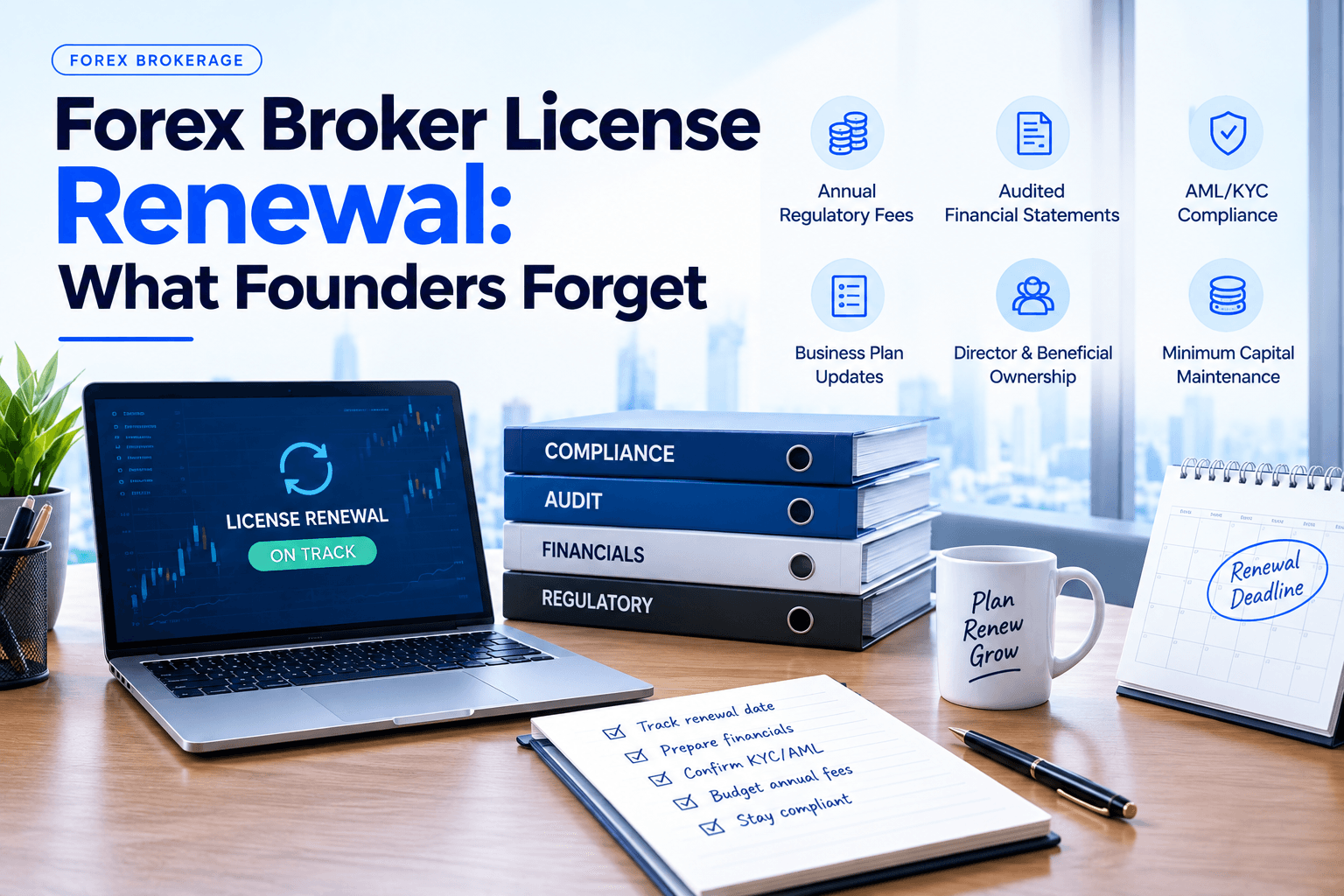
Notably, offshore regulators specifically are introducing stricter licensing renewal requirements to protect their own credibility — which means the compliance burden doesn't end when your license is issued. This connects directly to something we've written about separately: what founders forget about license renewal is increasingly the thing that determines whether their license survives its second year.
Trend 5: Marketing and Promotion Rules Are Cascading to Partners
Regulated regimes have long required that promotions be fair and not misleading, with mandatory risk warnings and bans on deposit bonuses. What's changed in 2026 is enforcement scope: the compliance question is no longer just what your own ads say, but whether you can prove which partner ran which creative, to which audience, and that it was approved.
For a broker planning an IB or affiliate network, this has real infrastructure implications. A PDF of brand guidelines sent to partners doesn't satisfy this standard. Your CRM needs to track partner creative and approvals as part of its normal function — which is one more reason CRM and back-office decisions deserve more attention at setup than most founders give them.
What This Actually Means for Your 2026 Launch
The through-line across all five trends is the same: the gap between "offshore" and "regulated" is narrowing, and it's narrowing from the offshore side. Jurisdictions that were genuinely light-touch three years ago now want capital, resident staff, audited accounts, security testing, and continuous AML monitoring.
That's not bad news for a serious operator — it's arguably good news, because the same changes that raise your entry cost also improve your banking access and client trust. But it does mean the "cheap and fast" offshore launch that dominated older advice is a smaller category than it used to be, and planning around outdated figures is the most common budgeting mistake we see this year.
Related Reading
- Offshore vs Regulated Forex License — Which Fits Your Budget? — how the two tiers compare now that offshore requirements have tightened
- Vanuatu Forex License Explained: Pros, Cons & Real Timeline — a closer look at the stepping-stone jurisdiction mentioned above
- Mauritius Forex License: Real Cost, Timeline & Requirements — the mid-tier option most multi-entity operators upgrade toward
- Forex Broker License Renewal: What Founders Forget — why tightening renewal requirements deserve planning from day one.
About FX Launch Pad
Keeping up with shifting capital thresholds and substance requirements across jurisdictions is part of what we do at FX Launch Pad — our legal and liquidity partners are direct relationships rather than outsourced referrals, so when a regulator changes its rules mid-year, we hear about it from the ground rather than from a blog post six months later. Because our trading technology is built in-house, we can also address requirements like security testing and AML monitoring infrastructure as part of your setup rather than sending you to a separate vendor after the fact.
If you're budgeting a launch and want to make sure your numbers reflect 2026 requirements rather than older figures, book a free consultation and we'll walk through what your target jurisdiction actually requires right now.
Frequently Asked Questions
Q-1 Have offshore forex license requirements actually gotten stricter?
Yes, measurably. Seychelles doubled its minimum capital from $50,000 to $100,000 under 2024 regulations, and jurisdictions including Vanuatu now require resident directors, local compliance officers, audited accounts, and an appointed Money Laundering Reporting Officer.
Q-2 Is offshore licensing still worth it in 2026?
For many operators, yes — offshore remains faster and less capital-intensive than Tier-1 licensing. But the cost gap has narrowed, and the "cheap and fast" positioning that applied a few years ago is less accurate now, so budgets built on older figures need updating.
Q-3 What is VAPT and why do forex brokers need it?
Vulnerability Assessment and Penetration Testing is a security audit of your technology infrastructure. Some jurisdictions now require it as part of licensing, meaning your trading platform and systems must pass a security review, not just function correctly.
Q-4 Should I get multiple licenses for my brokerage?
Most new brokers shouldn't start with multiple entities, but should choose a first jurisdiction that supports later expansion. Multi-entity structures — an offshore entity alongside a regulated one — have become the standard model for operators serving several geographic markets.
Q-5 Do these regulatory changes affect license renewal too?
Yes. Offshore regulators are tightening renewal requirements alongside initial licensing, which means ongoing AML monitoring, audited financials, and compliance reporting carry more weight than they did a few years ago.