Almost every founder we talk to during the setup phase is laser-focused on one milestone: getting licensed. That's understandable; it's the gate you have to get through before you can operate at all. But we've had more than one client call us in a mild panic eight or ten months after launch because a renewal deadline snuck up on them, or because they budgeted for the license but not for what it costs to keep it. Renewal isn't a footnote. It's an ongoing part of running a licensed brokerage, and it deserves the same planning attention as the initial setup.
Why Renewal Catches Founders Off Guard
Here's the pattern we see most often: a founder spends months focused entirely on the licensing process, the business plan, the FSC or regulator queries, the bank account setup and the moment the license is issued, their attention shifts entirely to running the business. Compliance becomes something that happens in the background, until a renewal notice (or worse, a missed deadline) forces it back to the front of their mind.
This isn't a knowledge gap so much as an attention gap. Founders know renewal exists. What they underestimate is how much ongoing work sits behind that word, and how early some of it needs to start relative to the actual renewal date.
What Renewal Actually Involves
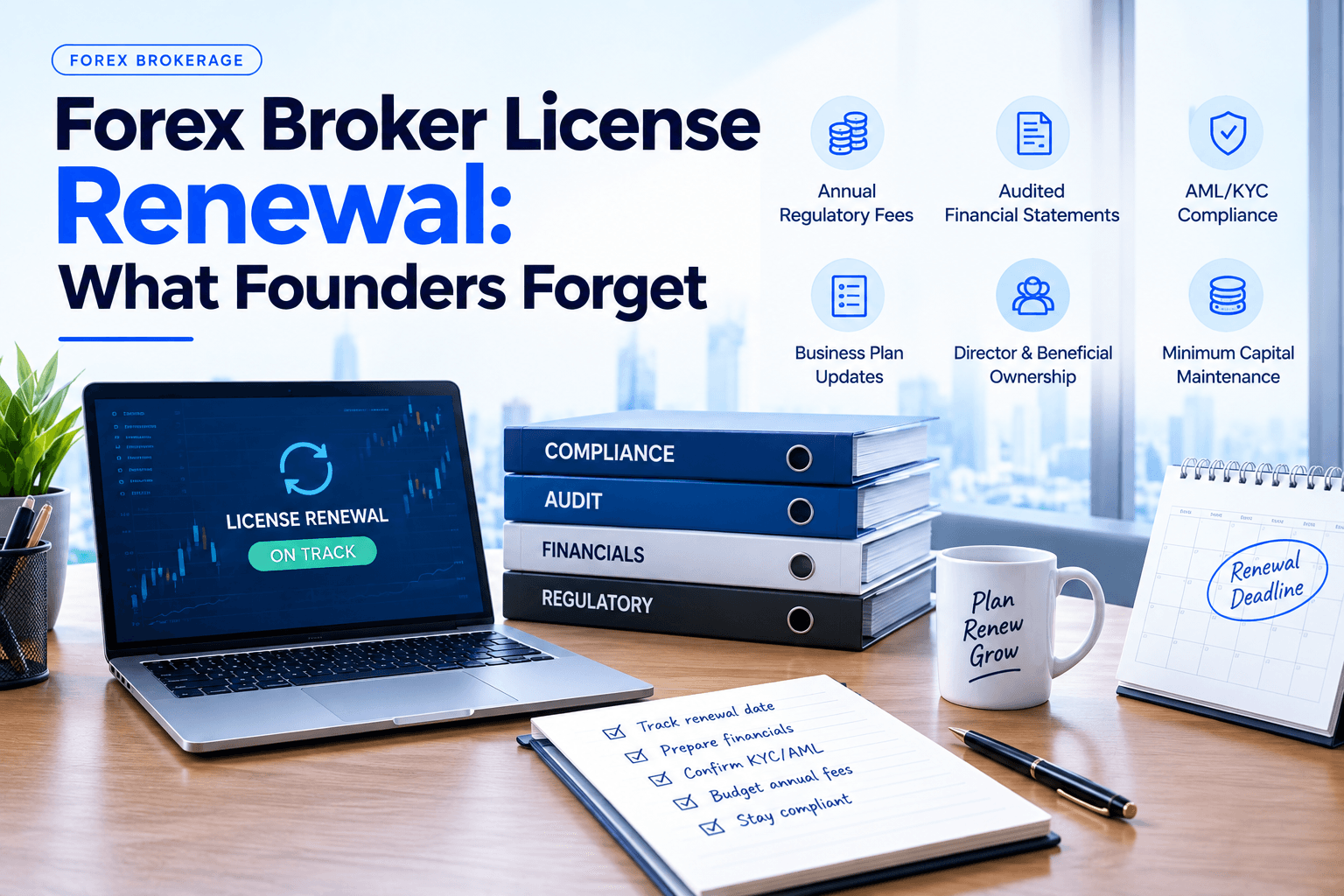
Renewal isn't a form and a fee, though that's often how it gets described in casual conversation. Depending on your jurisdiction, a genuine renewal cycle typically includes:
- Annual or ongoing regulatory fees, which vary significantly by jurisdiction — a regulated setup's annual renewal can run around $30,000, while an offshore renewal is comparatively low
- Updated audited financial statements, prepared by your appointed auditor and submitted on the regulator's schedule, not yours
- AML/KYC compliance reporting, confirming your ongoing monitoring and reporting obligations have actually been met throughout the year, not just documented in theory
- Business plan or operational updates, if your regulator requires confirmation that your actual operations still match what was originally licensed
- Director and beneficial ownership confirmations, especially in jurisdictions with substance requirements
- Continued minimum capital maintenance, proving the capital held against your license hasn't been drawn down below the regulatory threshold
Missing or rushing any one of these doesn't just risk a late fee. In most jurisdictions, it risks the license itself, and a lapsed or suspended license is a fundamentally different problem than a late renewal, because it can freeze your ability to onboard new clients or process withdrawals while it's being resolved.
The Three Things Founders Forget Most
They forget renewal has a lead time, not just a due date: Audited financials don't get produced overnight — your auditor needs weeks to prepare and finalize statements before a regulator will accept them. Founders who start thinking about renewal only when the deadline is close often find their own auditor is the bottleneck, not the regulator.
They forget the annual cost is a real operating expense, not a one-time setup fee they already paid: This is especially common with regulated-tier licenses, where a $30,000 annual renewal is a meaningful recurring cost that needs to be planned into cash flow from year one, not treated as a surprise bill that shows up once the initial excitement of launching has worn off. If you're still deciding between tiers, our Offshore vs Regulated comparison breaks down exactly how these ongoing costs stack up against each setup's lower entry price.
They forget that compliance is cumulative, not retroactive: AML monitoring, KYC documentation, and transaction reporting are supposed to happen continuously throughout the year. A founder who treats compliance as something to catch up on right before renewal often discovers gaps in their own records that can't simply be filled in after the fact because the whole point of ongoing monitoring is that it happens in real time.
Why This Connects Back to How You Set Up in the First Place
This is where the initial setup and renewal aren't really separate problems; they're the same problem at two different points in time. A CRM built with proper KYC logging and audit trails from day one makes renewal straightforward, because the documentation a regulator wants to see has already been generated as a byproduct of normal operations. We've written about exactly what a properly configured CRM needs to handle if you want the fuller picture. A brokerage that treated compliance logging as an afterthought during setup ends up reconstructing a year's worth of records under deadline pressure, which is a far worse position to renew from.
This is also part of why we build compliance infrastructure into the initial setup rather than treating it as something to figure out post-launch. The renewal your business faces in twelve months is being determined by decisions made in the first few weeks of setup, whether founders realize that connection or not.
A Simple Way to Stay Ahead of It
The founders who never have a renewal scare are the ones who treat it as a recurring calendar item from day one, not an annual emergency. That means: knowing your specific renewal date and your auditor's required lead time, budgeting the annual fee as a fixed operating cost rather than a surprise, and running AML/KYC compliance as a continuous process rather than a pre-renewal scramble. None of this is complicated. It just requires treating renewal as part of running the business, not as a separate event that happens to you once a year.
Related Reading
- Offshore vs Regulated Forex License — Which Fits Your Budget? — a full cost and timeline comparison, including the annual renewal gap between tiers
- Mauritius Forex License: Real Cost, Timeline & Requirements — see what ongoing compliance and audit obligations look like in a mid-tier regulated jurisdiction
- Forex CRM & Back-Office Systems: What New Brokers Underestimate — how the right CRM setup makes renewal documentation a non-issue
About FX Launch Pad
Because we build the compliance and CRM framework into your brokerage from the initial setup rather than as an afterthought, FX Launch Pad clients tend to walk into renewal season with their KYC and AML documentation already in order, not scrambling to reconstruct a year of records. We also flag renewal deadlines and lead times proactively as part of our ongoing relationship with clients, rather than treating our involvement as ending once your license is first issued.
If you're not sure what your specific renewal timeline and requirements look like, or want to make sure your compliance setup won't create problems down the road, book a free consultation and we'll walk through exactly what your jurisdiction requires.
Frequently Asked Questions
Q-1 What happens if I miss my forex broker license renewal deadline?
Ans- Consequences vary by jurisdiction, but a lapsed or suspended license can freeze your ability to onboard new clients or process client withdrawals while the issue is resolved — a significantly worse position than paying a late fee, and in some cases the license can be revoked entirely.
Q-2 How much does forex broker license renewal cost?
Ans- It depends heavily on jurisdiction. A regulated-tier license's annual renewal can run around $30,000, while offshore jurisdiction renewals are comparatively low. This is a recurring operating cost that should be budgeted separately from your initial setup fee.
Q-3 Do I need audited financial statements every year to renew my license?
Ans- In most regulated and mid-tier jurisdictions, yes. Annual audited financial statements are a standard renewal requirement, and they need to be prepared and finalized by your auditor with enough lead time to meet the regulator's submission deadline.
Q-4 Can I renew my license myself, or do I need a compliance provider?
Ans- Technically, you can manage renewal yourself if you have the internal compliance capacity to track deadlines, prepare documentation, and coordinate with your auditor. Many founders use a compliance provider specifically because missing a step has outsized consequences relative to the cost of support.
Q-5 Is renewal different for offshore versus regulated licenses?
Ans- Yes, meaningfully. Offshore jurisdictions generally have lighter ongoing reporting requirements and lower renewal costs, while regulated jurisdictions require more extensive audited reporting, higher renewal fees, and stricter ongoing compliance monitoring throughout the year.