St. Vincent comes up in almost every first conversation we have with a founder on a tight budget, usually phrased as "I want the cheap SVG license." We always stop right there, because that phrase contains the most important thing to understand about this jurisdiction before you spend a dollar on it. St. Vincent doesn't actually issue a forex license and understanding why it's still one of the most popular offshore setups anyway is the real story here.
The Correction Everyone Needs Before Reading Further
Here's the fact that gets glossed over by a lot of providers selling "SVG forex licenses": the St. Vincent & the Grenadines Financial Services Authority (FSA) does not regulate or license forex or CFD trading, and has said so repeatedly since 2023. What you actually get when you set up in SVG is a Business Company (BC) registration a legal corporate entity, not a regulatory approval to offer leveraged trading products.
This isn't a technicality. Since January 2023, the FSA's compliance framework specifically requires forex-related BCs to either hold a valid license from another jurisdiction, or provide confirmation that their target markets don't require forex licensing at all. Providers who market this as an "SVG forex license" without that context aren't wrong that the setup is real and useful; they're just skipping the part that protects you from a compliance and marketing-claims problem down the line. Being straightforward about what you actually hold, in your own client disclosures, matters more than the label on the package.
So Why Is It Still So Popular?
Once you understand what SVG actually is a fast, low-cost, tax-neutral company registration rather than a license, its popularity makes complete sense. It's the practical entry point for founders who need to be operational quickly and can't yet justify the cost of a regulated or Mauritius-tier setup.
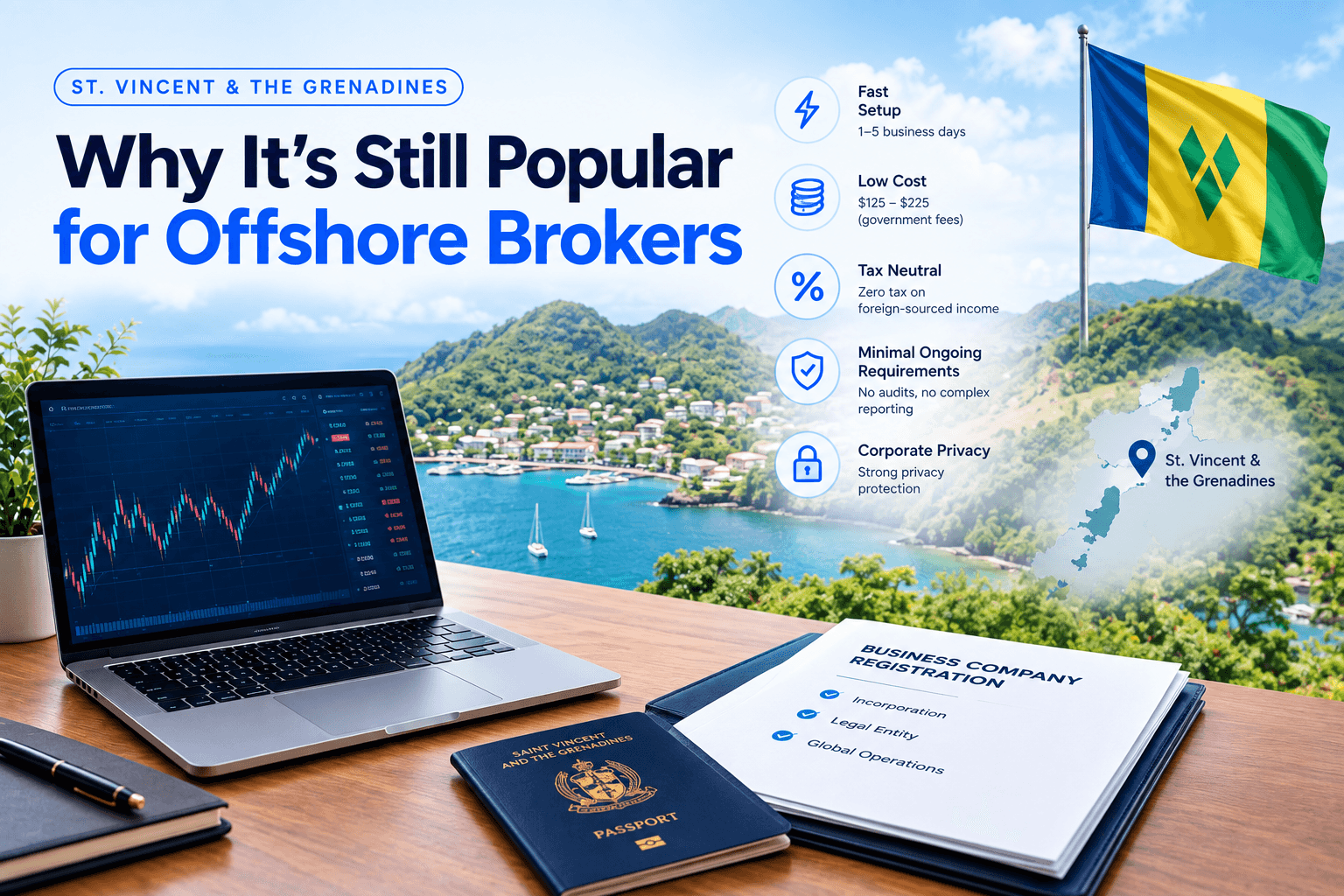
Speed: Incorporation typically completes in 1–5 business days, making it one of the fastest company setups available anywhere in the offshore world.
Cost: The government incorporation fee is genuinely low, commonly cited around $125–225 with modest annual renewal costs. Professional service fees for a properly structured setup (not just bare incorporation) typically bring the realistic total closer to a few thousand dollars, before you add the trading infrastructure a real brokerage needs.
Tax neutrality: SVG imposes zero tax on foreign-sourced income for Business Companies, with no capital gains tax and no withholding tax on dividends.
Minimal ongoing burden: No mandatory annual audits, no complex financial reporting requirements to the FSA, and no minimum share capital requirement the amount can technically be as low as $1.
Privacy: SVG maintains strong corporate privacy protections, which appeals to founders who don't want beneficial ownership details as publicly exposed as they would be in some regulated jurisdictions.
What Changed in 2023 and Why It Still Matters in 2026
Before 2023, SVG had a reputation as a genuinely "no-questions-asked" destination. That's no longer accurate, and treating it that way is the single most common mistake we see founders make with this jurisdiction. The FSA's 2023 Memorandum tightened the framework meaningfully: forex-related BCs now need to demonstrate either a valid license elsewhere, or documented confirmation that their operating markets don't require one.
In practice, this means SVG in 2026 works best as one of two things: a genuine early-stage entry point for a brokerage that's honest about being unregulated and targets non-Tier-1 markets accordingly, or a secondary "mirror entity" for an established operator who already holds a real license elsewhere and uses SVG for cost-efficient structuring. What it no longer works well as is a shortcut around getting licensed at all that gap has closed.
What You're Trading Away
The honest tradeoffs, because we'd rather you know them upfront than discover them after launch:
- No regulatory credibility: Banks, payment processors, and larger IBs increasingly know the difference between an SVG registration and an actual license, and treat the two differently in due diligence.
- Weaker banking access: Some banks apply more scrutiny to SVG entities specifically because of how many unregulated brokerages have used the structure.
- No investor protection framework: There's no regulatory body standing behind client funds the way there is in a licensed jurisdiction which matters for how you can honestly market yourself.
- A ceiling on institutional growth: Larger IBs and institutional clients bringing real volume often want to see a licensed structure before committing, which is a natural point where operators outgrow SVG.
Who SVG Actually Fits
SVG makes the most sense for founders testing a business model before committing serious capital to licensing, IB-led startups converting existing trading relationships into their own brand, and operators specifically targeting non-Tier-1 retail markets where a formal license isn't a hard requirement for their clients' trust. It's a deliberately temporary base for most operators the plan should be to prove the model, then upgrade to Vanuatu, Seychelles, or Mauritius once volume and client expectations justify it, not to stay indefinitely.
Related Reading
- Offshore vs Regulated Forex License — Which Fits Your Budget? — how an SVG-style setup compares against a fully regulated tier
- Vanuatu Forex License Explained: Pros, Cons & Real Timeline — a natural upgrade path once you outgrow an SVG registration
- Mauritius Forex License: Real Cost, Timeline & Requirements — the credibility and banking tier most SVG operators eventually move toward
- 2026 Regulatory Trends Every New Forex Broker Should Know — how offshore substance requirements are tightening industry-wide
About FX Launch Pad
We set up SVG structures for clients honestly as a fast, cost-efficient starting point with a clear upgrade path, not as a "license" it isn't. Because our own liquidity and legal partnerships span multiple jurisdictions, we can map out exactly when it makes sense to move from SVG to Vanuatu, Mauritius, or a fully regulated setup, rather than leaving you to figure that transition out on your own once you've outgrown the entry tier.
If you're weighing SVG against a licensed jurisdiction for your specific business model and target market, book a free consultation and we'll give you a straight answer.
Frequently Asked Questions
Q-1 Does St. Vincent actually issued a forex broker license?
Ans- No. The SVG Financial Services Authority does not regulate or license forex or CFD trading. What you get is a Business Company (BC) registration as a legal corporate entity, not a financial services license.
Q-2 How much does it cost to set up a company in St. Vincent?
Ans- Government incorporation fees are typically in the $125–225 range with low annual renewal costs, but a properly structured setup with professional support usually runs to a few thousand dollars once legal and compliance work is included.
Q-3 How long does SVG company registration take?
Ans- Incorporation is typically completed within 1–5 business days, making it one of the fastest offshore company setups available.
Q-4 Is it legal to operate a forex brokerage from an SVG company?
Ans- It can be, but since 2023 the FSA requires forex-related BCs to either hold a valid license from another jurisdiction or confirm their target markets don't require one. Operating without meeting that requirement, or marketing an SVG registration as a "license," carries real compliance risk.
Q-5 Should I upgrade from SVG to a licensed jurisdiction eventually? F
Ans- or most operators, yes. SVG works well as a fast, low-cost starting point, but banking access, institutional credibility, and client trust generally improve significantly once you move to a genuinely licensed jurisdiction as your volume grows.