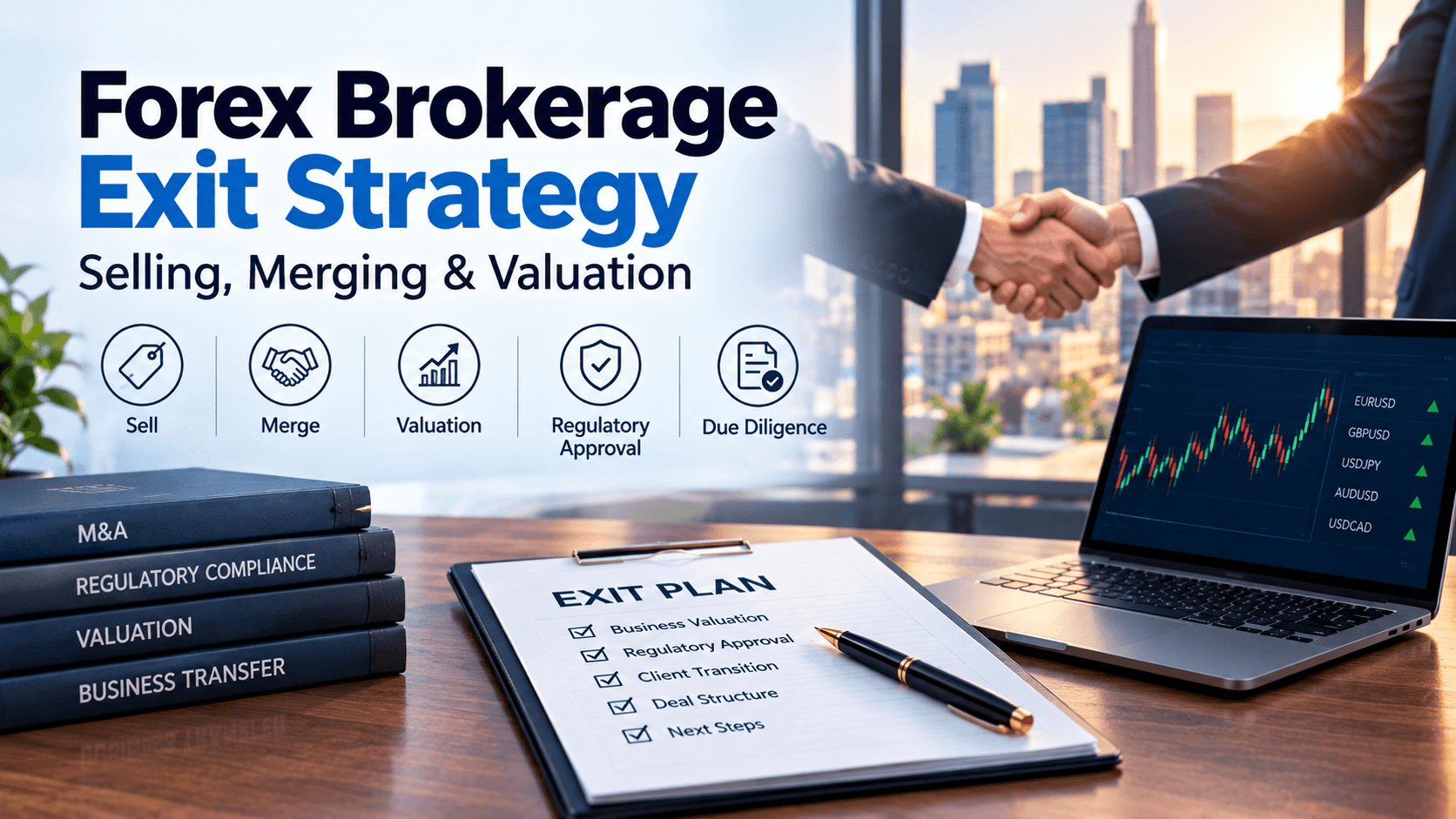
Most founders think about exit when a buyer calls. In forex, that's too late.
A brokerage isn't like most small businesses. Its most valuable assets- the licence, the banking relationships, the payment providers, and the platform arrangements- aren't things you can simply hand over. Regulators approve who owns a licensed firm. Banks and processors re-underwrite when ownership changes. A buyer's due diligence will test your records back to your first client.
That means exit readiness is built over years, not weeks. This guide covers your exit options, what buyers pay for, how regulatory approval works, and how to prepare. It's general information, not legal, tax, or financial advice. Use experienced M&A counsel for any real transaction.
Your Exit Options
Route | What it is | Strengths | Watch-outs |
Sell the company (share sale) | The buyer acquires the entity, licence, contracts, and history | Clean transfer of the whole business | The buyer inherits everything, so diligence is intense. Regulatory approval is required. |
Sell the client book or assets | The buyer takes clients and selected assets, not the entity | Buyer avoids legacy liabilities | Client transfer rules, consent and notification, and platform migration |
Merge with another broker | Combine operations, often with shares as consideration | Scale, shared costs, and an ongoing stake | Integration risk, and valuation of shares you receive |
Sell a minority or partial stake | A strategic or financial investor buys part | Capital and a partner, while you stay involved | Governance rights and eventual exit terms |
Management or partner buyout | Insiders or key partners buy you out | Continuity and familiarity | Financing, and whether the buyer can pass regulatory tests |
Orderly wind-down | Return client funds and surrender the licence | A clean, responsible end if no buyer fits | Needs planning and regulator engagement. It's not a quiet shutdown. |
Both asset-style and company-style deals have a long history in the industry. For example, GAIN Capital acquired Global Futures & Forex in 2013 and City Index in 2015, and took over retail accounts from FXCM after that firm's settlement with the CFTC, according to public records.
More recently, Admirals reportedly sold its Australian subsidiary in 2025, which was later rebranded by PU Prime, and Finance Magnates reported in June 2026 that INFINOX was in advanced talks to acquire a stake in the group. Treat these as illustrations of deal types, not templates.
What Buyers Actually Pay For
A word of caution on valuation. We could not find reliable public benchmarks for the multiples paid for private retail forex brokerages. Many articles about "brokerage valuation" cover insurance or real estate brokerages, which have very different economics, so their multiples don't transfer. Be wary of any adviser who quotes a firm multiple without comparable forex deals behind it.
What matters is why buyers pay more or less:
Value driver | Why it matters | How to improve it |
Revenue per active client and active-client count | Shows the quality of monetization, not just client numbers | Track it monthly and explain spikes |
Revenue durability | Trading revenue swings with market conditions, and B-book results swing more | Show multi-year results and risk controls |
Client acquisition efficiency | A business that acquires clients cheaply is worth more | Document cost per funded client and payback |
IB and partner concentration | Dependence on a few partners is a risk | Diversify and keep contracts current |
Licence quality and history | A clean, appropriate licence supports the deal | Keep filings current and resolve open issues |
Records and compliance quality | Weak KYC files and audit trails reduce price or kill deals | Build them from day one |
Banking and payment relationships | Hard to replace, but may need re-approval | Keep clean processing and dispute records |
Technology and platform arrangements | Buyers need to know what they're getting and what can be transferred | Document ownership, licences, and integrations |
Owner dependence | A business that needs its founder is worth less | Build a management team and written processes |
Normalized financials | Buyers adjust for owner perks and one-offs | Keep clean, audited accounts |
The Gating Item: Regulatory Approval
In a regulated firm, a change of ownership usually needs the regulator's approval, and this often sets your timeline.
UK example (official FCA guidance): Anyone who wants to acquire or increase control in an FCA-authorised firm must get the FCA's approval first, by submitting a Section 178 notice. Key points:
- The FCA has up to 60 working days to assess a complete notification, and the clock can be paused when it asks for more information.
- The buyer is responsible for the notice.
- Completing a deal without approval can be a criminal offence.
- Even inserting a new holding company counts as a change in control, even if the people behind it don't change.
- Control is assessed against shareholding bands, typically 10%, 20%, 30%, and 50%.
- The regulator looks at whether the buyer is fit and proper, where the money comes from, and how the acquisition affects the firm.
Other jurisdictions: Most regulators require prior approval or notification of ownership changes, and the process varies. For example, consultancy guidance on the BVI says FSC approval is needed for changes in ownership and directors. Check what your regulator requires.
See our BVI licensing guide.
What this means for your deal:
- Make completion conditional on regulatory approval in the sale agreement
- Set a realistic long-stop date that allows for approval time and for questions
- Agree what the business can and can't do between signing and completion
- Prepare the buyer's source-of-funds evidence early, because it's often what slows approval
Be Careful With "Licence for Sale" Offers
You'll see offers to sell forex licences or licensed shell companies. Treat them with great caution.
- A licence isn't a standalone product. Regulators assess the owners, the business, and the people running it, so an unrelated buyer may not be approved.
- Some "licences for sale" are scams or aren't what they claim.
- Always verify the authorisation on the regulator's own public register before paying anything, using the licence number and the legal entity name, not the seller's documents.
For why operating without proper authorization is dangerous, see the risks of running a brokerage without a licence.
What a Buyer's Due Diligence Will Examine
Expect scrutiny of:
- Licence and regulatory history: conditions, inspections, breaches, and correspondence
- Client money: segregation, reconciliation, and records
- KYC and AML files: completeness, quality, and the audit trail. See our compliance checklist and KYC automation guide.
- Payments: provider contracts, chargeback history, and reserves
- Banking relationships and their terms
- Liquidity and platform agreements: and whether they have change-of-control clauses
- IB and partner agreements: commissions owed, liabilities, and promotional conduct.
- Complaints, disputes, and litigation
- Financials: revenue quality, B-book exposure, and normalized earnings
- Technology: ownership, security, and documentation
- Data protection and employment matters
Check your key contracts for change-of-control or assignment clauses before you start talks. A platform, bank, or processor may have the right to review or end an agreement when ownership changes.
Deal Structures to Understand
- Share sale versus asset or client-book transfer: A share sale moves the whole entity, with its liabilities. An asset deal moves selected items, but client transfers raise notification and consent issues and may need regulator involvement.
- Earn-outs and deferred consideration: Part of the price depends on future client retention or revenue. Define the measurement carefully, because disputes are common.
- Warranties, indemnities, and escrow: The buyer will want protection against undisclosed problems.
- Transition support: Buyers often need the founder or key staff for a period.
- Client communication: Plan what clients are told, when, and how.
If a Sale Isn't Possible: Orderly Wind-Down
Sometimes the right exit is closed responsibly. That means:
- Returning client funds properly and promptly
- Engaging the regulator before announcing, not after
- Meeting record-keeping obligations after closure
- Settling partner, vendor, and banking obligations
- Surrendering or cancelling the licence through the proper process
Regulators care about this. Many expect a documented wind-down plan, as we noted in our business plan guide.
Prepare 12–24 Months Ahead
- KYC and AML files complete, consistent, and easy to produce
- A CRM with a full audit trail. See our CRM feature checklist.
- Audited, normalized financials
- Reduced dependence on any one IB or on you
- Contracts reviewed for change-of-control clauses
- Complaints and disputes resolved or documented
- A clean ownership structure
- Regulatory filings current, including renewals
- Technology and licences documented
- A management team that can run the business without you
Common Mistakes
- Starting exit planning when a buyer appears
- Quoting valuation multiples from unrelated industries
- Underestimating regulatory approval time
- Signing without a condition tied to regulatory approval
- Weak or incomplete client records
- Heavy reliance on a few IBs or on the founder
- Overlooking change-of-control clauses in key contracts
- Talking to buyers without legal and tax advice
What's New in 2026
- Consolidation and restructuring continue: with reports of subsidiary sales, stake talks, and licensing changes among established brokers.
- Regulators look harder at controllers and funds: Buyers should expect detailed source-of-funds and source-of-wealth questions.
- Record quality drives deals: Buyers increasingly walk away from firms with thin KYC and audit trails.
- Regulatory timelines are real: Plan around approval periods, not hopeful estimates.
Related Reading
- Forex Broker Compliance Checklist – KYC, AML, and Data Security
- Building a Forex Franchise / IB Network Business Model
- Forex Broker License Renewal: What Founders Forget
- Key Features Every Forex CRM Should Have Before You Choose One
About FX Launch Pad
Exit readiness starts at setup. The records you keep in your first year, the contracts you sign, and the structure you choose are what a buyer will examine years later. We build brokerages so that the KYC files, audit trails, and agreements are in good order from the start, which keeps your options open if you ever want to sell, merge, or bring in a partner.
If you're planning a launch and want it built with a future sale or investment in mind, book a free consultation, and we'll go through it with you.
Frequently Asked Questions
Q-1 Can I sell my forex brokerage?
Ans- Yes, but regulated firms usually need regulator approval for a change of ownership, and the buyer must pass fit-and-proper tests. The licence, banking, and platform arrangements aren't simply transferred, so plan for diligence and approval time.
Q-2 How long does regulatory approval for a sale take?
Ans- It depends on the regulator. In the UK, the FCA has up to 60 working days to assess a complete change-in-control notice, and the clock can be paused for questions. Plan for approval time in the sale agreement.
Q-3 How much is a forex brokerage worth?
Ans- There are no reliable public multiples for private retail forex brokers, and figures for insurance or real-estate brokerages don't apply. Value depends on revenue quality, client activity, licence standing, records, and risk. Get a valuation from advisers with forex deal experience.
Q-4 Can I buy or sell just a forex licence?
Ans- Be very cautious. A licence isn't a standalone asset, since regulators assess the owner and the business. Many "licences for sale" are scams. Always verify on the regulator's own public register.
Q-5 What do buyers look at first?
Ans- Licence and regulatory history, client money handling, the quality of KYC and AML records, payments and banking, and how dependent the business is on the founder and key partners.