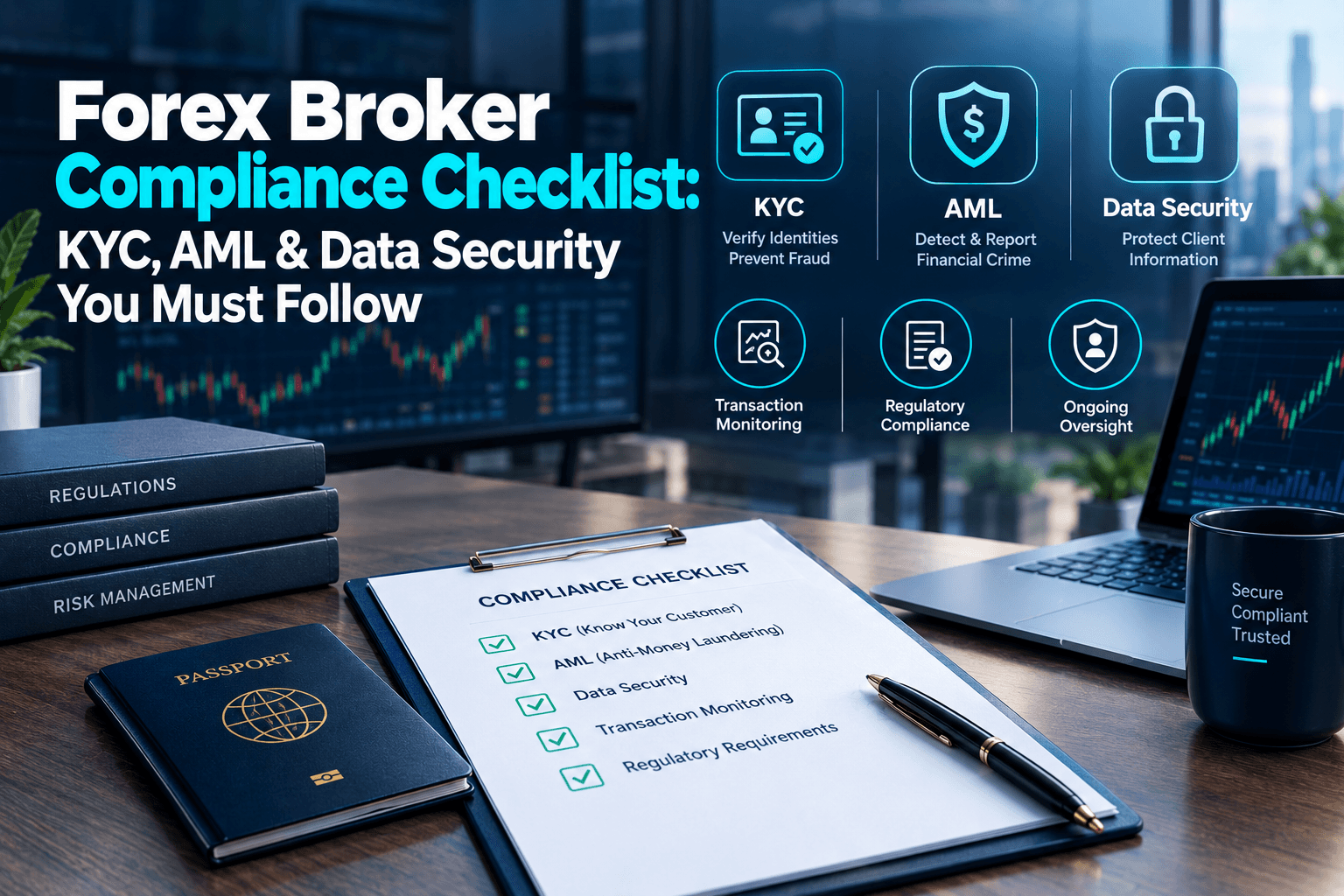
Compliance is the part of running a brokerage that never actually finishes. It's not a box you tick during licensing and move past, it's a system you run every single day you have clients. We walk every client through building this system from day one, and the brokers who treat it as ongoing infrastructure, not a one-time setup task, are the ones who sail through renewals and due diligence reviews without drama.
Here's the real checklist, built around what regulators are actually enforcing in 2026 — including a genuinely fresh development most guides haven't caught up on yet.
The 2026 Update Worth Knowing About
In April 2026, the US Financial Crimes Enforcement Network (FinCEN) published a Notice of Proposed Rulemaking overhauling AML/CFT program requirements for financial institutions. If any part of your client base or operations touches the US, this is worth watching closely regulatory shifts like this tend to influence how other jurisdictions' examiners interpret "adequate" compliance, even outside the US directly.
The broader 2026 trend across regulators: a defensible AML program is now expected to function as a control system, not a static policy document sitting in a drawer. Examiners are checking whether your controls actually operate day to day, not just whether you have a policy that describes them.
Part 1: KYC — What Real Identity Verification Requires
KYC isn't a one-time ID check at signup. A compliant program covers:
- Full identity data collection: government ID, proof of address, tax residency
- Source of Funds (SoF) and Source of Wealth (SoW): documentation — not just where the deposit came from, but a credible picture of the client's overall financial standing
- Trading experience assessment: required by many regulators to determine appropriate product access and leverage
- Corporate client due diligence: full beneficial ownership identification for any client onboarding as a company, not an individual
- Structured data collection: avoid free-text onboarding forms that make it difficult to compare and audit client data later; this sounds minor and causes real friction during a regulator review
The detail founders most often miss: clients acquired through IBs and affiliates carry the exact same KYC obligations as clients who sign up directly. The broker, not the IB, owns the compliance liability. If your IB onboarding flow doesn't capture the same KYC data as your direct flow, that's a real gap, not a convenience shortcut.
Part 2: AML — The Five Layers That Actually Matter
A genuine AML program in 2026 has five integrated layers, and regulators expect all five from day one, scaled to your license tier and client volume:
- Identity and document verification: the KYC foundation above
- Sanctions and PEP (Politically Exposed Person) screening: checked at onboarding and re-checked on an ongoing basis, not just once
- Risk-based onboarding tiers: higher-risk clients (by jurisdiction, transaction pattern, or profile) get enhanced due diligence, not the same standard process as everyone else
- Ongoing transaction monitoring: this is where forex-specific AML risk actually concentrates, since deposit/withdrawal patterns are the signal regulators care most about
- A unified audit trail: every check, flag, and decision documented in a way an examiner can actually follow
Policies every broker needs in writing:
- A written AML/KYC policy, approved by senior management, aligned with your license and FATF standards
- A named MLRO (Money Laundering Reporting Officer) with documented authority and responsibilities
- A staff compliance training program, delivered at least annually with attendance tracked
Part 3: Data Security Where Compliance Meets Cybersecurity
Your CRM holds identity documents and financial data for every client. A breach here is both a regulatory violation and a reputational catastrophe that needs to be treated as a core compliance pillar, not an IT afterthought.
Baseline technical controls expected in 2026:
- AES-256 encryption for data at rest
- TLS 1.3 for data in transit
- Multi-factor authentication for all users and administrators, no exceptions
- Role-based access controls with network segmentation isolating critical financial systems
- Regular penetration testing and vulnerability assessments: not a one-time audit at launch
- A documented incident response plan, tested before an incident happens, not written during one
Regulatory frameworks that apply: GDPR (or equivalent regional privacy law) for personal data handling, and PCI-DSS for payment card data specifically. Data residency matters too — some KYC verification providers route data through infrastructure that creates a direct GDPR conflict for EU-regulated brokers, so this is worth checking before you commit to a provider, not after.
The Compliance Officer's Actual Job
Many founders underestimate what this role requires day to day. A compliance officer or MLRO is responsible for:
- Ongoing KYC reviews, not just initial onboarding approval
- AML transaction monitoring and suspicious activity reporting (SAR filing where required)
- Keeping all policy documentation current as regulations evolve
- Overseeing staff training and verifying it actually happened
This isn't a part-time responsibility bolted onto someone's existing role once you have real client volume — treating it that way is a common reason gaps appear exactly when a renewal or audit puts pressure on the system.
Quick Audit: Where Does Your Brokerage Stand?
- [ ] Written AML/KYC policy aligned with your license and FATF standards
- [ ] Named MLRO/compliance officer with documented authority
- [ ] Onboarding captures full KYC data, SoF/SoW, and trading experience for every client type
- [ ] Same KYC standard applied to IB/affiliate-acquired clients as direct clients
- [ ] Sanctions/PEP screening at onboarding and on an ongoing basis
- [ ] Risk-based onboarding tiers in place, not a one-size-fits-all process
- [ ] Transaction monitoring reads the same payment and trading data your CRM and trade server hold
- [ ] AES-256 encryption at rest, TLS 1.3 in transit, MFA enforced
- [ ] Documented, tested incident response plan
- [ ] Annual staff compliance training, with attendance tracked
If more than a couple of these are unchecked, that's worth addressing before your next renewal or review — not after.
Why This Connects to Your Infrastructure, Not Just Your Policies
A compliance policy that isn't actually enforced by your systems is a document, not a control. This is exactly why we've written before about CRM selection mattering for compliance — your transaction monitoring needs to read the same data your trade server and payment gateway hold, not a disconnected spreadsheet someone updates manually.
About FX Launch Pad
We build the AML/KYC framework into a client's setup from day one — not as a document to satisfy a regulator, but as a system that actually operates through your CRM and onboarding flow, including IB-acquired clients from the start. Watching founders scramble to reconstruct compliance records right before a renewal is exactly what pushed us to make this part of the initial build rather than something clients figure out after launch.
If you want your compliance framework built to hold up under an actual regulator review, not just look good on paper, book a free consultation and we'll walk through what your specific license requires.
Related Reading
- Forex Brokerage Business Plan: What Regulators Want to See
- Forex Broker License Renewal: What Founders Forget
- 2026 Regulatory Trends Every New Forex Broker Should Know
- Forex CRM & Back-Office Systems: What New Brokers Underestimate
Frequently Asked Questions
Q-1 Is KYC verification required for all forex brokers?
Ans- Yes. Any brokerage handling real client funds requires KYC to reduce fraud risk and verify client identity, regardless of jurisdiction or license tier — though the depth of verification required scales with your regulator's standards.
Q-2 Do IB-acquired clients need the same compliance checks as direct clients?
Ans- Yes, and this is a common gap. The broker owns the compliance liability for every client regardless of acquisition channel, so IB and affiliate onboarding flows need to capture the same KYC data as your direct signup process.
Q-3 What data security standards apply to a forex brokerage?
Ans- GDPR or your region's equivalent privacy law governs personal data handling, while PCI-DSS applies specifically to payment card data. Baseline technical controls expected in 2026 include AES-256 encryption at rest, TLS 1.3 in transit, and multi-factor authentication.
Q-4 Who is responsible for compliance within a forex brokerage?
Ans- A designated compliance officer or MLRO (Money Laundering Reporting Officer) oversees KYC reviews, AML monitoring, suspicious activity reporting, and keeping documentation current — this is a substantial ongoing role, not a part-time addition to someone else's job.
Q-5 Does crypto trading fall under the same compliance rules as forex?
Ans- Yes. KYC and AML obligations apply to crypto transactions at a broker in the same way they apply to fiat deposits and withdrawals, particularly around funding and withdrawal monitoring.