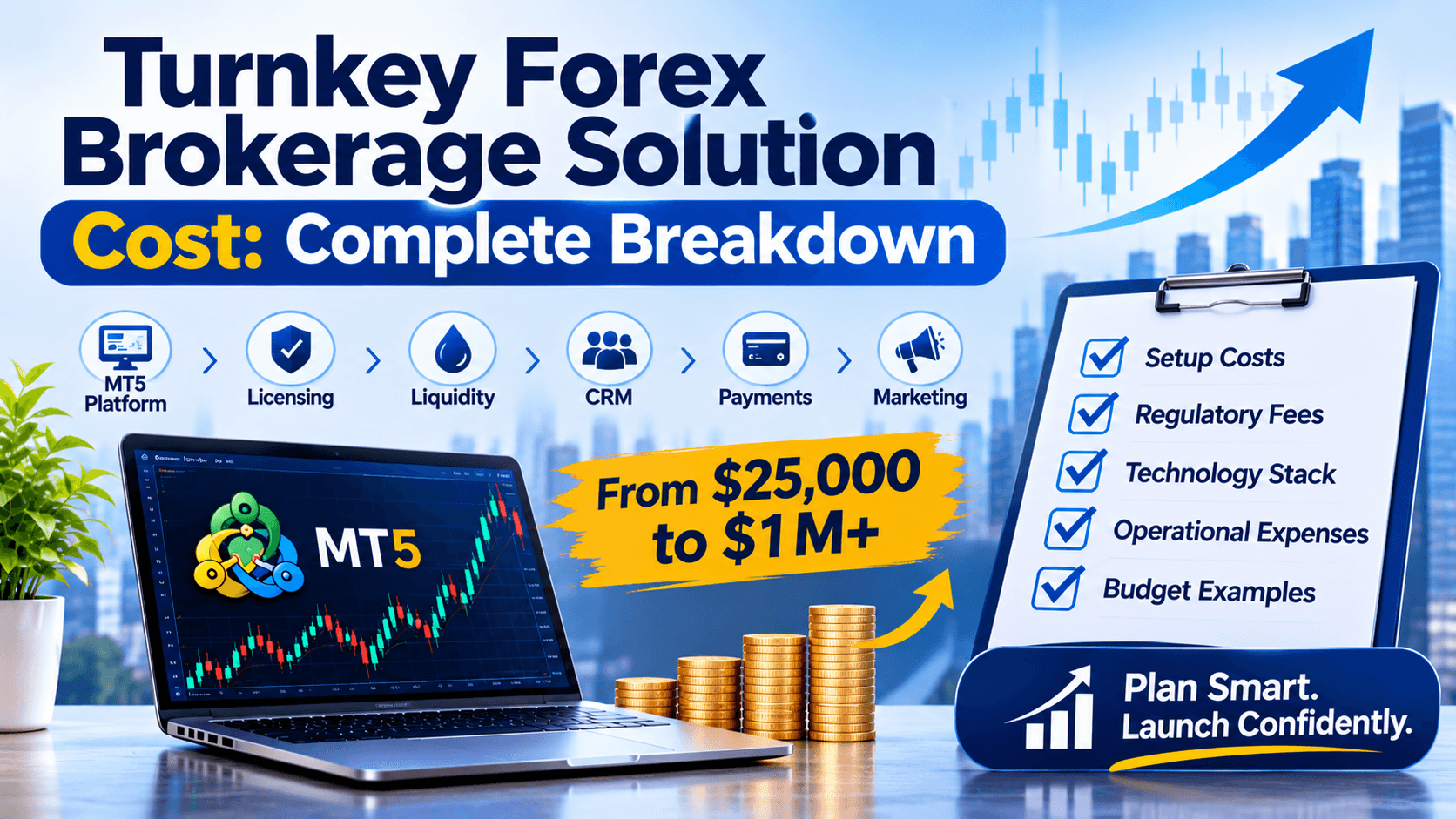
Search for what a turnkey forex brokerage costs and you'll find answers from about $25,000 to more than $1 million. They aren't all wrong. They're measuring different things.
One number covers a company, a platform, and basic policies. Another also includes liquidity deposits and regulatory capital. A third adds staff and a year of operating costs. Without knowing the scope behind a figure, you can't compare it with a quote, and that's how founders end up with a budget that's half what they need.
This guide untangles the numbers: what a turnkey package usually includes, what each cost line looks like, and how to compare quotes properly. For the full included-and-excluded list and the questions to ask providers, see our full-stack guide. This is the money view. Most published figures come from providers and consultancies, so treat all ranges as planning estimates and get itemized quotes. It's general information, not financial advice.
Why the Numbers Disagree
Headline figure you'll see | What it usually covers | What it usually leaves out |
About $25,000 "all-in" starter | Company registration, a licence-type fee, MT5 white-label setup, basic AML documents | Operating capital, liquidity deposits, ongoing banking, staff |
50,000–150,000 first year (offshore) | Licence fees, technology setup, and early operations | Regulatory capital, some staff, and heavier marketing |
200,000–500,000 first year | The above plus liquidity deposits and a fuller team | Often still excludes regulatory capital for regulated routes |
350,000–800,000 plus capital (CySEC-style) | A regulated licence, a dedicated bridge, multiple payment providers, compliance and risk staff, and acquisition spend | Capital held for your regulator |
500,000–1 million+ (Tier-1, custom platform) | A custom-built stack and a full operating team | Little; this is near full scope |
The pattern: small numbers exclude the expensive parts. Always ask what's outside the figure.
What a Turnkey Package Usually Includes
A compact view. For the complete list
Usually included | Often excluded or variable |
White-label MT5 platform | The licence itself, and regulator capital and fees |
Liquidity bridge and a first provider | Negotiated liquidity pricing, and a second provider |
CRM and client portal | Custom onboarding flows and data export rights |
One or two payment integrations | Banking and EMI accounts, and payment reserves |
Website template and hosting | Marketing, compliance staff, and audit |
The Cost Stack, Line by Line
Ranges below come from published provider guides, and they vary a lot between sources. They show the shape of the cost, not a quote.
Line | One-time | Recurring | Notes |
Company and licence route | Offshore government fees in the low thousands to about $15,000, and advisory support on top. Mid-tier regulators commonly $100,000+ including advice. | Annual renewal and compliance | Regulatory capital is separate and held, not spent. See our jurisdiction guides below. |
MT5 white label | Roughly 5,000–25,000 | Roughly 1,000–10,000 a month depending on provider and scope | See our MT5 cost guide |
Own MT5 server licence | Higher, with MetaQuotes fees and infrastructure | MetaQuotes fees plus hosting and staff | A scaling decision, not a starting one. See our MT5 server guide. |
Hosting and infrastructure | Setup varies | Roughly 1,000–7,500 a month depending on architecture and who hosts | Cheaper if bundled in a white label |
Bridge and liquidity | Often bundled | Bridge fees of roughly 500–4,000 a month, plus volume-linked costs | A liquidity deposit or collateral may be held, from about $50,000 with some retail providers to 100,000–500,000 with prime-of-prime providers |
CRM and back office | Roughly 1,000–15,000 | Roughly 500–3,500 a month for SaaS, far more for enterprise IB-heavy platforms | See our CRM feature checklist |
Payments | Roughly 2,000–15,000 plus underwriting | Processing fees plus reserves | One guide puts effective cost at 0.5–2% of volume, and another up to 3–8% once reserves and conversion are included |
KYC and AML tooling | Integration work | Roughly 0.50–3 per verification, plus screening and monitoring | See our KYC automation guide |
Compliance, audit, legal | Policies and application work | Roughly 1,500–4,000 a month for a small offshore operation, and much more for a regulated one | Often the largest long-term line |
Staff and support | Recruitment | A lean team can run roughly 10,000–35,000 a month | Founder pay is often deferred |
Marketing and partners | Roughly 5,000–50,000 to start | Variable, and partner payouts scale with clients | See our digital marketing guide |
Regulatory capital deserves its own mention: It's held for your regulator, not spent, and it can be the largest single number. Examples from our guides: Seychelles requires $100,000, CySEC requires €75,000, €150,000, or €750,000 depending on your services, and BVI and Cayman are assessed case by case.
Three Illustrative Budget Profiles
These are composites built from published ranges, not quotes. Your numbers will differ.
Lean offshore | Mid-tier regulated | Tier-1 regulated | |
Typical route | Offshore registration or lighter licence, MT5 white label | Seychelles, BVI, or Mauritius-type licence, fuller stack | CySEC-style licence, dedicated bridge and platform |
First-year spend, excluding regulatory capital | About 50,000–150,000 | About 150,000–450,000 | About 350,000–800,000, and up to $1 million+ for a custom build |
Regulatory capital | None or minimal | Jurisdiction-specific, held | Jurisdiction-specific, held, and significant |
Liquidity deposit | May apply | May apply | Usually applies |
Team | Founder-led | Compliance, risk, operations | Full regulated team |
What pushes you to the top | Heavier marketing, more staff | Multiple payment providers, a bigger compliance team | Custom technology, more staff, longer licensing |
Where package prices fit: Setup packages, including the ones we list on our site, are one line in this stack, covering company and licence-route work and related setup. They aren't first-year totals, and a low setup price doesn't mean a low launch budget.
Where Quotes Quietly Grow
Our MT5 cost guide found real costs often run 20–60% above a headline quote. Common reasons:
- Volume-based fees that look small at 50 test accounts and large at 500 live ones
- Payment reserves and holdbacks, which tie up cash
- Custom integration work. Connecting a CRM to MT5 through the server API can cost thousands on top of a "standard" package.
- Resubmission and add-on fees for KYC, screening, and monitoring
- Currency conversion on payments and settlements
- Exit and data-export fees when you change provider
- A second liquidity or payment provider that the base price assumes you won't need
Ask for the price at two to three times your expected volume, not just at launch.
How to Compare Two Quotes
Put every quote into the same grid before you compare totals.
Line | Quote A | Quote B |
What "licence" means (assistance, application, or something else) | ||
One-time setup, itemized | ||
Monthly platform fee, with volume tiers | ||
Liquidity and bridge fees | ||
Number of payment integrations and reserve terms | ||
CRM fees, and cost of custom integration | ||
KYC and screening cost per check | ||
Compliance and support included | ||
Whose name the contracts are in | ||
Data export and exit terms | ||
Price at 3× volume |
A quote with blank cells hasn't told you its price yet.
The Cash-Flow View
Revenue starts only when funded clients trade. Costs start before. A useful way to plan:
Phase | What you spend on |
Pre-launch (months 0–3) | Setup, licence work, capital, deposits, integration, and legal |
Early operation (months 4–12) | Platform and liquidity fees, compliance, staff, payment costs, and marketing |
Break-even period | Whatever remains until client revenue covers the running costs |
Model 12 to 18 months of operating costs before meaningful revenue, and add a contingency, since licensing and banking delays are common and every month of delay costs money. As a planning rule, we suggest 15–25%. For investor-facing budgets.
Where to Save, and Where Not To
Reasonable places to save:
- Start with a white label, not your own server licence or a custom platform
- Choose a modular CRM you can grow into
- Defer custom features until you have clients
- Phase marketing spend against compliance readiness
Places not to save:
- Compliance staffing and AML controls
- KYC and transaction monitoring
- Risk management and exposure limits
- Testing and failover
- Banking and payment redundancy
- Legal documents and risk disclosures
Cutting these doesn't remove the cost. It moves it to a time when it's larger.
What Pushed Costs Up in 2026
- Capital requirements have risen in some jurisdictions: Seychelles doubled its minimum from $50,000 to $100,000.
- Card-network monitoring is tighter: Visa's merchant dispute threshold was reported to fall to 1.5% on 1 April 2026, which affects provider tolerance and reserves.
- Compliance obligations are growing: EU firms face DORA, and the EU AML Regulation applies from 10 July 2027.
- Resilience and vendor oversight: now feature in diligence and regulation.
- Search and ad costs are shifting: so budget acquisition conservatively.
Common Mistakes
- Comparing headline numbers without checking scope
- Forgetting regulatory capital and liquidity deposits
- Budgeting setup but not 12 months of running costs
- Ignoring volume-linked fees and payment reserves
- Treating a licence "assistance" fee as the licence
- Skipping contingency
- Cutting compliance, testing, or redundancy to hit a number
- Choosing the cheapest quote without comparing the grid above
Related Reading
- Full 360° Forex Solution: Registration + MT5 + CRM + Payments + Marketing Explained
- MT5 White Label Setup Cost: A Realistic Breakdown
- How to Launch a Forex Brokerage in 30 Days: Full Checklist
- Offshore vs Regulated Forex License — Which Fits Your Budget?
About FX Launch Pad
We'd rather you see the full cost picture before you commit than discover it after. When a founder asks us for a price, we start by asking which of the lines above sit inside the quote and which sit outside it, because that's what decides whether the number is useful. Our setup packages are one part of that stack, and we're happy to go through the rest with you.
If you'd like an itemized cost view for your jurisdiction, model, and markets, book a free consultation and we'll go through it with you.
Frequently Asked Questions
Q-1 How much does a turnkey forex brokerage cost?
Ans- Published figures range from about $25,000 for a minimal starter to over $1 million for a Tier-1 custom build, because they cover different scopes. Offshore white-label launches are often quoted at 50,000–150,000 in the first year, and regulated ones at several hundred thousand dollars, excluding or including regulatory capital depending on the source.
Q-2 What's usually included in a turnkey package?
Ans- Typically a white-label MT5 platform, a liquidity bridge and first provider, a CRM and client portal, one or two payment integrations, and a website. The licence itself, regulatory capital, banking, compliance staff, and marketing are often excluded.
Q-3 What are the ongoing monthly costs?
Ans- Platform fees, bridge and liquidity costs, CRM, payment processing and reserves, KYC, compliance and audit, hosting, and staff. Published ranges put platform fees alone at roughly 1,000–10,000 a month, with a lean team adding far more.
Q-4 Why do turnkey quotes differ so much?
Ans- Scope, volume tiers, reserves, integration work, and what "licence" means. Compare quotes in the same itemized grid, and ask for pricing at higher volume.
Q-5 How much cash should I plan for?
Ans- Enough for 12 to 18 months of running costs before meaningful revenue, plus regulatory capital and any liquidity deposit, plus a contingency for delays. The right figure depends on your jurisdiction and model.