Manual KYC doesn't scale. When a new broker has fifty clients a month, an analyst reviewing passports by hand is fine. At five hundred, onboarding queues grow, clients drop out waiting, and reviewers start missing things.
KYC automation tools fix the speed problem, but they bring new questions. Which tool? What does it actually automate? What do regulators expect you to keep doing yourself? And how does it connect to your CRM and trading accounts?
This guide covers what these tools do, what to look for, and how to avoid the common mistakes. It's general information, not legal advice. For what KYC and AML require.
see our compliance checklist.
What "KYC Automation" Actually Includes
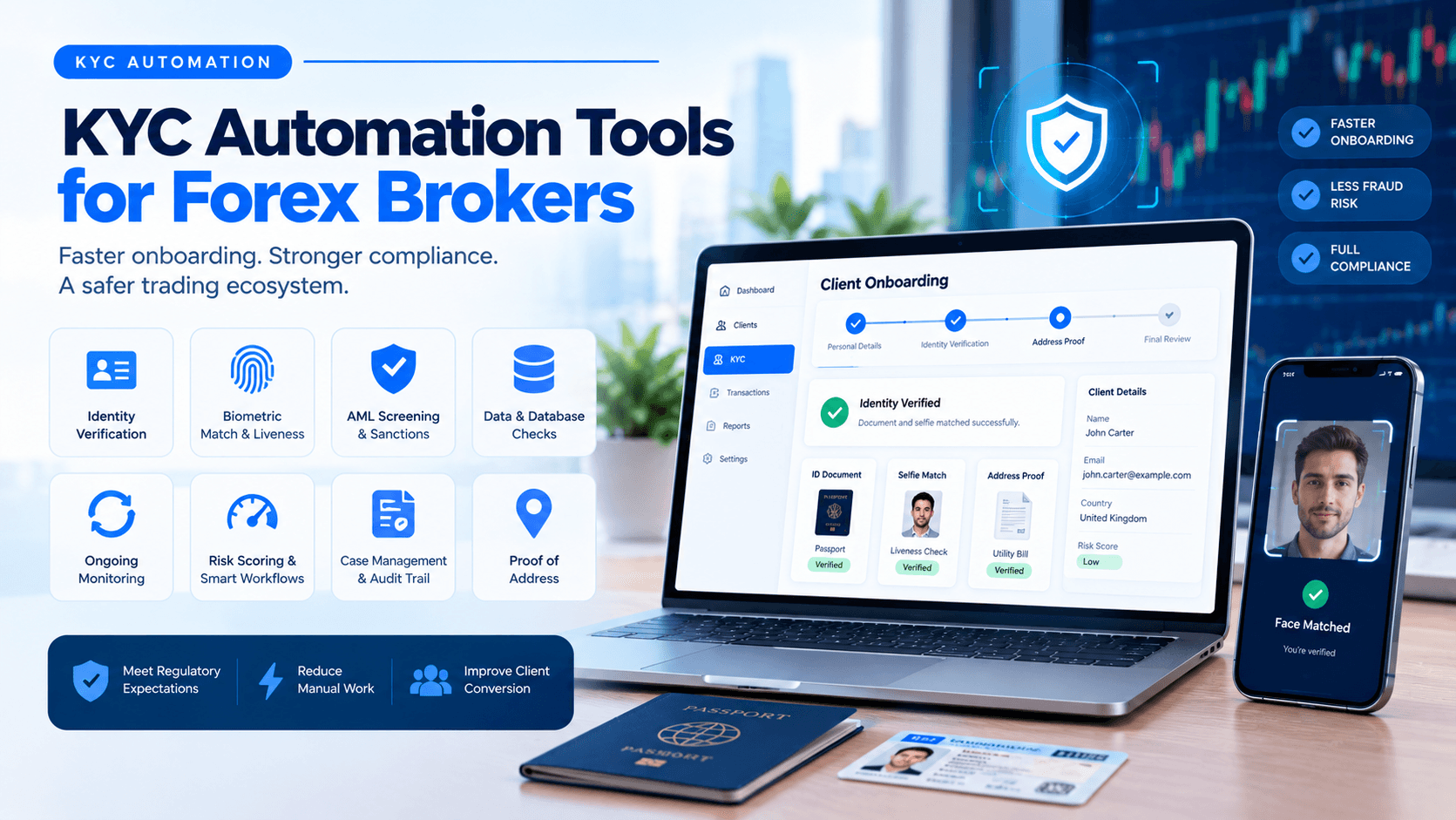
Most providers bundle several layers. Know which ones you're buying.
Layer | What it does | Why it matters for a broker |
Document verification | Reads the ID, checks security features and data consistency | Catches forged and tampered documents |
Biometric match and liveness | Compares a selfie to the ID photo and checks the person is real and present | Stops impersonation and stolen identities |
Data and database checks | Cross-checks against official or trusted data sources where available | Adds assurance beyond the document |
AML screening | Checks sanctions lists, politically exposed persons (PEPs), and adverse media | Required in most regulated frameworks |
Ongoing monitoring | Re-screens existing clients as lists and risk change | Onboarding is a snapshot. Risk isn't. |
Risk scoring and workflow | Routes low-risk clients through automatically and high-risk clients to enhanced review | Keeps analysts on the cases that matter |
Case management | Gives reviewers a queue, notes, and decisions | Produces the audit trail |
Proof of address | Verifies address documents | Required by many regulators |
Notice what's not fully automatable: source of funds and source of wealth assessments, complex corporate clients, and judgment on high-risk cases. Good tools route these to a human reviewer instead of pretending to solve them.
What Regulators Expect From Automated KYC
Automation changes how checks are done, not who is responsible for them. A few anchors:
- FATF's digital identity guidance: accepts that reliable digital ID systems can be used for customer due diligence, provided appropriate risk mitigation is in place. Ongoing due diligence still applies.
- In the EU, the AML Regulation applies from 10 July 2027: On 1 October 2026, the EU's Anti-Money Laundering Authority (AMLA) sent its final draft technical standards on customer due diligence to the European Commission. As reported, they treat identity documents and eIDAS electronic identification as the default routes, with other remote verification tools remaining lawful as a fallback that a firm must be able to justify. Every identification data point is expected to be verified.
- EU Digital Identity Wallets are arriving: Member states are required to offer at least one wallet by the end of 2026, so wallet-based verification is becoming part of onboarding.
- Outside the EU: requirements depend on your regulator and the markets you serve. Offshore frameworks can be lighter on paper, but banks, payment providers, and liquidity partners will ask what your onboarding controls are.
You remain responsible for the outcome. "The vendor approved it" isn't a defense if the decision was wrong. The AML rules above apply if you're an EU-regulated firm or serve clients through an EU entity. Confirm what applies to you.
The Threats Your Tool Has to Handle
Fraud against onboarding has changed. Two attack types matter:
- Presentation attacks: someone holds a printout, mask, or screen showing a deepfake in front of the camera.
- Injection attacks: the attacker bypasses the camera entirely and feeds forged images or synthetic faces straight into the data stream, often using a virtual camera.
Vendors report that injection attacks and deepfakes are growing quickly, though most of those figures come from vendors themselves, so treat the specific numbers with caution. The direction is clear. The EU's draft standards don't yet name injection-attack detection as a requirement, but being able to demonstrate it is where compliance is heading.
For a broker, add two patterns: multi-accounting and bonus abuse, and mule accounts used to move funds. Ask whether the tool detects duplicate faces and devices across your client base.
Example Providers
Many established vendors serve brokers and fintechs. This table summarizes how they're commonly positioned. It is not a ranking.
Provider | Commonly positioned for | Things to check |
Sumsub | All-in-one KYC, business verification, and AML, with published per-check pricing | Which tier includes AML screening and monitoring |
Veriff | Fast self-serve start and conversion focus | How AML screening is provided, since it's often an add-on or integration |
Jumio | Enterprise-grade verification with continuous monitoring | Contract size and minimums |
Onfido (Entrust) | Developer-friendly API integration | Enterprise contracts and annual commitments |
Ondato | EU-focused compliance | Fit with your target markets |
Two cautions. First, most "best KYC software" comparisons are published by vendors or affiliates, and figures like "98% automation" or "91% pass rates" are self-reported. Second, published prices vary widely by source and change often. Entry prices are commonly quoted from under $1 to a few dollars per verification, with enterprise vendors quoting separately. Treat all of it as indicative, and get written quotes for your volume.
How to Choose: A Practical Checklist
Coverage and accuracy
- Document types and countries that match your target markets
- Liveness (active and passive) and demonstrated injection-attack defense
- Genuine-client pass rate and false-rejection rate on your own traffic, not only the vendor's benchmark
Compliance fit
- AML screening, ongoing monitoring, and re-screening, either built in or integrated
- A configurable risk-based workflow
- A complete audit trail and manual review queue
- Support for restricted-country blocking
Integration
- Documented API, SDK, and webhooks
- Ability to connect to your CRM and trading account creation
- Mobile-friendly capture, since most clients verify on a phone
Data and privacy
- Where data is stored and processed, and whether you can choose
- Handling of biometric data, which is sensitive personal data under GDPR
- Retention and deletion controls
- Ability to export your records if you leave
Commercial terms
- Pricing at two or three times your expected volume
- Minimum commitments and resubmission fees
- What AML screening, monitoring, and proof of address cost on top
- Service levels and support
Test it before you sign
Don't rely on a demo. In a sandbox, run:
- Genuine documents from your main target countries
- Poor lighting, glare, and low-quality camera captures
- Expired and mismatched documents
- A restricted-country and sanctions-list test case
- A high-risk case, to see how it routes to manual review
Connect It to Your CRM and Trading Accounts
KYC automation only helps if the result drives what happens next. A sound flow looks like this:
- Client registers
- Verification starts in the tool
- The tool sends the result to your CRM through a webhook
- The CRM updates the KYC status on the client record
- Low-risk approved clients proceed. High-risk cases go to a reviewer.
- Approved status unlocks trading account creation and funding, as your compliance rules allow
- Ongoing monitoring flags changes back to the CRM
Apply the same flow to clients referred by IBs and affiliates. The broker owns the compliance responsibility either way. See our CRM feature checklist.
Common Mistakes
- Treating the vendor as the compliance function: The tool assists. Your policy and your officer decide.
- Verification and CRM that don't talk: Statuses drift apart, and reconciling them becomes a manual job.
- No manual review path: Automation can't handle every case, and clients rejected wrongly leave.
- Ignoring ongoing monitoring: Onboarding is only the start.
- Choosing on per-check price alone: Resubmission fees, add-ons, and minimums change the real cost.
- Skipping the privacy review: Biometric data needs a lawful basis, limited retention, and secure handling.
What's New in 2026
- EU AML rules are taking shape: AMLA's final draft standards went to the Commission on 1 October 2026, ahead of the 10 July 2027 start.
- eID and EU Digital Identity Wallets: are moving toward the default route for remote onboarding in the EU.
- Injection-attack and deepfake defense: has become a standard question when evaluating vendors.
- KYC and AML are converging: with more providers bundling identity, screening, and monitoring.
- Continuous monitoring: is replacing the one-time check as the expected standard.
Quick Checklist
- [ ] Target markets and regulatory requirements confirmed
- [ ] Vendor tested in a sandbox with your real scenarios
- [ ] AML screening and ongoing monitoring covered
- [ ] Manual review queue and audit trail in place
- [ ] Webhooks connected to your CRM and account creation
- [ ] Same flow applied to IB-referred clients
- [ ] Data location, biometric handling, and retention reviewed
- [ ] Pricing modeled at higher volume
Related Reading
- Forex Broker Compliance Checklist – KYC, AML, and Data Security
- Key Features Every Forex CRM Should Have Before You Choose One
- Forex Broker Website Design: Best Practices for Conversions
- 2026 Regulatory Trends Every New Forex Broker Should Know
About FX Launch Pad
The question we ask first about KYC tools isn't "which vendor?" but "what happens after the result comes back?" A verification tool is only useful if its decisions reach the CRM, control account creation and funding, and leave an audit trail. We set up and test the whole flow together, including the cases that go to manual review, before any client goes through it.
If you're choosing a KYC provider and want help testing it against your markets and workflow, book a free consultation and we'll go through it with you.
Frequently Asked Questions
Q-1 What are KYC automation tools?
Ans- Software that automates parts of client onboarding: document verification, selfie and liveness checks, AML screening against sanctions and PEP lists, risk scoring, and ongoing monitoring, with a queue for cases that need human review.
Q-2 Can KYC be fully automated for a forex broker?
Ans- Largely for low-risk individual clients, but not entirely. Source of funds and wealth reviews, complex corporate clients, and high-risk cases still need human judgment, and you remain responsible for the outcome.
Q-3 How much do KYC automation tools cost?
Ans- Published entry prices are commonly quoted from under $1 to a few dollars per verification, but real cost depends on volume, AML screening, monitoring, proof of address, resubmission fees, and minimum commitments. Get written quotes for your volume.
Q-4 Does automated KYC protect against deepfakes?
Better tools include liveness detection and defenses against injection attacks, where forged images bypass the camera. Ask each vendor to demonstrate these, and test them in a sandbox.
Q-5 Does my offshore broker need to follow the EU's new AML rules?
Ans- The EU AML Regulation, applying from 10 July 2027, applies to EU obliged entities. It matters if you're regulated in the EU or serve EU clients through an EU entity. Banks and partners also often use these standards as a benchmark, so confirm what applies to you.