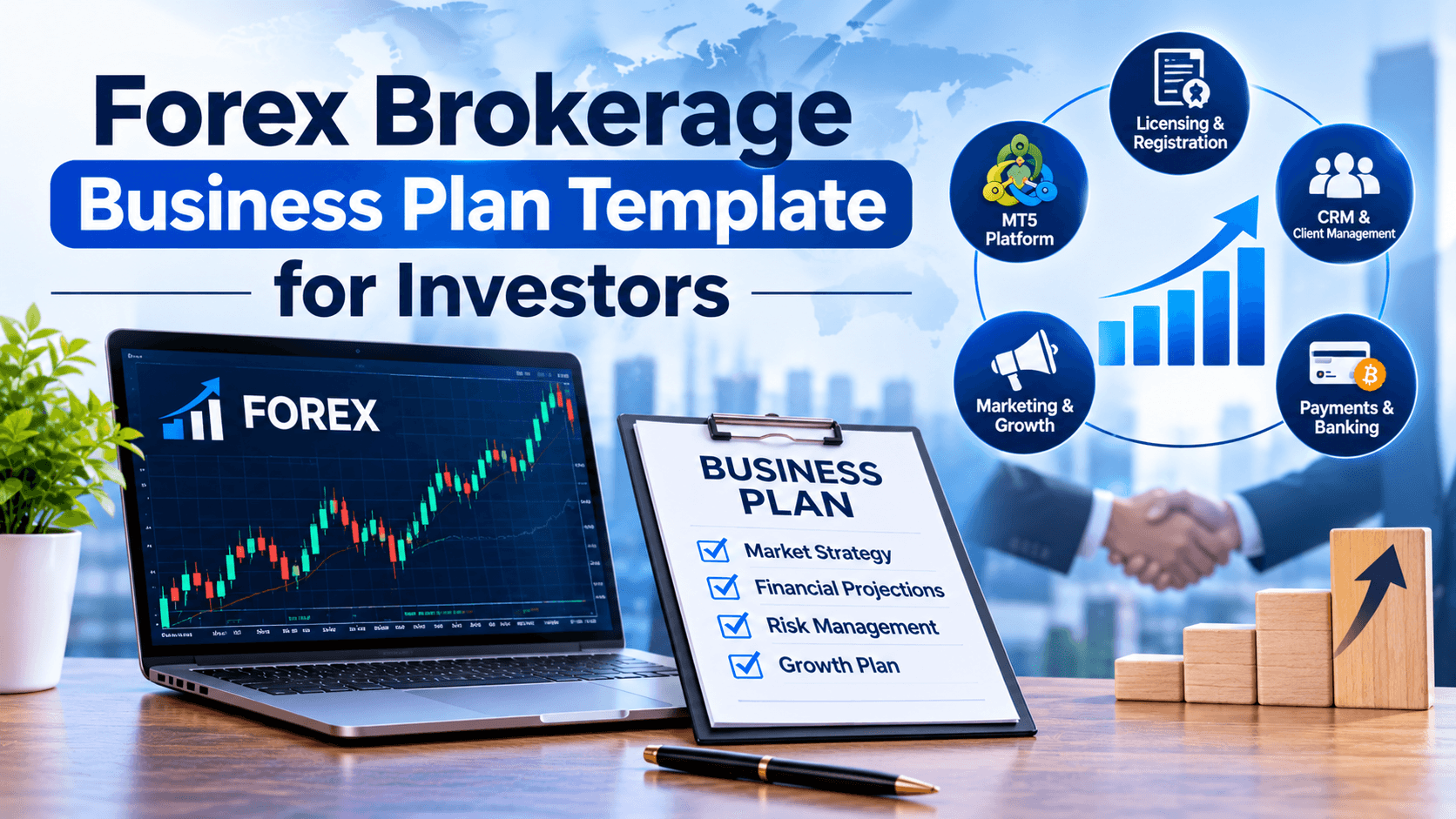
A business plan for a regulator and a business plan for an investor are different documents.
A regulator asks: Can this firm operate safely and compliantly? An investor asks: Can this business make money, how fast, how reliably, and what could go wrong? Our regulator-facing business plan guide covers the first. This template covers the second.
It's written as a working outline. Each section tells you what to write, what investors look for, and what evidence to attach. Use it to build your own plan. It's general information, not legal or investment advice, and raising capital has legal requirements of its own, covered near the end.
How Investors Think About a Broker
Investors tend to treat a retail forex or CFD broker as a market-infrastructure or fintech business, not a bank. The questions they return to:
- Revenue quality: how much comes from client activity, how much from financing, and how much from B-book results?
- Volatility sensitivity: what happens to revenue when markets are calm?
- Client economics: what does a funded client cost to acquire, and what do they generate?
- Regulatory durability: will the licence, the model, and the markets survive tighter rules?
One mistake sinks plans quickly: valuing the business on peak-volatility earnings as if they were permanent. Model normal and weak years, not just good ones.
The Template at a Glance
# | Section | The question it answers |
1 | Executive summary | Why should I keep reading? |
2 | Company, licence, and structure | What exactly am I investing in? |
3 | Market and clients | Who are the clients, and where can you serve them? |
4 | Business model and revenue | How does money come in? |
5 | Product and technology | Is the infrastructure real and resilient? |
6 | Go-to-market and acquisition | How do clients arrive, and at what cost? |
7 | Unit economics | Does one client make money? |
8 | Financial model | What do the next three to five years look like? |
9 | Funding request and use of funds | What will the money buy? |
10 | Team and governance | Who runs it, and who oversees it? |
11 | Risks and mitigation | What could go wrong? |
12 | Milestones and exit | How and when does the investor get a return? |
13 | Appendices | Where's the proof? |
1. Executive Summary (One Page)
Write:
- What the business does, in two sentences
- Licence status and the markets you're authorized to serve
- Business model (A-book, B-book, or hybrid)
- Traction to date
- The amount you're raising and what it achieves
- Three to five headline metrics
Investors look for: clarity and honesty. State licence status plainly, and don't hide a pending application.
2. Company, Licence, and Structure
Write:
- Legal entities, jurisdictions, and group structure
- Regulator, licence type, conditions, and status
- Ownership and the cap table
- Which regulatory approvals the investment itself requires
Regulatory point specific to brokers: an investor who acquires a meaningful holding in a licensed firm generally needs the regulator's approval as a controller. In the UK, control bands start at 10%. EU rules use qualifying-holding thresholds at 10%, 20%, 30%, and 50%. The regulator assesses the investor's fitness and the source of funds. Plan for it, and make closing conditional on approval.
See our exit strategy guide and licence transfer guide.
Attach: licence evidence, group chart, and cap table.
3. Market and Clients
Write:
- Target client segments, and the markets you can lawfully serve
- A bottom-up market view, based on funded accounts you can realistically win, not a "trillion-dollar market" headline
- Competitors, and an honest account of why you'd win
Investors look for: that every target market matches your licence. Plans that rely on markets you can't legally serve lose credibility immediately.
See our Google Ads compliance guide.
4. Business Model and Revenue
Write:
- Execution model and the logic behind it
- Revenue streams, and your estimate of each share:
Stream | What it is | Investor concern |
Spread markup | Margin added to liquidity provider prices | Competitive pressure |
Commission | Per-lot charges | Volume dependence |
Swap / financing | Overnight financing income | Rate-cycle sensitivity |
B-book P&L | Results from taking the other side of client trades | Volatile, and a conflict-of-interest issue |
Investors look for: the revenue mix and its stability. Heavy reliance on B-book results makes earnings lumpy and invites regulatory attention. Show how you manage that risk and how you'd perform in calm markets.
5. Product and Technology
Write:
- Platform, liquidity and bridge, CRM, payments, and risk tools
- What you own versus what you license or outsource
- Vendor dependencies and what happens if one fails
- Resilience, security, and your roadmap
Investors look for: whether the stack actually exists and is tested, and concentration risks, such as a single liquidity provider or payment provider.
See our full-stack setup guide, MT5 server setup guide, and scaling guide.
Attach: architecture diagram, vendor list, and test evidence.
6. Go-to-Market and Acquisition
Write:
- Channels (SEO, partners and IBs, email, social, and paid), with a cost estimate for each
- How marketing complies with each market's promotion rules
- Partner and IB structure and its cost
- Retention approach
Investors look for: realistic acquisition costs. Operator guidance often puts the cost per funded client at several hundred dollars or more in tier-1 markets, so a plan with a far lower figure needs evidence. Also look at whether growth depends on one channel that a platform can switch off.
See our SEO strategy guide, IB network guide, and email retention guide.
7. Unit Economics
This is the section investors read most closely. Use these definitions consistently:
- Revenue per active client = total operating revenue ÷ average active clients
- Gross profit per client = revenue per client minus liquidity, partner, and variable costs
- CAC payback (months) = acquisition cost per funded client ÷ monthly gross profit per client
- LTV: CAC = lifetime gross profit per client ÷ acquisition cost. A ratio of around 3:1 is a commonly quoted rule of thumb, not a standard.
Show a cohort chart: the month in which a cohort's cumulative gross profit overtakes its acquisition cost.
A hypothetical illustration (not a benchmark):
Assumption | Value |
Acquisition cost per funded client | $400 |
Monthly gross profit per active client | $50 |
Payback | 8 months |
If the average client stays active 6 months | Lifetime gross profit $300, LTV: CAC 0.75, so the business loses money on each client |
If the average client stays active 18 months | Lifetime gross profit $900, LTV: CAC 2.25 |
The lesson is that client lifetime matters as much as acquisition cost, and retail client lifetimes are short and variable. Investors will test your churn assumption harder than any other number. See our email retention guide on building retention without pressure tactics.
8. Financial Model
Include:
- Three to five years of profit and loss, cash flow, and balance sheet
- Scenarios: base case, low-volatility case, and downside case
- A clear capital stack that separates regulatory capital from working capital. Capital held to meet your regulator's requirements isn't available to fund growth.
- A cost schedule: liquidity, payment fees and reserves, partner payouts, technology, compliance staff, audit, and licence fees
- Break-even month and headcount plan
Assumptions to state explicitly: active clients by month, funded-account conversion, revenue per active client, churn, acquisition cost by channel, partner payout rate, and regulatory capital growth.
Investors look for: modest, evidence-based assumptions, and a model that survives a calm-market year.
9. Funding Request and Use of Funds
Write:
- The amount, the instrument, and indicative terms (agree with counsel)
- Runway the money provides
- A table showing how the money maps to milestones:
Use | Amount | Milestone it unlocks |
Regulatory capital | Licence granted or capital requirement met | |
Technology and integration | Platform live and tested | |
Compliance and key staff | Compliance function in place | |
Marketing and partner programme | Target funded accounts | |
Working capital and reserve | Runway to break-even |
Investors look for: a plan where the money buys specific, checkable milestones, with a buffer for the delays licensing and banking routinely cause.
10. Team and Governance
Write:
- Founders and key hires, with relevant financial-services experience
- The compliance officer and MLRO
- Board composition, advisers, and conflicts of interest
- Key-person risk and succession
Investors look for: regulatory credibility. A team without visible forex or financial-services experience is a concern for the regulator and the investor alike.
11. Risks and Mitigation
Use a risk register:
Risk | Why it matters | Mitigation |
Regulatory change | Leverage caps, bonus bans, and promotion rules can reshape the model | Strong jurisdiction, flexible product, compliance investment |
Licence conditions or delay | Revenue can't start without authorization | Realistic timeline, application readiness |
Market calm | Lower volatility reduces trading activity | Normalized earnings, diversified revenue |
Revenue concentration | Dependence on a few partners or channels | Diversification and monitoring |
Counterparty and vendor failure | Liquidity, bank, payment, or platform outage | Redundancy and tested failover |
AML and conduct risk | Penalties and reputational damage | Automated KYC, monitoring, and training |
Cyber and operational risk | Downtime and data loss | Security controls and continuity planning |
Key-person dependence | One founder holds the knowledge | Documentation and a management team |
Regulation is typically the first risk an investor assesses, not the last. Be direct about it.
12. Milestones and Exit
Write:
- A 12- to 24-month milestone roadmap tied to the funding
- KPIs you'll report to investors
- Realistic exit routes (sale, merger, or share buyback), with a note that regulator approval applies to ownership changes
13. Appendices
Attach the proof: licence documents, regulator correspondence you're allowed to share, AML and KYC framework summary, vendor contract list, full financial model, org chart, and key legal documents.
The KPI Dashboard Investors Expect
Area | Metric |
Growth | Registrations, KYC completions, funded accounts, FTD conversion |
Activity | Active clients, 30- and 90-day retention, churn |
Economics | Revenue per active client, gross profit per client, CAC and payback by channel |
Revenue mix | Share from spread, commission, swap, and B-book |
Risk | Net exposure versus limits, liquidity provider concentration |
Client money | Segregation and reconciliation status |
Operations | Time to verify, withdrawal time, support response, uptime |
Compliance | Complaints, open alerts, audit findings |
Partners | Partner concentration, payout accuracy |
Questions to Be Ready For
- Is every target market covered by your licence?
- What happens to revenue in a low-volatility year?
- How much of revenue is B-book, and how do you manage the conflict?
- What's your churn assumption, and what's it based on?
- Which channel, if switched off, hurts most?
- Whose name are the liquidity, bank, and payment agreements in?
- How much of the raise is regulatory capital you can't spend?
- What's your plan if licensing takes twice as long?
- How would the business change under a leverage cap or a bonus ban?
- Which approvals does the investment itself require?
Red Flags That End Conversations
- Valuing the business on peak-volatility earnings
- Marketing plans aimed at markets the licence doesn't cover
- Acquisition costs with no supporting data
- An opaque or unmanaged B-book conflict
- No separation between regulatory and working capital
- Projections presented as promises
- Poor records and no audit trail
- No answer on who owns the vendor contracts
Raising Capital: Rules of the Road
Soliciting investors is itself regulated. In general:
- Investor communications can be regulated: as promotions or offers, depending on the country and the investors. Take legal advice before circulating a plan.
- Don't promise returns: Label projections as estimates, with the assumptions shown.
- Expect scrutiny of the investor: Regulators and your bank may examine the source of funds and ownership, and investors may need approval as controllers.
- Know your investor's own obligations: including AML checks on them.
- Keep records: of what you provided to whom.
What's New in 2026
- Regulators and investors both emphasize operational resilience and records: EU firms face DORA, and diligence increasingly tests audit trails and vendor oversight.
- AML rules are tightening: ahead of the EU AML Regulation in 2027, which affects diligence on owners and funds.
- Consolidation continues: which rewards clean records and credible exits.
- Marketing and partner scrutiny is high: so growth plans need documented compliance.
Related Reading
- Forex Brokerage Business Plan: What Regulators Want to See
- Forex Brokerage Exit Strategy: Selling or Merging Your Business
- Full 360° Forex Solution: Registration + MT5 + CRM + Payments + Marketing Explained
About FX Launch Pad
We're a setup and infrastructure provider, not an investment adviser or fundraising agent, and nothing here is investment advice. What we can help with is the operating foundation a credible plan depends on: realistic vendor costs, licence requirements and timelines, and a stack built and tested before you promise investors a launch date. Plans fall apart when the numbers in them don't match what the licence, the vendors, and the banks actually require.
If you're preparing a plan and want to check its assumptions against real setup costs and timelines, book a free consultation and we'll go through it with you.
Frequently Asked Questions
Q-1 What should a forex brokerage business plan for investors include?
Ans- An executive summary, licence and structure, market and clients, business model and revenue mix, technology, go-to-market, unit economics, a multi-year financial model with scenarios, a funding request with use of funds, team and governance, a risk register, milestones and exit, and supporting evidence.
Q-2 How is an investor plan different from the plan I give a regulator?
Ans- A regulator's plan shows the firm can operate safely and compliantly. An investor's plan shows the business can make money reliably, with credible unit economics, scenarios, and a use of funds tied to milestones. Many sections overlap, so build them from the same facts.
Q-3 What unit economics do investors look for in a broker?
Ans- Revenue and gross profit per active client, acquisition cost by channel, payback period, churn, and LTV:CAC. A ratio of around 3:1 is a commonly quoted rule of thumb, but investors care more about whether your assumptions are evidence-based.
Q-4 Do investors need regulatory approval to invest in a licensed broker?
Ans- Often, if the stake is meaningful. Regulators generally assess anyone acquiring a qualifying or controlling holding, including their fitness and source of funds, with thresholds such as 10% in the UK and EU. Make closing conditional on approval.
Q-5 What's the biggest mistake in a broker's financial model?
Ans- Building it on peak-volatility revenue. Investors want normalized earnings and a downside scenario showing the business survives a calm-market year.