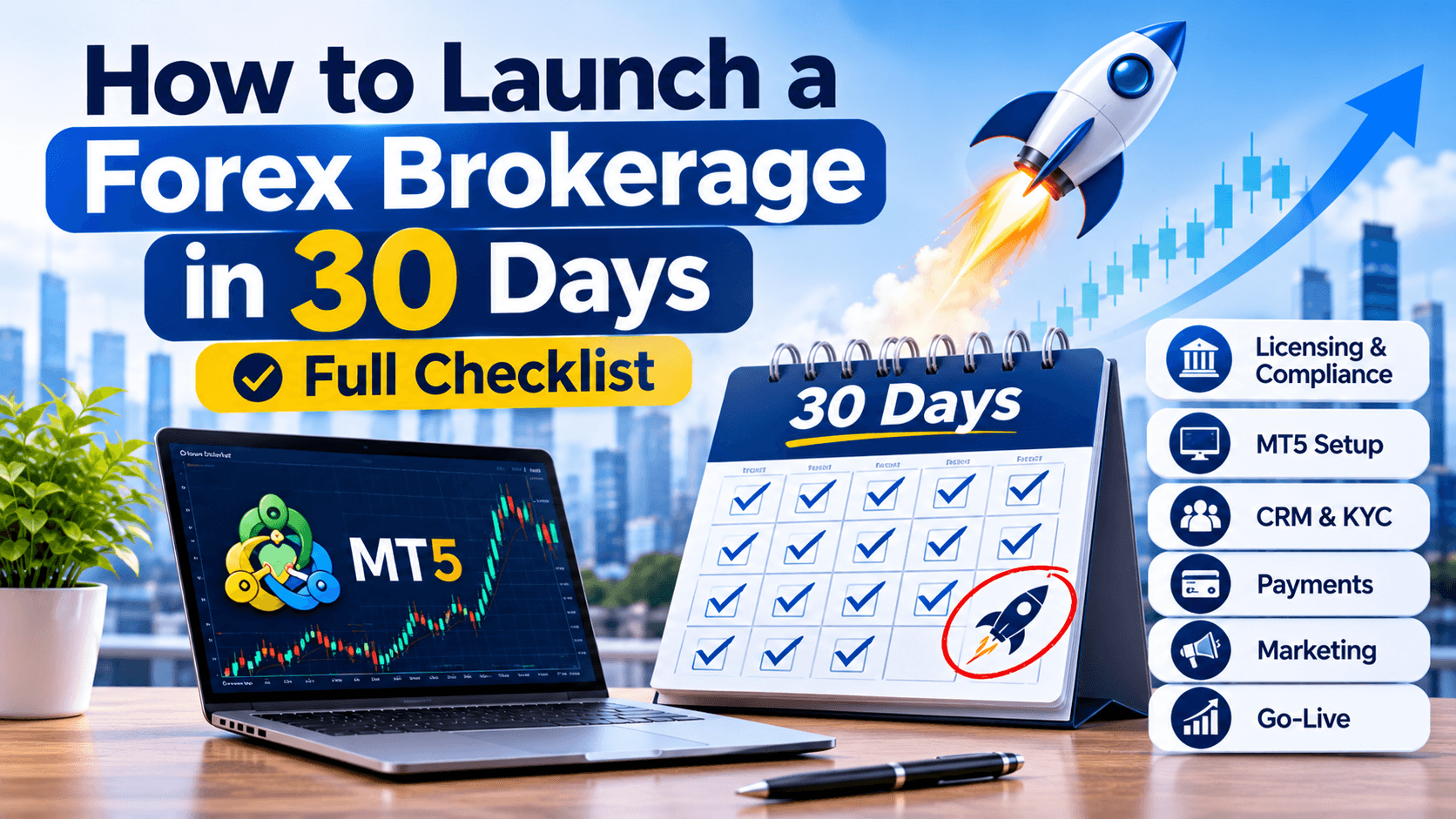
You can build a working brokerage in 30 days. You can't always open it to clients in 30 days. The difference is the most important thing to understand before you start.
A brokerage runs on two clocks. The first is yours: platform, CRM, payments integration, website, policies, and staff training. With decisions made upfront and parallel work, that clock can run in about a month. The second belongs to regulators, banks, and payment providers, and it doesn't care about your launch date.
This checklist covers the full 30-day build, the dependencies that decide whether it works, and a go-live gate you must pass before real client money moves. It's general information, not legal advice. For the realistic total timeline.
See our launch timeline guide.
What 30 Days Covers, and What It Doesn't
Within your control (about 30 days) | On someone else's clock |
MT5 platform configuration and branding | Licence approval |
Liquidity bridge connection and testing | Bank and EMI account opening |
CRM and KYC workflow setup | Payment provider underwriting |
Payment integration in test, then live-test mode | Liquidity agreement negotiation and credit approval |
Website, legal pages, and disclosures | Regulator approval of owners and directors |
Policies and procedures, drafted and reviewed | |
Staff training and support scripts | |
Marketing assets prepared and staged |
The right-hand column is where timelines slip. Start those items on Day 1, in parallel, not after the build.
External clock | Typical range |
Offshore company setup | 20–25 working days, per our own service page |
Regulated setup (standard jurisdiction) | 45–50 working days |
Mauritius setup | 90–100 working days |
Seychelles / BVI licence | Commonly 3–6 months |
Cayman licence | Commonly 3–9 months |
CySEC licence | Commonly 9–16 months |
See our guides to Seychelles, BVI, Cayman, and CySEC.
Day 0: Decisions to Make Before the Clock Starts
A 30-day build assumes you arrive with these settled. Each undecided item turns a configuration week into a decision week.
- Target markets confirmed against your licence route.
- Licence or authorization route chosen, and the application started
- Business model decided: A-book, B-book, or hybrid
- Platform path chosen: white label on a licensed provider, or your own server licence.
- Liquidity providers shortlisted, with onboarding documents ready
- Asset classes and account types defined
- Payment methods chosen for each target market
- Compliance owner named: compliance officer and MLRO
- Branding finalized: name, logo, colours
- IB or partner structure outlined, if launching with partners
The 30-Day Plan
Each week has five tracks running side by side.
Week 1 (Days 1–7): Foundations
Technology
- Sign platform and bridge providers, and confirm delivery dates in writing
- Provision the MT5 environment, and the backup arrangement
- Start liquidity provider onboarding
Compliance and legal
- Begin company formation and the licence application, in parallel
- Draft the AML/KYC policy and risk assessment
- Brief a lawyer on the trader agreement, terms, and risk disclosures
Payments and banking
- Open applications with banks, EMIs, and payment providers. Underwriting is slow, so start now.
- Collect underwriting documents: company records, ownership, licence status
Website and marketing
- Lock the site structure and brand assets
- Draft the core pages. Payment providers review your website, so have the basics live early.
People
- Confirm key staff: compliance, operations, support, and a risk owner
Week 2 (Days 8–14): Build and Configure
Technology
- Configure MT5 groups, symbols, margin and leverage rules within your regulator's limits, execution modes, and pricing
- Connect the bridge to a liquidity provider in test mode and verify the price feed
- Configure the CRM, and connect it to MT5 through the server-side API.
Compliance and legal
- Select and set up a KYC and AML screening provider, and test it in a sandbox.
- Finish first drafts of policies: complaints, conflicts, client money, and best execution
Payments and banking
- Integrate payment providers in sandbox. Credit only on verified server-to-server confirmation.
Website and marketing
- Build the registration and KYC flow, mobile-first.
- Add licence details, risk warnings, and restricted-country notices
People
- Begin training on the CRM, back office, and platform admin tools
Week 3 (Days 15–21): Integrate and Test
Technology
- Run end-to-end tests: registration, KYC, deposit, account creation, trade, withdrawal
- Test every execution mode and account group
- Set exposure limits and risk alerts
- Set up monitoring, backups, and access controls
Compliance and legal
- Complete a compliance review of every website page and marketing claim
- Finalize legal documents with counsel
- Prepare transaction monitoring rules and complaint procedures
Payments and banking
- Test duplicate webhooks, failed payments, refunds, and withdrawal approvals
- Set up daily reconciliation between the CRM, MT5, and provider reports
Website and marketing
- Prepare lifecycle emails with consent handling.
- Set up SPF, DKIM, DMARC, and one-click unsubscribe before sending anything
- Prepare partner materials with approved claims.
People
- Run support scenarios and complaint handling drills
Week 4 (Days 22–30): Prove It, Then Decide
Technology
- Load test with realistic concurrent connections
- Rehearse failover to the backup server, and restore a backup
- Review administrator access and security settings
- Check daylight-saving, rollover, and session settings
- Run a soft launch with internal and test accounts
Compliance and legal
- Publish final terms, privacy policy, risk disclosure, and complaints procedure
- Confirm what your licence and approvals actually permit
Payments and banking
- Complete low-value live tests where providers are approved
- Confirm limits, reserves, and settlement terms in writing
Website and marketing
- Stage launch content and track analytics events. Keep promotions off until the go-live gate is passed.
People
- Finalize support scripts, escalation paths, and an incident plan
Day 30: hold the go-live gate review.
The Go-Live Gate
Don't accept real client funds until every item is true. If one isn't, stay in demo or internal-testing mode.
- Authorization is in place for every market you will serve
- Bank and payment accounts are live, approved, and tested with real transactions
- Liquidity agreement is signed, in your entity's name
- KYC flow works end to end, and results control account creation and funding
- Client money safeguards are in place, with reconciliation tested
- Compliance officer and MLRO are appointed and able to act
- Legal documents and risk warnings are published and reviewed
- Monitoring, backups, and failover are tested
- Support and complaints processes are staffed
- Marketing claims are reviewed and match your licence
- Restricted countries are blocked at registration
A live platform doesn't authorize you to take deposits.
What Day 30 Can Look Like
Your situation | What Day 30 realistically means |
Licensed entity already in place, banking and payments approved | You can pass the gate and open, if every item above is true |
Licence application in progress | The platform, CRM, and website are ready. Operate in demo or internal mode until authorization arrives. |
Offshore company structure only | A non-regulated company isn't a licence. It can limit banking, advertising, and which markets you may approach, so check these before launch. |
The Critical Path
- Licence, banking, and payment underwriting: are the long poles. Start them on Day 1.
- Underwriting reviews your website: so the legal pages, licence details, and disclosures must exist by about Week 2.
- Liquidity credit approval: can take weeks. Your documents need to be ready on Day 1.
- Provider lead times for MT5: set when Week 2 can really begin. Confirm them before you commit.
- Everything else: can run in parallel with these.
2026 Checks Worth Building In
- MT5 only for new brokers: MetaQuotes stopped licensing MT4 in 2022, and current builds need 64-bit servers.
- Card-network limits are tighter: Visa's merchant dispute threshold was reported to drop to 1.5% on 1 April 2026, so plan evidence and monitoring from the start.
- Email authentication is mandatory in practice: Gmail and Yahoo enforce it for bulk senders, and so does Microsoft for Outlook.com.
- KYC rules are evolving: The EU AML Regulation applies from 10 July 2027, and its technical standards were sent to the Commission on 1 October 2026.
- DORA applies to EU firms and shapes vendor oversight and incident reporting.
- Ad platforms follow your licence: Google requires a local licence for each country you advertise in.
Common Mistakes
- Starting the build before the Day 0 decisions
- Treating "platform live" as "ready for clients"
- Starting licence, bank, and payment applications after the technical build
- Publishing a thin website that fails payment underwriting
- Skipping end-to-end testing, failover, and backup restores
- Putting liquidity or bank agreements in the provider's name
- Launching marketing before authorization
- Ignoring the go-live gate under deadline pressure
Related Reading
- How Long Does It Really Take to Launch a Forex Brokerage?
- Full 360° Forex Solution: Registration + MT5 + CRM + Payments + Marketing Explained
- MT5 Server Setup Guide for New Forex Brokers
- Top Mistakes New Forex Brokers Make When Setting Up Their Platform
About FX Launch Pad
When a founder asks for a 30-day launch, the first thing we do is separate the two clocks: what we can build in a month, and what depends on regulators and banks. We run licensing, banking, and payment applications alongside the technical build, and we're direct about which of the three Day 30 scenarios you're in.
If you'd like a checklist adapted to your jurisdiction, model, and markets, book a free consultation and we'll go through it with you.
Frequently Asked Questions
Q-1 Can I launch a forex brokerage in 30 days?
Ans- You can build the platform, CRM, payments integration, and website in about 30 days if decisions are made upfront and work runs in parallel. Opening to real clients also needs authorization, banking, and payment approvals, which run on their own timelines and often take longer.
Q-2 What's the critical path for a 30-day launch?
Ans- Licence approval, bank or EMI account opening, payment provider underwriting, and liquidity agreements. Start them on Day 1 and run them alongside the technical build.
Q-3 Can I take clients on Day 30?
Ans- Only if you pass every item in the go-live gate, including authorization for your markets, live banking and payments, KYC working end to end, and compliance staff in place. If not, operate in demo or internal mode.
Q-4 What do I need to decide before Day 1?
Ans- Your target markets, licence route, business model, platform path, liquidity providers, payment methods, compliance owner, branding, and partner structure. Undecided items turn build time into decision time.
Q-5 What does a launch cost?
Ans- It depends on your jurisdiction, platform path, and volume. See our MT5 cost guide and full-stack guide for cost categories and the setup options we offer.