Short answer: technically, in some form, yes. Should you? Almost never.
We get this question from founders trying to cut costs on their first launch. Fair question — licensing is the single biggest line item in most startup budgets. But "can I skip it" and "should I skip it" have very different answers, and the risks involved are bigger than most founders realize until they've read a real enforcement case.
Here's the honest breakdown.
What "Unlicensed" Actually Means
There's no single global forex license. What exists is a patchwork of national regulators — the CFTC/NFA in the US, the FCA in the UK, ASIC in Australia, CySEC in the EU — each with jurisdiction over their own market.
"Unlicensed" usually means one of two things:
- You have no license anywhere: a fully unregistered operation
- You have an offshore registration, but no authorization in the country where your clients live: this is the more common gray zone, and it's the one that gets founders in trouble most often
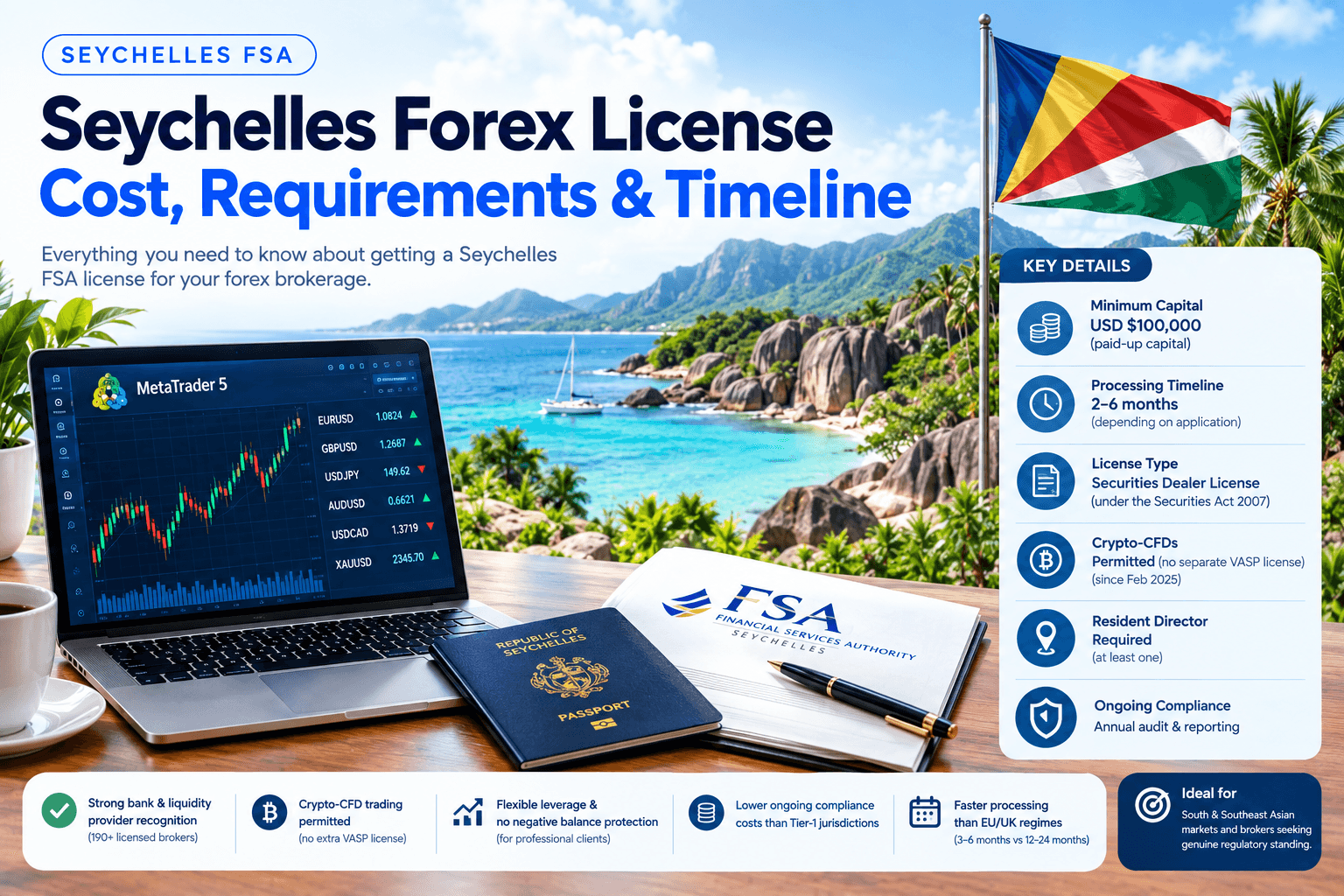
That second scenario is where a lot of confusion comes from. An SVG or Comoros company registration is real. It's just not a license to solicit clients in a regulated market.
The Regulators Are Actually Enforcing This
This isn't theoretical. Real cases from the CFTC alone:
Company | Violation | Outcome |
JAFX (claimed SVG/Bulgaria base) | Offered US retail forex, never registered as an RFED | $600,000 civil penalty |
FXOpen Investments | Solicited US clients without RFED registration | $140,000 penalty + forced to close all US accounts |
VOS Capital Management | Unregistered forex pool, misappropriated funds | Fraud charges, $1.1M+ misappropriated funds cited |
8 entities + 8 individuals (2018 sweep) | Offered forex/binary options to US retail clients, unregistered | Multiple simultaneous enforcement orders |
The pattern is consistent: regulators don't need you to be based in their country. They act against anyone soliciting their citizens, regardless of where your company is registered.
Why This Keeps Happening
Founders often assume an offshore entity puts them outside a regulator's reach. It doesn't.
Cross-border enforcement has gotten more coordinated, not less. In 2025, the CFTC, NFA, FCA, ESMA, and ASIC formalized joint enforcement announcements and intelligence-sharing on cross-border fraud. A compliance breach flagged in the EU can trigger scrutiny from a US regulator through the same information-sharing channel.
Translation: operating from a "safe" offshore base doesn't create the insulation founders assume it does especially if you're actively marketing to clients in a regulated jurisdiction.
The Risks, Broken Down
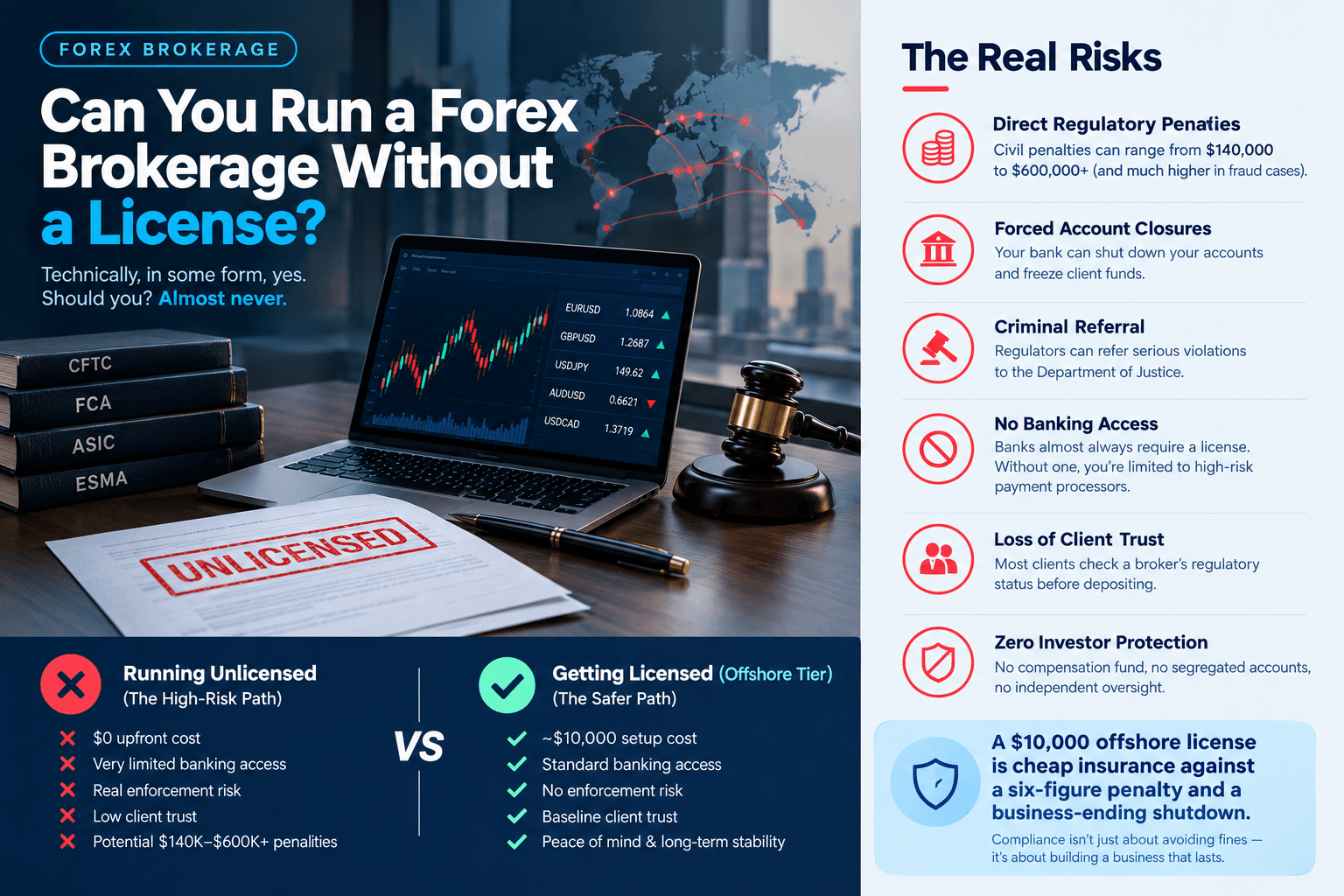
1. Direct regulatory penalties: Civil monetary penalties in real cases have ranged from $140,000 to $600,000+ for a single unregistered operator. Larger fraud cases have resulted in penalties in the hundreds of millions to billions.
2. Forced account closures: FXOpen's settlement didn't just include a fine it required closing all US customer accounts and returning funds. That's a business-ending event if US clients were a meaningful part of your book.
3. Criminal referral: The CFTC's Division of Enforcement can refer criminal violations to the Department of Justice. Civil penalties are the floor, not the ceiling.
4. No banking access: Banks require a license to open a corporate account for a forex business in almost every case. Without one, you're limited to a shrinking pool of high-risk payment processors a real operational bottleneck, not just a compliance one.
5. No client trust, no client retention: Clients checking a broker's regulatory status before depositing is increasingly standard behavior, not a niche precaution. An unlicensed operation loses these clients before a conversation even starts.
6. Zero investor protection framework No compensation fund, no segregated-account requirement, no independent oversight if something goes wrong. If a dispute arises, clients have essentially no recourse — and neither do you, if a liquidity provider or partner acts in bad faith.
"But I'm Only Targeting Emerging Markets"
This is the most common workaround founders propose, and it's worth addressing directly.
Some emerging markets genuinely have lighter regulatory frameworks for forex, and a lot of legitimate offshore brokers do operate this way successfully. The distinction that matters:
- Operating from a real offshore registration, targeting markets where that registration is sufficient → legitimate, common, and what most of our offshore clients do
- Operating with no registration at all, hoping enforcement won't reach you → the scenario every case above describes
The difference isn't subtle once you look at it this way. One is a business decision about which markets to serve. The other is a bet that regulators won't notice — and the 2025 cross-border enforcement cooperation described above is making that bet worse every year, not better.
The Real Cost Comparison
Founders skip licensing to save money upfront. Here's the actual math:
Skip Licensing | Get Licensed (Offshore tier) | |
Upfront cost | $0 | ~$10,000 |
Banking access | Very limited | Standard |
Enforcement risk | Real — see cases above | None |
Client trust | Low | Baseline established |
Worst-case cost | $140,000–$600,000+ in penalties, forced closure | N/A |
A $10,000 offshore setup is cheap insurance against a six-figure penalty and a business-ending forced shutdown.
Related Reading
- Offshore vs Regulated Forex License — Which Fits Your Budget?
- St. Vincent & the Grenadines: Why It's Still Popular for Offshore Brokers
- 2026 Regulatory Trends Every New Forex Broker Should Know
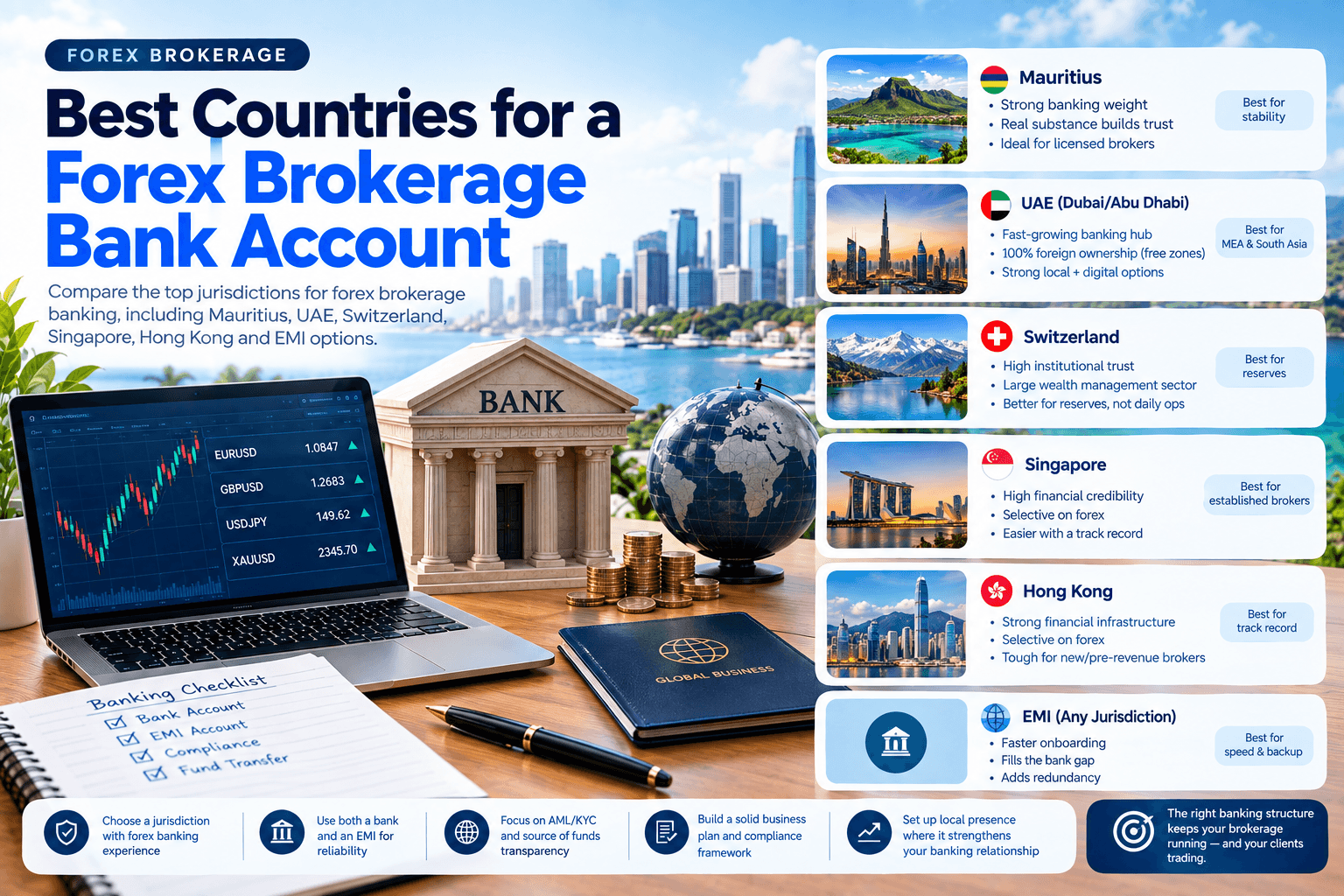
- Best Countries to Open a Bank Account for a Forex Brokerage
About FX Launch Pad
We've had founders come to us after a "quick, cheap" unlicensed launch turned into a payment processor freezing funds mid-operation, with no license to point to and no way to reassure the processor it was safe to release them. Getting licensed properly from day one even at the $10,000 offshore tier — is the cheapest insurance policy in this entire business, and it's the first thing we walk every client through before touching tech or branding.
Not sure what license level actually protects you for your target market? Book a free consultation and we'll map out the real risk, not just the sales pitch.