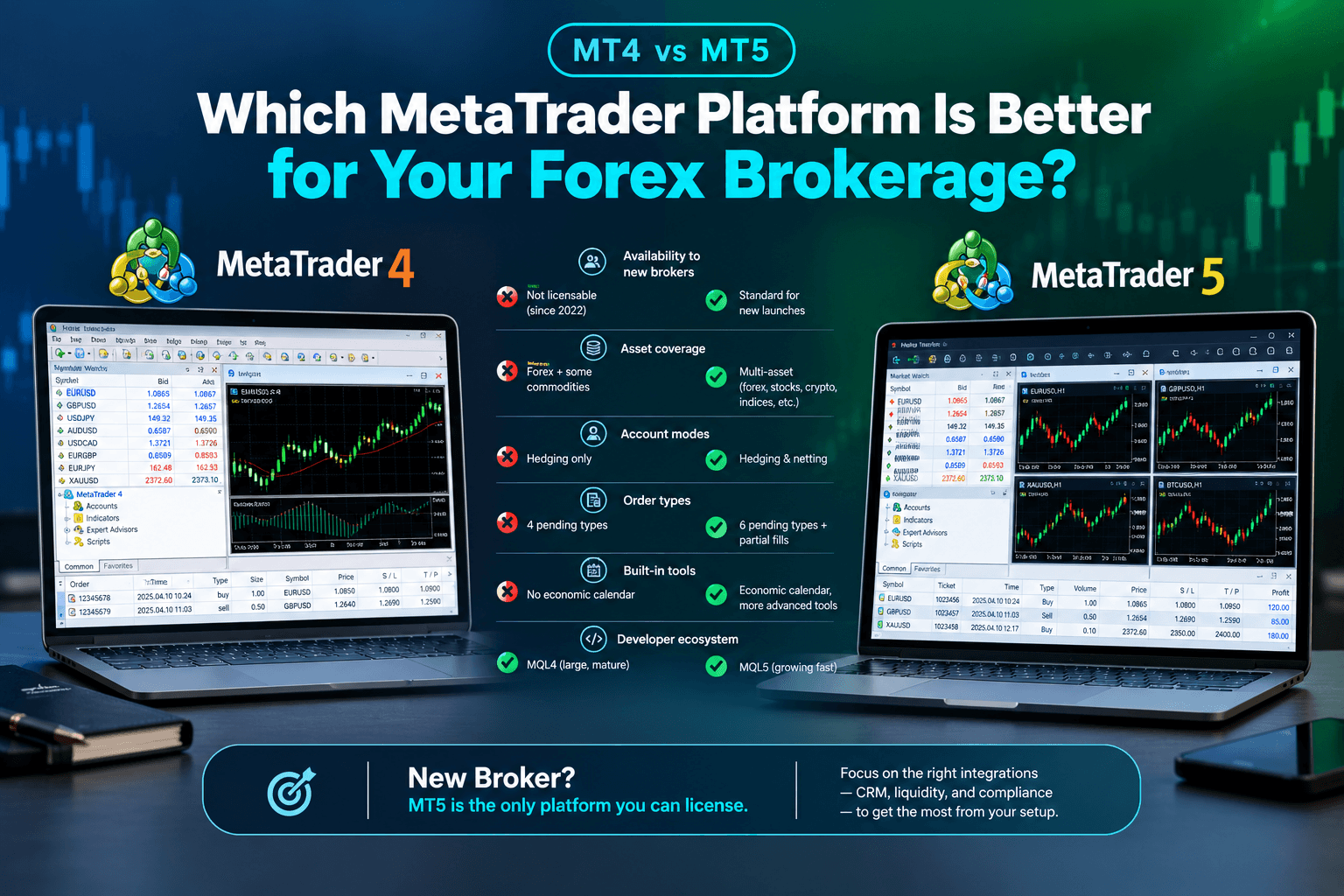
We've already written the full MT4 vs. MT5 breakdown, and the short version is this: MetaQuotes stopped issuing new MT4 licenses in 2022, so if you're launching today, half of the debate is already settled for you. If you want a deeper feature comparison, read the full MT4 vs MT5 breakdown here.
The decision that actually matters for a new startup is a different one: MT5 versus building your own proprietary platform. That's what this article is about.
The Real Question: MetaTrader or Proprietary?
Every established broker you've heard of eventually asks this question. Some — IC Markets, Pepperstone, FP Markets stick with MetaTrader as their core offering. Others — Plus500, eToro- have built proprietary platforms as their primary product, sometimes offering MetaTrader as a secondary option.
Neither path is "correct." They serve different business strategies, and the right answer depends entirely on your budget, timeline, and how much platform differentiation actually matters to your target clients.
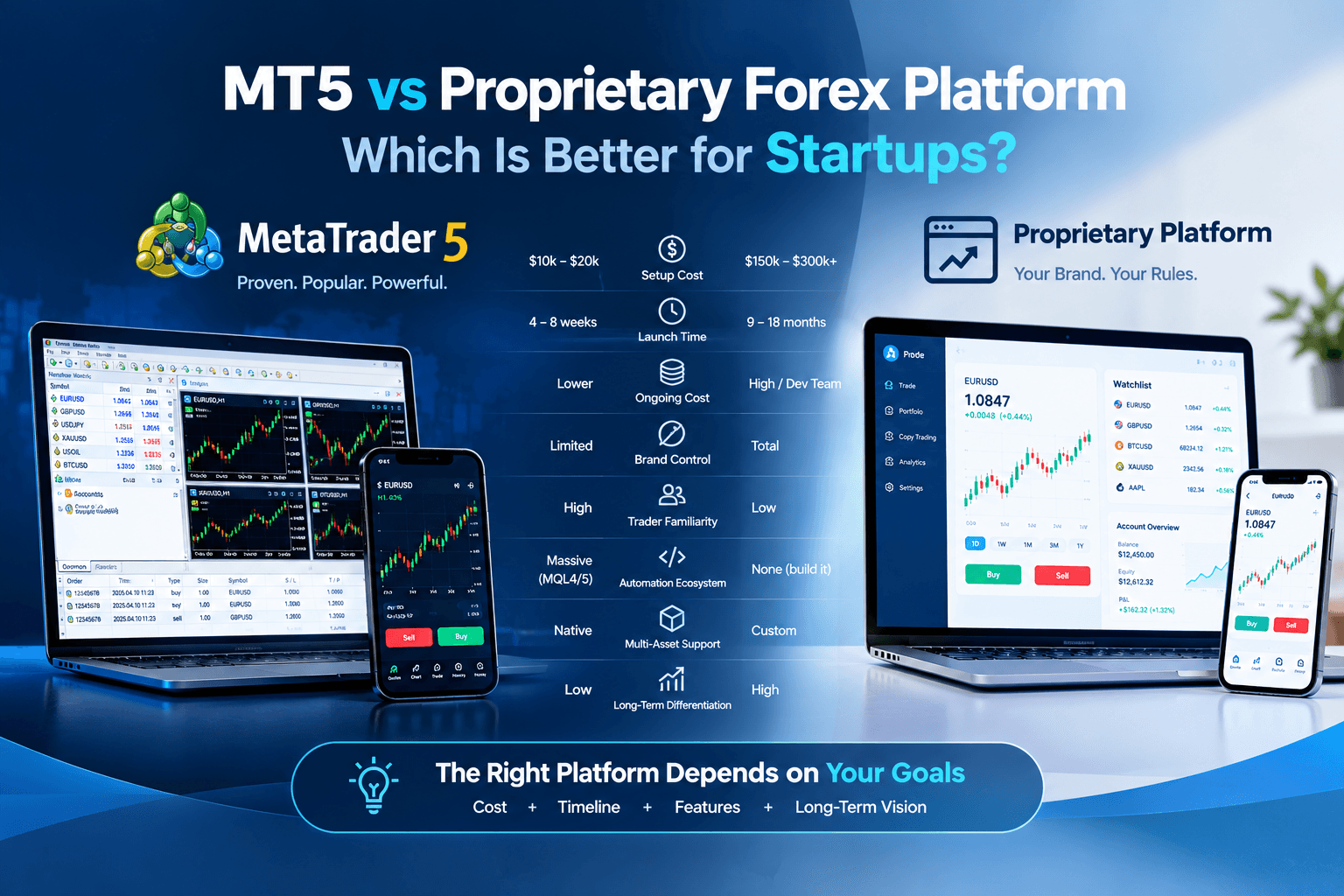
Quick Comparison
MT5 (White Label) | Proprietary Platform | |
Setup cost | 10,000–20,000 | 150,000–300,000+ |
Timeline to launch | 4–8 weeks | 9–18 months (MVP can be faster, full build longer) |
Ongoing monthly cost | 2,000–5,000 | Your own dev/infrastructure team |
Brand control | Limited — MetaTrader's UI, your branding on top | Total — every pixel is yours |
Trader familiarity | High — millions already know MT4/MT5 | Zero — you're asking clients to learn something new |
EA/automation ecosystem | Massive (MQL4/MQL5) | None, unless you build it |
Multi-asset support | Native | Whatever you build |
Long-term differentiation | Low — same platform as competitors | High — genuinely unique product |
Why Most New Startups Should Start with MT5
For a first launch, the math strongly favors MetaTrader, and it's not close.
Cost: A White Label MT5 setup runs 10,000–20,000 to launch, versus 150,000–300,000+ for even a lean proprietary build, and that proprietary figure can climb well past $2 million for institutional-grade infrastructure with proper risk engines and reconciliation systems.
Speed: MT5 gets you live in 4–8 weeks. A proprietary platform realistically takes 9–18 months for a full build, even with an efficient dev team, and that's assuming nothing goes wrong, which is optimistic for a first build.
Trader trust: Millions of traders already know MT5. Asking a new client to learn an unfamiliar interface, on top of trusting a brand-new brokerage with their money, is a real conversion barrier you don't need to add to an already difficult first year.
The automation ecosystem: MT4/MT5's MQL library, Expert Advisors, indicators, and signal services represent 20+ years of third-party development you get access to instantly. Building that from scratch isn't realistic for a startup.
The overwhelming majority of new brokers should launch on MT5, prove their business model, and only then consider whether a proprietary platform makes sense.
When Proprietary Actually Makes Sense
Proprietary isn't a mistake for the right business, at the right stage. It makes sense when:
- You've already validated demand on MetaTrader: and have real trading volume to justify the investment
- Your core differentiator is the product experience itself: think eToro's social/copy-trading interface, which couldn't exist as a MetaTrader skin
- You're targeting mobile-first, beginner traders: who want a clean web app over a downloaded terminal; proprietary platforms typically win here
- You have real capital and a technical team, not just a business plan. A $150,000+ investment with a 9-18 month timeline needs a funded runway behind it, not hope
Even in these cases, many successful brokers run proprietary as a secondary platform alongside MetaTrader, rather than replacing it entirely giving beginner-friendly clients a clean web app while keeping MT5 for traders who want the automation ecosystem.
The Hybrid Approach Most Founders Miss
You don't have to choose one exclusively. A meaningful number of established brokers Forex.com, IG Group, AvaTrade offer both: MetaTrader for traders who want it, and a proprietary web/mobile platform for everyone else.
For a startup, the realistic sequence is:
- Launch on MT5 to get to market fast and prove demand
- Build revenue and a real client base on that foundation
- Consider a proprietary layer later once you understand your actual client behavior and can justify the investment with real data, not assumptions
Starting proprietary before you've validated your business model is one of the more common ways we see founders burn through their launch budget before they've onboarded a meaningful number of clients.
What Actually Determines Success Here
The platform choice matters less than most founders assume once you get past the extremes. A well-integrated MT5 setup with proper liquidity, a functioning CRM, and a correctly configured bridge will outperform a poorly built proprietary platform every time. The infrastructure around the platform is usually the bigger differentiator than the platform brand itself.
Related Reading
- MT4 vs MT5 – Which MetaTrader Platform Is Better for Your Forex Brokerage?
- MT5 White Label Setup Cost: A Realistic Breakdown
- Launch Your Forex Brokerage in 30 Days – MT5, CRM & Website Solutions
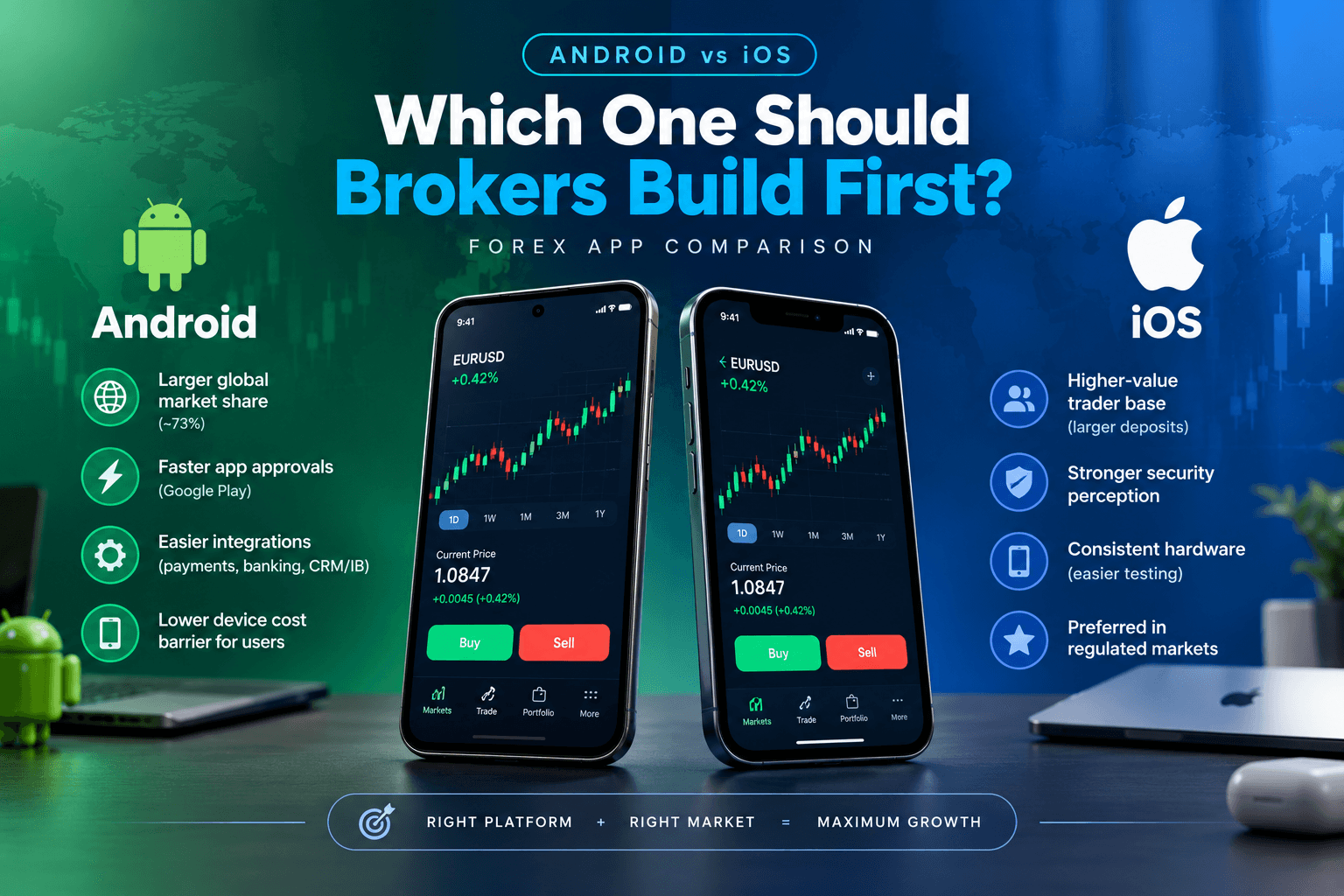
- Android vs iOS Forex App: Which One Should Brokers Build First?
About FX Launch Pad
We steer almost every first-time client toward MT5, not because it's the only option, but because we've watched founders sink their entire launch budget into a proprietary build before they had a single paying client to justify it. Because our trading technology is developed in-house, we can also help you plan a genuine hybrid path: MT5 now, a proprietary layer once your business model is proven, rather than treating it as an all-or-nothing decision on day one.
If you're weighing MT5 against a proprietary build for your specific business plan, book a free consultation, and we'll give you a realistic read on what actually makes sense at your stage.
Frequently Asked Questions
Q-1 Should a new forex broker build a proprietary platform or use MT5?
For most new startups, MT5 is the sensible choice it costs 10,000–20,000 and launches in 4–8 weeks, versus 150,000–300,000+ and 9–18 months for a proprietary build. Proprietary makes more sense once you've validated demand and have capital to invest in differentiation.
Q-2 Can I offer both MT5 and a proprietary platform?
Yes, and several established brokers do exactly this MetaTrader for traders who want automation and familiarity, and a proprietary web/mobile app for beginners who want a simpler experience. This is usually a later-stage addition, not a day-one requirement.
Q-3 Why do some big brokers still use MetaTrader instead of their own platform?
MetaTrader's automation ecosystem, trader familiarity, and multi-asset support are hard to replicate, and building proprietary infrastructure carries high ongoing cost and complexity even for large, well-funded operators.
Q-4 How much does it actually cost to build a proprietary forex platform?
Realistic estimates run $150,000 for a lean MVP up to $300,000+ for a full-featured platform, with institutional-grade infrastructure including risk engines and reconciliation systems sometimes exceeding $2 million.
Q-5 Is MT4 still an option for a proprietary-vs-MetaTrader decision?
No. MetaQuotes stopped issuing new MT4 licenses to brokers in 2022, so the real decision for a new startup is MT5 versus proprietary, not MT4 versus anything.