Here's the fact that explains almost every payment problem a new broker runs into: forex brokers get classified under merchant category code MCC 6211 — securities brokers and dealers — which sits in the same high-risk tier as gambling and adult content, regardless of how legitimate or well-licensed your operation is.
That single classification is why Stripe, PayPal, and most standard payment processors either reject forex merchants outright or bury them in restrictions. Understanding this upfront changes the entire search: you're not looking for the "best" payment gateway in some general sense. You're looking for the specific providers who've built their risk models around this classification, not around it.
Why Standard Gateways Don't Work Here
Forex generates over $7 trillion in daily global trading volume but volume isn't the issue. The issue is the transaction pattern: frequent deposits and withdrawals, cross-border clients from dozens of jurisdictions, high chargeback exposure when clients dispute trading losses, and heavy AML scrutiny.
Standard processors are built around predictable, low-dispute transaction patterns. Forex is close to the opposite of that. This is why brokers need purpose-built, high-risk payment infrastructure not a workaround, but a genuinely different category of provider.
The Payment Method Categories Every Global Broker Needs
Global clients don't all want the same payment method. Coverage across categories, not depth in just one, is what actually drives deposit conversion.
Cards (Visa/Mastercard): Still the default expectation for most retail clients, but requires a genuine high-risk forex merchant account; a standard card processing account will get shut down or frozen the moment forex activity is detected.
E-wallets (Skrill, Neteller): Widely accepted by regulated brokers, offering instant transfers, multi-currency support, and meaningfully lower chargeback risk than cards. A strong secondary option, especially for experienced trader demographics already comfortable with these wallets.
Crypto (USDT and similar stablecoins): Growing fast, particularly in markets with banking access restrictions. Crypto deposits settle instantly, involve no chargebacks, and bypass card network restrictions entirely but require integrating a dedicated crypto payment processor rather than treating it as a card-gateway add-on.
Local/regional methods (PIX, SPEI, UPI, and similar): This is the category most global gateway strategies get wrong by treating it as optional. It isn't.
The Region You Can't Ignore: Local Payment Rails
If you're serious about global clients, the data on this is specific and worth taking seriously: brokers offering the right local payment methods in the right markets see a 20–30% lift in deposit conversion. That's not a marginal optimization; it's often the difference between a client completing a deposit and abandoning it.
Brazil is the clearest example. PIX has become the default expectation for Brazilian clients: instant credit on deposits and equally fast payouts on withdrawals, addressing the exact pain point traders have with multi-day bank wire withdrawals. A broker without PIX integration is genuinely disadvantaged against any competitor who has it, regardless of how strong the rest of their offering is.
Mexico expects SPEI and OXXO. India increasingly expects UPI. Southeast Asia expects PayNow, PromptPay, and similar region-specific rails. Treating these as "nice to have" rather than baseline expectations is a common reason brokers see weaker conversion in markets they're actively trying to grow.
Why One Gateway Rarely Covers Everything
Most mid-to-large brokers end up running a multi-gateway stack, not a single processor — and this is a deliberate architecture decision, not a failure to pick "the right one."
A typical structure looks like:
- A primary card gateway covering European or broader card-based deposits
- A dedicated LATAM processor with PIX, SPEI, and local method support for Brazilian and Mexican clients
- A US-focused processor with ACH support for American client funding
- A crypto payment processor for clients who prefer stablecoin deposits
Running this as one coordinated stack rather than bolting on processors reactively as client complaints come in is what separates a broker with reliable global coverage from one constantly patching gaps.
What to Actually Evaluate in a Provider
Skip the marketing claims and check these directly:
- Approval rates specifically for forex merchants: not their general high-risk approval rate
- Decline rate under 5%: a realistic benchmark for a properly matched high-risk processor
- No rolling reserves: or clearly disclosed terms if reserves apply; this affects your actual cash flow, not just your fee sheet
- PCI DSS compliance: and real fraud tooling, tokenization, and machine-learning-based fraud detection, not just a checkbox claim
- 24/7 payout capability: client withdrawal speed is a trust signal that directly affects retention
- Genuine multi-currency and local method support: for the specific markets you're targeting, not a generic "global coverage" claim
The Mistake We See Most Often
Founders frequently sign with the first high-risk processor who approves them, without checking whether that processor actually has strength in the regions they're targeting. A gateway with excellent European card coverage but no PIX support is a poor match for a broker building a Brazilian client base regardless of how good its overall reputation is.
The better approach: map your target markets first, then build your payment stack around those markets specifically, not the other way around.
About FX Launch Pad
We build a client's payment stack around their actual target markets, not a generic global template because we've watched brokers lose real conversion in markets like Brazil and India simply because their gateway strategy never accounted for local rails clients expect by default. Since our CRM and compliance framework is built in-house, payment data flows directly into KYC and reporting from day one, rather than sitting in a separate, disconnected payment dashboard your team has to manually reconcile.
If you're planning which markets to target and want a payment stack that actually matches them, book a free consultation and we'll map out what coverage you'll actually need.
Related Reading
- Best Countries to Open a Bank Account for a Forex Brokerage
- Forex CRM & Back-Office Systems: What New Brokers Underestimate
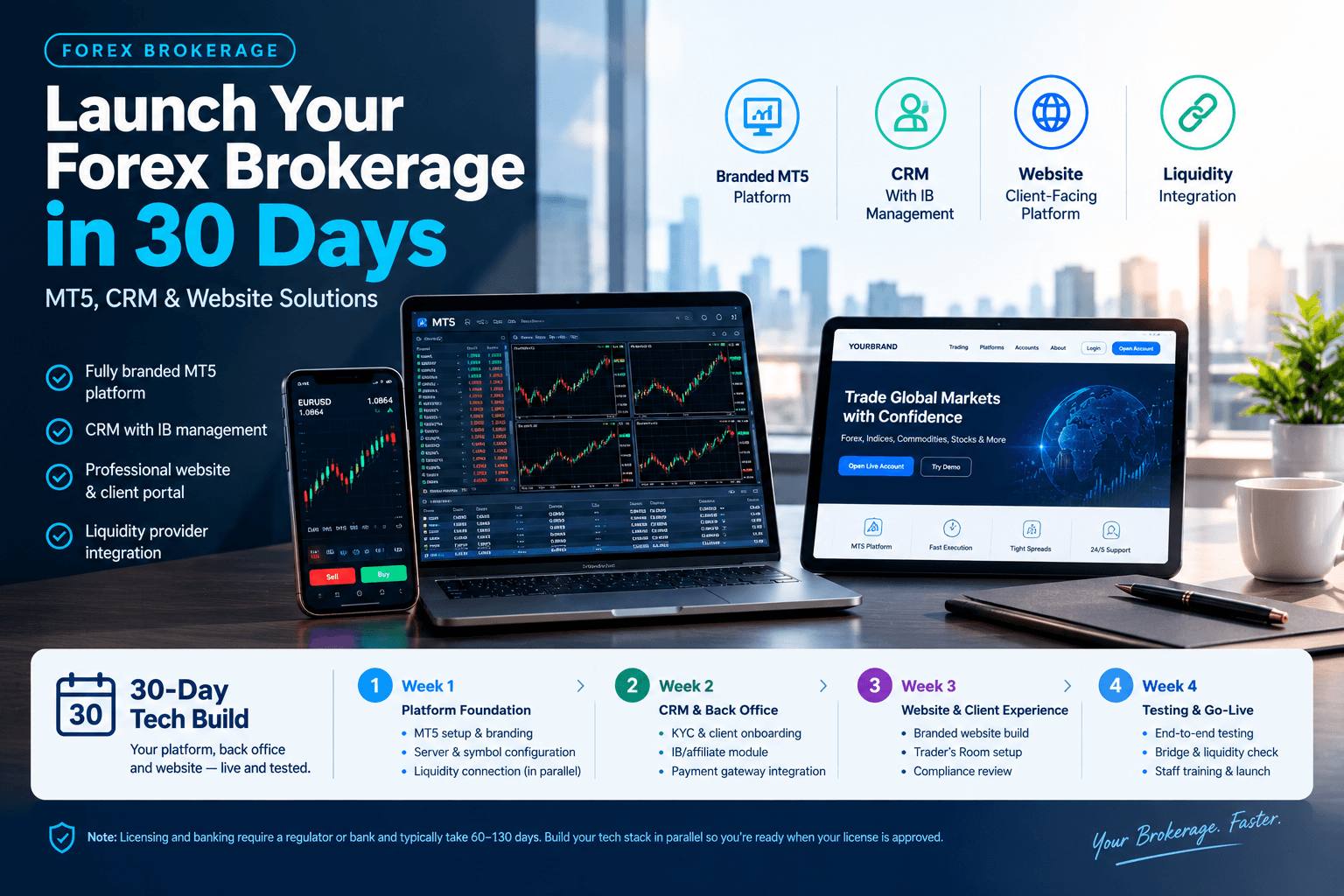
- Launch Your Forex Brokerage in 30 Days – MT5, CRM & Website Solutions
- Can You Run a Forex Brokerage Without a License? The Real Risks
Frequently Asked Questions
Q-1 Why do Stripe and PayPal reject forex brokers?
Forex brokers are classified under MCC 6211 (securities brokers and dealers), placing them in the same high-risk merchant category as gambling. Standard processors like Stripe and PayPal are built around low-dispute transaction patterns and either reject or heavily restrict forex merchants as a result.
Q-2 Do I need more than one payment gateway for a global forex brokerage?
Almost always, yes. Most brokers serving multiple regions run a multi-gateway stack, typically a card processor, a region-specific processor for markets like Brazil or Mexico, a US ACH processor, and a crypto processor rather than relying on a single provider to cover everything.
Q-3 How important is local payment method support?
Very. Brokers offering the right local methods like PIX in Brazil or UPI in India for their target markets see a 20–30% lift in deposit conversion compared to card-only or generic global processing.
Q-4 Are crypto deposits a good option for forex brokers?
Yes, particularly for clients in markets with banking access restrictions. Crypto deposits settle instantly with no chargebacks, though they require integrating a dedicated crypto payment processor rather than treating it as an extension of your card gateway.
Q-5 What should I look for in a high-risk forex payment gateway?
Genuine forex-specific approval rates, a decline rate under 5%, no undisclosed rolling reserves, PCI DSS compliance with real fraud tooling, fast payout capability, and actual local payment method support for your specific target markets not just a general "global coverage" claim.