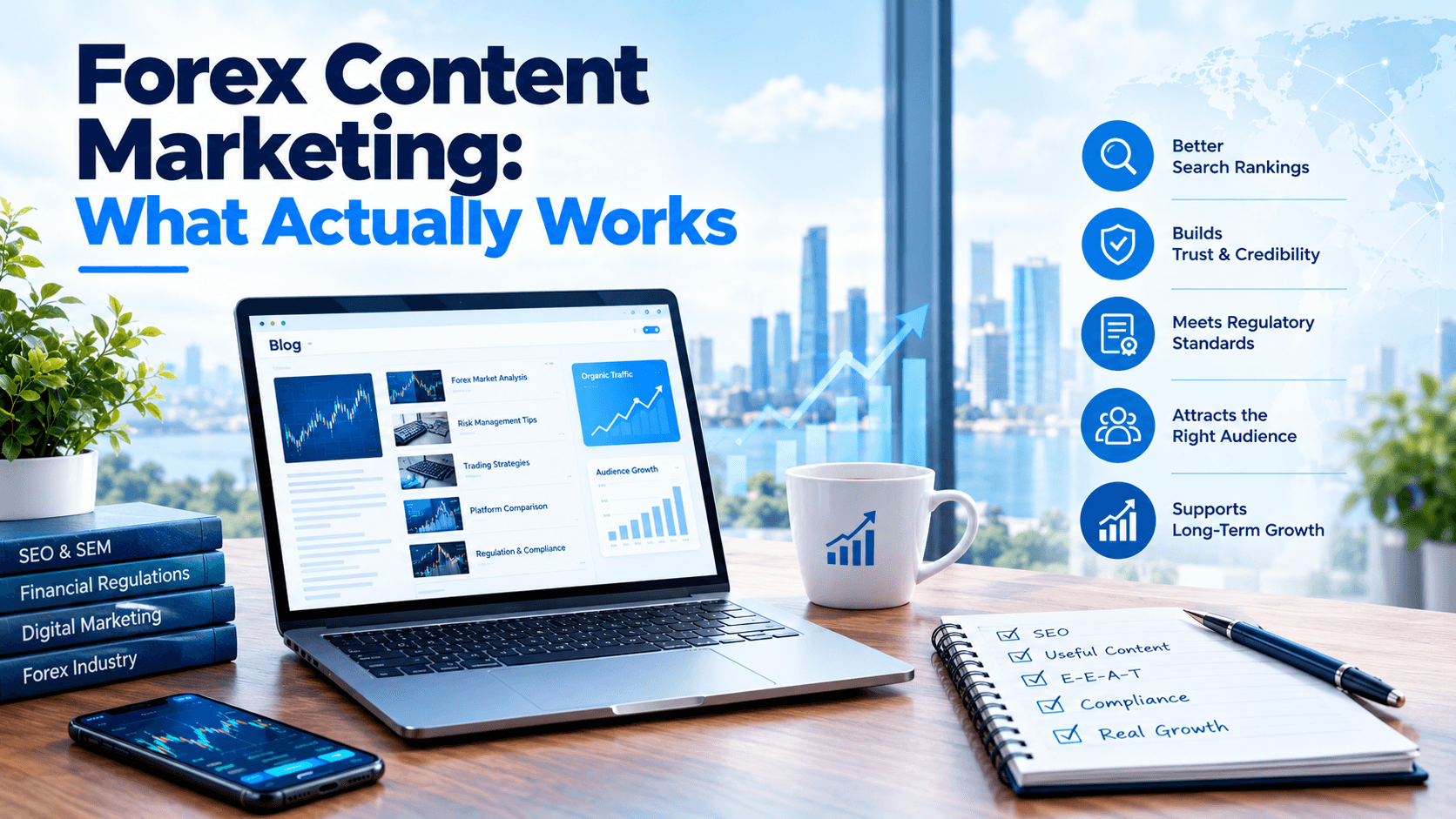
Most forex broker blogs fail the same way. They publish generic "how to trade forex" posts; nobody links to them, Google ignores them, and the founder concludes that content marketing doesn't work.
The problem isn't content. It's content built for the wrong standard. Forex content is judged more strictly than almost any other kind, by search engines, by regulators, and by traders who've been burned before.
This guide covers what works in 2026, what doesn't, and how to build a content program that holds up. For the wider channel mix, including paid ads and IB marketing.
See our digital marketing guide. This post goes deeper on content itself.
Why Broker Content Is Held to a Higher Standard
Google treats financial content as "Your Money or Your Life" (YMYL), meaning content that can affect a reader's financial well-being. For YMYL topics, Google expects clear signs of Experience, Expertise, Authoritativeness, and Trustworthiness (E-E-A-T).
In practice, that means thin or anonymous content struggles to rank for commercial forex terms, however many backlinks it has. It also means inaccurate content does more than underperform. It can mislead readers and expose you to regulatory risk.
There's a second audience too. AI tools like ChatGPT, Perplexity, and Google's AI Overviews now answer many definitional and comparison questions. Content that is accurate, well-structured, and clearly sourced is more likely to be cited there.
The Content Types That Earn Their Place
Content type | Job it does | Example for a broker |
Educational guides | Build trust early in the journey | "How leverage and margin actually work" |
Comparison pages | Capture high-intent searches | "MT5 vs cTrader: what traders should know" |
Regulation and jurisdiction explainers | Show real expertise, earn links | "What an offshore license does and doesn't cover" |
Original data and research | Earns citations from other sites and AI tools | Anonymized platform statistics, with methodology |
Calculators and tools | Earn repeat visits and links | Margin, pip value, and position-size calculators |
Anonymized case studies | Show outcomes without breaking privacy or compliance rules | "How a new IB structured their referral tiers" |
Video and webinars | Serve audiences who don't read long guides | Platform walkthroughs, market-structure sessions |
Notice what's missing: trade signals, "best strategy" claims, and anything implying guaranteed results. Those are the content types that create the most regulatory and reputational risk.
The E-E-A-T Checklist for Every Article
Build this into your template so it happens every time:
- Named, credentialed author with a real bio, not "Admin" or "Team"
- First-hand experience where relevant: what you've seen in practice, not just what's been published
- Sourced claims: official regulator pages, court records, or primary data, with dates
- Visible publish and "last reviewed" dates, and real updates when facts change
- Corrections when others get it wrong, stated plainly
- Risk disclosures that match your license and the markets you serve
- Internal links to related, supporting articles
We hold our own articles to this standard. For example, when search results are dominated by vendor-published "top 10" lists, we say so rather than repeating their rankings.
Build Compliance Into the Brief, Not the Final Review
A common mistake is treating compliance as the last gate. That creates bottlenecks, and it means problems are found after the content is written.
A workflow that works:
- Brief: the strategist states the topic and exactly which claims the piece will make
- Pre-check: compliance confirms which claims are allowed in which markets before writing starts
- Draft: the writer follows the approved claims
- Review: a lighter check, because the risky decisions were already made
- Re-review on edits: any change after approval gets another look
Never publish:
- Guaranteed or implied returns
- Performance claims without full context and disclosures
- Content aimed at markets your license doesn't allow you to solicit.
See our guide to the risks of operating without proper authorization. - Claims about regulation that your license details don't support
Also keep educational content ungated. Gate only genuinely premium material, such as proprietary research or detailed tools.
Writing for AI Search as Well as Google
AI search now sits in the discovery path for many traders, especially on definitional and comparison questions. The practical response is not a separate strategy. It's good content, structured well:
- Answer-first structure: put a clear, direct answer near the top of each section, in a short paragraph that can stand alone
- FAQ sections: with direct answers, marked up with FAQ schema
- Organization and author schema: so search engines can verify who you are
- Topic clusters: a hub article linked to deep-dive posts, instead of isolated posts
- Verifiable facts: dated statistics and cited sources, because AI tools favor content they can attribute
Agency reports claim AI answers now intercept a large share of high-intent broker queries. Those numbers vary widely and come mostly from marketing firms, so treat them as a direction of travel, not a measurement. What's consistent across sources is that ranking well and being well-structured helps in both places.
Using AI to Write: Helpful and Risky
AI tools can speed up outlines, first drafts, and repurposing. They can't replace verification, and they can produce confident, wrong statements.
For a broker, treat AI-assisted content like any other regulated communication:
- Fact-check every claim: against primary sources before publishing
- Run it through your normal compliance workflow: Regulators in several regions have said existing promotion rules apply to AI-assisted content.
- Add real experience: A generic AI summary adds nothing that search engines or AI tools can't already produce. Your first-hand knowledge is what makes content worth citing.
- Avoid overstating what your own AI tools do: In the US, regulators have taken action over exaggerated AI claims in marketing.
Distribution That Actually Works
Publishing isn't distribution. Channels that work for brokers:
- Email and newsletters: for traders and prospects who've opted in
- IB and partner enablement content: guides, explainers, and approved materials that make partners better at promoting you. This links directly to your growth engine.
See our IB scaling guide. - Digital PR and contributed articles: in trade and finance publications, which build links and authority
- Community participation: in forums and groups, where being genuinely useful matters more than posting links
How to Measure It
Metric | Why it matters |
First-time depositors (FTDs) from organic content | The number that connects content to revenue |
Qualified leads and assisted conversions | Content often influences deposits it doesn't close |
Brand search growth | A sign that trust and awareness are building |
Rankings for target commercial terms | Shows whether authority is compounding |
AI citations and mentions | Tracks visibility where clicks aren't happening |
Content-to-compliance cycle time | Shows whether your workflow is working |
Be realistic about timing. A new content program typically takes 12–24 months to show material organic results, with early signs around month six.
A Practical 90-Day Plan
Days 1–30: Foundation
- Set the compliance claim rules for each market
- Create the article template with the E-E-A-T checklist
- Name your authors and publish real bios
- Plan a topic cluster around your core services
Days 31–60: Publish
- Publish the hub article and 4–6 supporting posts
- Add FAQ sections and schema
- Set up internal links between all pieces
Days 61–90: Distribute and measure
- Pitch one contributed article to a trade publication
- Start an email list with a genuinely useful resource
- Review FTDs, rankings, and brand search, then adjust
What Doesn't Work
- Anonymous, generic educational posts
- Publishing volume with no review process
- Content that implies returns
- Gating basic education
- Copying competitors' vendor-written "best of" lists
- Treating SEO as a three-month campaign
Related Reading
- Digital Marketing Strategies for Forex Brokers – Grow Your Brokerage Globally
- How to Scale Your Forex Brokerage with Multi-Level IB and Affiliate CRM System
- Forex Broker Compliance Checklist – KYC, AML, and Data Security
- 2026 Regulatory Trends Every New Forex Broker Should Know
About FX Launch Pad
We apply the same standard to our own blog that we recommend here: named expertise, verified sources, and a correction when an industry claim is out of date. Content is part of the branding side of a launch, and we help founders plan it alongside licensing, so what your website says matches what your license actually permits.
If you're setting up a brokerage and want your content foundation built on claims you can stand behind, book a free consultation and we'll go through it with you.
Frequently Asked Questions
Q-1 Does content marketing work for forex brokers?
Ans- Yes, but it needs to meet the higher standard that applies to financial content: named experts, sourced claims, compliance review, and real experience. Generic content rarely ranks or earns trust.
Q-2 What is YMYL and why does it matter for brokers?
Ans- YMYL stands for "Your Money or Your Life." Google applies stricter quality standards to content that can affect a reader's finances, so forex content needs strong E-E-A-T signals to rank.
Q-3 Can I use AI to write broker content?
Ans- You can use it to speed up outlines and drafts, but you still need to fact-check every claim and run the content through compliance. AI can state incorrect information confidently, and existing promotion rules still apply.
Q-4 How long does forex content marketing take to work?
Ans- Typically 12 to 24 months for material organic results, with early signs around month six. It compounds over time, unlike paid ads, which stop when the budget stops.
Q-5 What content should a forex broker avoid?
Ans- Anything implying guaranteed returns, unbalanced performance claims, trade signals presented as advice, and content aimed at markets your license doesn't allow you to serve.