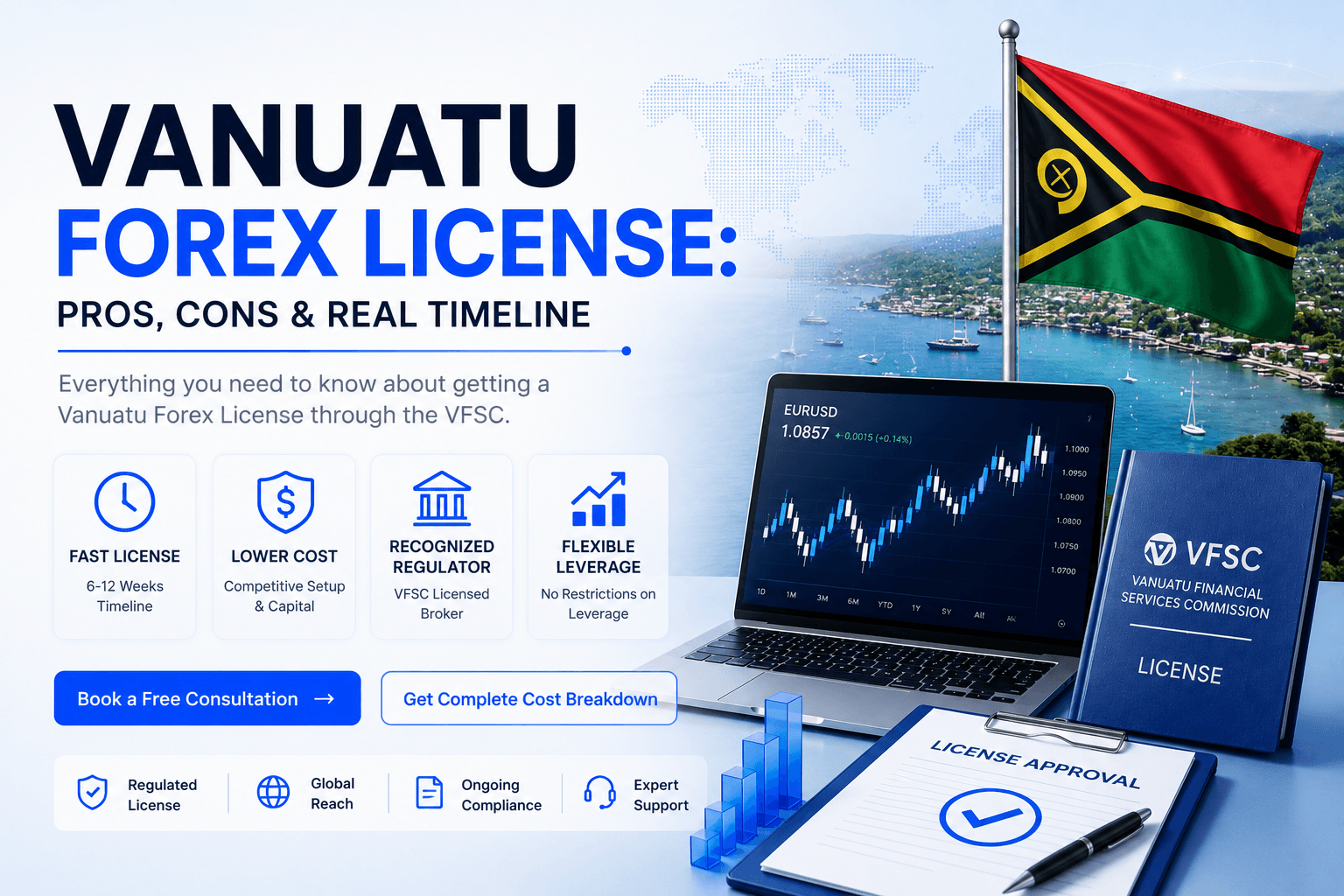
Vanuatu comes up constantly in our consultations, usually from founders who've heard it's the fastest route to something that looks more like a real license than a bare company registration. That reputation is largely earned but "fast" and "right for your business" aren't always the same thing, and we've seen enough brokers pick Vanuatu for the wrong reasons to know it deserves a straight answer, not a sales pitch.
What a Vanuatu Forex License Actually Is
The Vanuatu Financial Services Commission (VFSC) issues licenses that authorize a Vanuatu-incorporated company to deal in forex and derivative instruments. It sits in what the industry treats as the "established middle" tier of offshore licensing a genuine step up from a St. Vincent or Comoros company registration, which technically issues no forex-specific license at all, but well below Mauritius or BVI in terms of banking weight and regulatory depth.
That middle position is exactly why it's popular. You get an actual license with a real regulator's name on it something you can point to on your website and in your onboarding documents without the capital and compliance load that Mauritius demands.
VFSC Requirements
To get licensed under the VFSC, you'll need to work through:
- Incorporation of a Vanuatu International Company (IC), the standard vehicle for licensed brokers
- A business plan and application dossier submitted to the VFSC covering your operating model and management structure
- Minimum capital — this has moved over the past few years as the VFSC has tightened its framework; current guidance from licensing specialists puts realistic capital closer to the tens of thousands of dollars rather than the historic $2,000 figure that still circulates online and is now outdated
- A registered agent and local office in Vanuatu, maintained on an ongoing basis
- Professional indemnity insurance, with premiums commonly starting around €15,000 annually depending on scale
- Ongoing compliance reporting — audited annual financial statements under International Accounting Standards, plus quarterly compliance reports to the VFSC
That last point is where a lot of the "cheap and fast" reputation quietly breaks down. Vanuatu is fast and comparatively affordable to get licensed, but staying compliant afterward, with quarterly reporting and annual audits, is a real ongoing operational commitment, not a one-time fee.
The Real Cost Picture
Total setup costs for a VFSC license typically run in the USD 25,000–60,000 range, covering incorporation, the application and government fees, legal and consulting support, and your first year of registered office and secretarial services. That's before factoring in:
- Capital held to satisfy the VFSC's requirement
- Annual indemnity insurance (~€15,000+)
- Ongoing registered agent and compliance costs
- Auditor fees for your annual statements
We flag this to every client comparing Vanuatu against a pure company registration like St. Vincent: the sticker price looks similar at a glance, but Vanuatu carries real recurring compliance overhead that a bare offshore registration doesn't. You're paying for a functioning license, not just a certificate.
Timeline: What "Fast" Really Means
Vanuatu earns its reputation here. Realistic timelines run 6–12 weeks from application to license issuance, assuming your business plan and documentation are in order the first time through. That's genuinely quick compared to Mauritius's 90–100 days or a Tier-1 regime's 6–18 months.
Where founders lose time isn't the VFSC's processing; it's incomplete applications, business plans that don't match what the VFSC expects to see, or founders who assume "fast" means "informal" and under-prepare the compliance side. We build the compliance framework alongside the application rather than after licensing, which is what keeps clients inside that 6–12 week window instead of drifting toward 4–5 months.
Pros of a Vanuatu License
- Speed: one of the fastest legitimate forex licenses available, typically 6–12 weeks
- Lower capital burden: than Mauritius, BVI, or onshore Tier-1 regimes
- A recognized regulator name: on your documentation, which carries more weight with payment providers than an unlicensed offshore company
- No restriction on leverage: unlike Tier-1 regimes, which cap it, which matters for brokers targeting markets where higher leverage is standard
Cons of a Vanuatu License
- Weaker banking access: than Mauritius or the BVI, some banks and payment processors still treat VFSC-licensed entities with caution
- Ongoing compliance load: quarterly reporting and annual audits are real obligations, not formalities
- Cannot legally solicit Tier-1 retail clients: a VFSC license does not authorize you to actively market to clients in the EU, UK, Australia, or similar regulated markets
- Reputational ceiling: institutional clients and larger IBs sometimes push for a stronger jurisdiction before committing serious volume
Who Vanuatu Actually Fits
Vanuatu makes the most sense for brokers targeting emerging markets — Southeast Asia, Africa, Latin America, the Middle East — where a recognized license matters for trust and payment processing, but the deeper banking relationships and institutional credibility of Mauritius aren't yet a priority. It's a strong middle step for an IB converting real client volume into their own brokerage, or a founder who wants to launch quickly and can move to a stronger jurisdiction later once volume justifies it.
If your growth plan includes raising capital, targeting institutional clients, or building banking relationships that can scale, it's worth weighing Vanuatu against Mauritius before you commit the cost difference is smaller than most founders assume once Vanuatu's ongoing compliance costs are factored in.
Weighing Vanuatu against Mauritius or a standard offshore setup for your specific plan? Book a free consultation, and we'll map out which jurisdiction actually fits your target market, budget, and timeline.
Frequently Asked Questions
Q-1 How much does a Vanuatu forex license cost?
Ans- The setup costs usually range from USD 25,000-60,000, which includes incorporation, application fees for VFSC, legal and consultancy fees, and the first year of registration of the office, among other costs; thereafter, a yearly cost of around USD 2,000 for indemnity insurance and compliance reporting is incurred.
Q-2 How long does it take to get a Vanuatu forex license?
Ans- It is one of the quickest and most legitimate forex licenses available, as a majority of applications are accepted within 6-12 weeks – if the business plan and documentation are complete at the initial application.
Q-3 What is the minimum capital requirement for a Vanuatu forex license?
Ans- Ans- What capital requirements have risen in recent years, from the historic $2000 that is still being quoted online? Current requirements are more in the thousands of dollars, and it is vital to consult with a licensed specialist prior to budgeting, as there has been a change in the guidance of the VFSC.
Q-4 Can a Vanuatu-licensed broker accept clients from the UK, EU, or Australia?
Ans- No. VFSC is not licensed to solicit retail clients in Tier-1 regulated markets. It is essential to have local authorization like FCA, CySEC, or ASIC in those regions.
Q-5 Is Vanuatu better than Mauritius for forex brokerage?
Ans- This will depend on your target market and stage. Vanuatu is quick and inexpensive, making it a good place to start for emerging-market brokers. Mauritius has better banking relationships and institutional credibility, which becomes more relevant once size or demand for investors increases.