Best Countries to Open a Bank Account for a Forex Brokerage
Ask any founder what the hardest part of launching a brokerage was, and most won't say licensing. They'll say banking.
We've watched clients sail through licensing, then spend three extra months trying to get a corporate account that actually accepts client deposits and processes withdrawals reliably. Generic "best offshore banking" content rarely helps here, because forex is treated as a fundamentally different risk category than most businesses.
Here's what actually works in 2026.
Why Forex Banking Is Different
Most "best offshore countries" guides are written for holding companies, e-commerce, or wealth protection — not for a business processing high-volume client deposits in a sector banks flag as high-risk.
The key fact to understand upfront:
Tier-1 banks in the US, UK, and most of the EU decline forex brokerage accounts as a matter of policy — regardless of how strong your license is.
So the search isn't for the world's most prestigious bank. It's for a bank with a genuine, demonstrated risk appetite for forex specifically.
The realistic banking structure for most brokers:
- An offshore bank in the same or an adjacent jurisdiction to your license
- An Electronic Money Institution (EMI) with a specific forex risk appetite
- Usually both together, not one relationship alone
Founders who expect a single clean banking relationship to cover everything are usually the ones scrambling when that one account gets flagged.
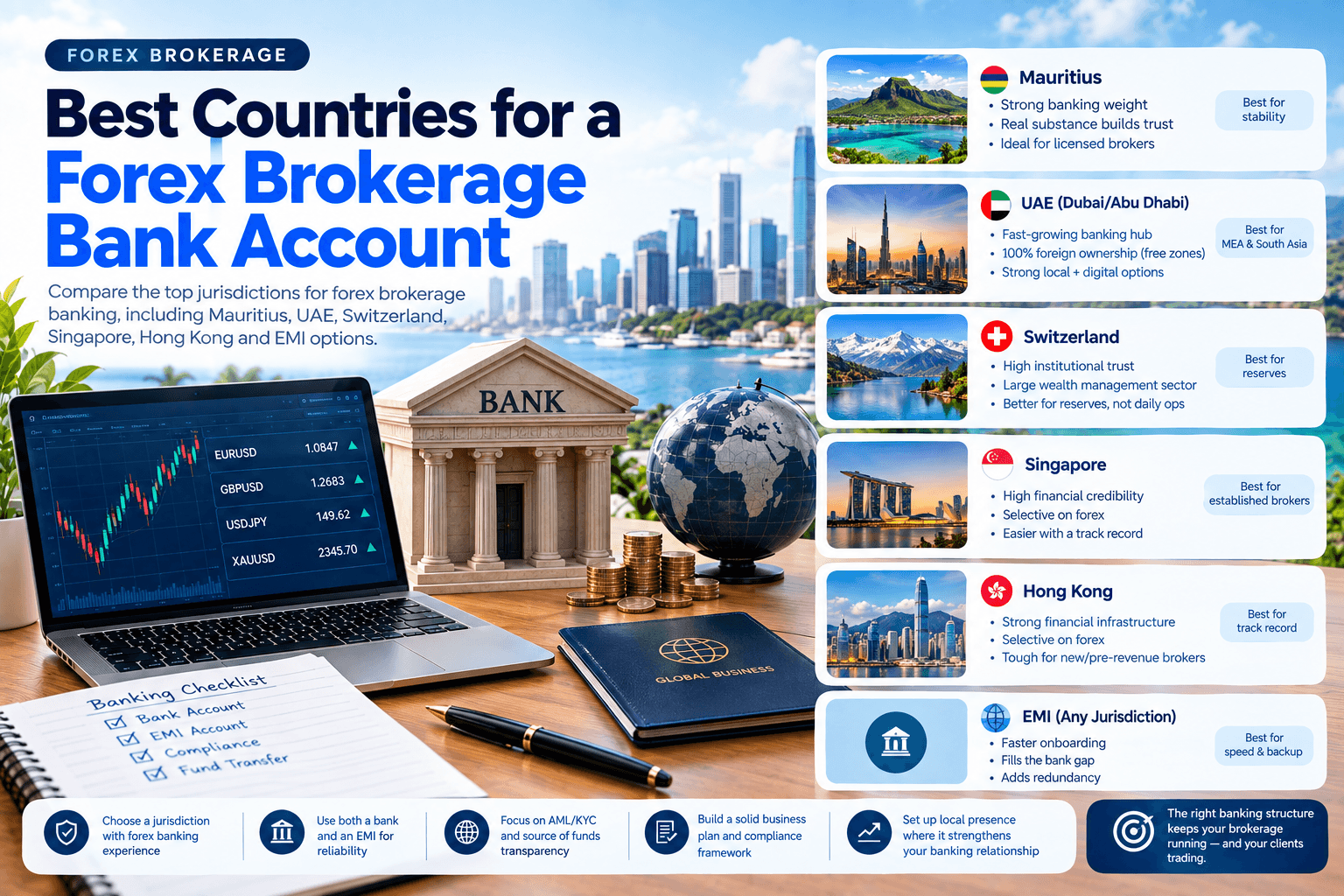
Quick Comparison: Best Jurisdictions at a Glance
Jurisdiction | Best For | Banking Strength | Watch Out For |
Mauritius | Licensed brokers wanting real stability | Strong — substance requirements build bank trust | Slower, pricier setup |
UAE (Dubai/Abu Dhabi) | Targeting MEA & South Asia clients | Growing fast, strong local + digital options | Remote onboarding is oversold — most banks still want local presence |
Switzerland | Holding reserves, not daily operations | High institutional trust | High minimum balances, not built for volume |
Hong Kong / Singapore | Established brokers with a track record | High credibility | Very selective on forex, tough for new/pre-revenue brokers |
EMI (any jurisdiction) | Fast onboarding + redundancy | Fills the gap banks leave | Should supplement, not replace, a bank |
Mauritius: Strongest Banking Weight for a Licensed Broker
Mauritius consistently outperforms lighter offshore jurisdictions when banking access is your top priority.
Why it works: the Financial Services Commission requires resident directors and real substance as part of licensing. Banks view that substance favorably — far more than a bare offshore registration with no local presence.
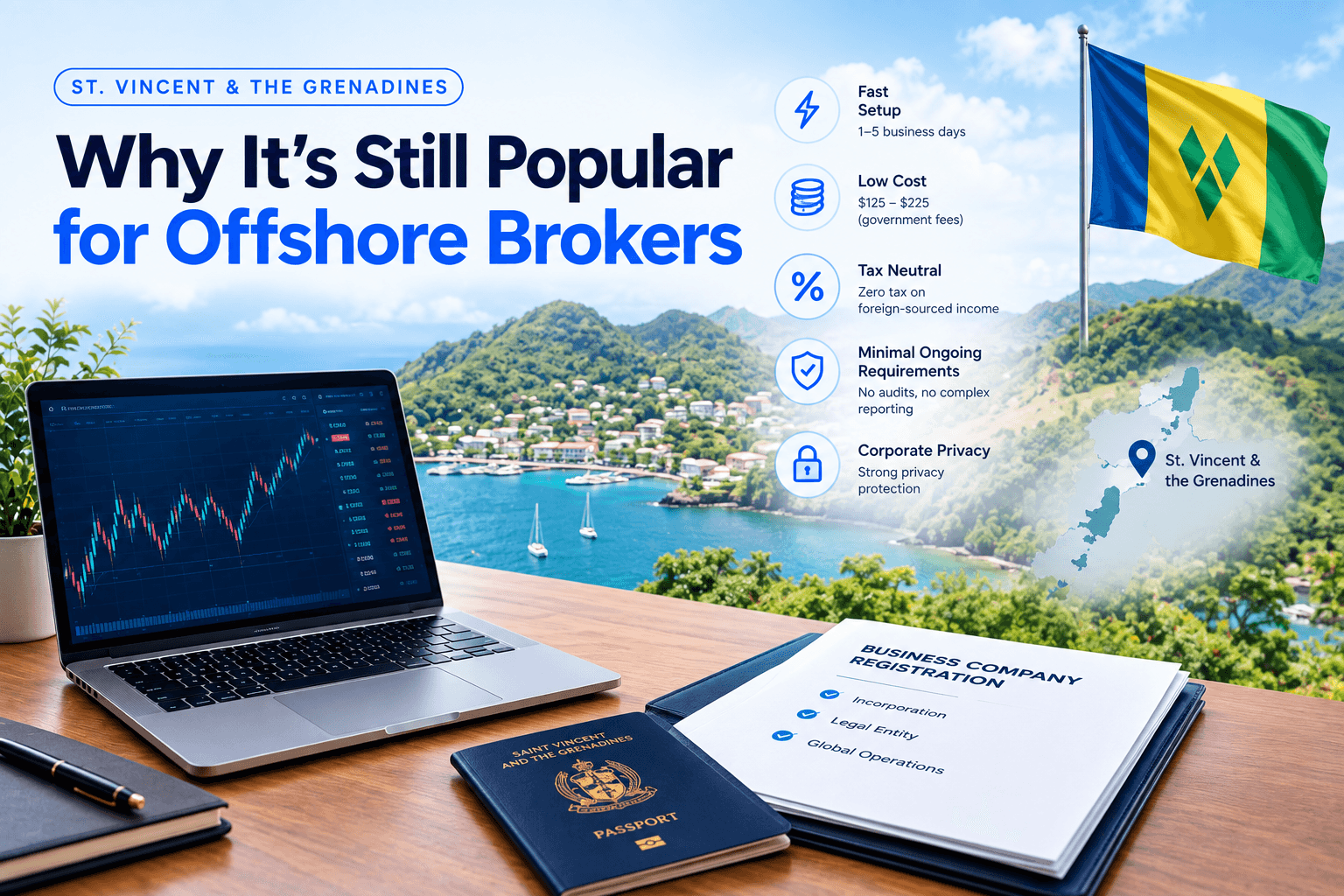
A pattern we see often: clients who moved from a St. Vincent registration to Mauritius specifically because their old bank flagged the account for review every few months. The same substance requirements that make Mauritius slower to set up are what make the resulting account stable.
UAE (Dubai & Abu Dhabi): The Fastest-Growing Option
The UAE has become one of the most active banking hubs for brokers targeting the Middle East, Africa, and South Asia.
What makes it work:
- Free-zone structure allows 100% foreign ownership
- Established banks: Emirates NBD, Mashreq, RAKBANK, ADCB
- Growing digital/fintech sector supporting AED, USD, EUR, GBP
The catch: "remote onboarding" gets oversold by some agents. Most traditional UAE banks still prefer a documented local presence or an in-person visit — treat it as a relationship that benefits from that, not one that opens purely online.
Switzerland: Strong, But Not Built for Volume
Switzerland carries real institutional weight — assets under management at Swiss banks hit CHF 9,284 billion in 2024, up 10.6% year-on-year.
But:
- High minimum balances are standard
- Better suited to holding reserves than processing daily client transactions
- Rarely the right first account for a launch-stage broker
We've placed it as a secondary relationship for established clients wanting a stable place to hold reserves — never as the primary operating account.
Hong Kong and Singapore: Built for Trade, Selective on Forex
Both carry strong financial credibility, which cuts both ways — that same reputation makes their banks more selective, and forex draws more scrutiny than standard trade or e-commerce businesses.
A real contrast we've seen: a client with a full year of clean operating history got approved in Singapore. The same documentation, submitted pre-revenue, would have been rejected outright.
Takeaway: strong options once you have a track record — not your easiest first account.
The EMI Layer Most Founders Underestimate
Most operating brokerages keep at least one EMI relationship running alongside their bank, for deposits, withdrawals, and card acquiring.
Why it matters:
- EMIs with forex experience often onboard faster than traditional banks
- They provide redundancy if your bank account faces delays or restrictions
We've had clients come to us mid-crisis — their sole bank account frozen pending review, client withdrawals stacking up, no second channel available. An EMI set up from day one prevents exactly that scenario.
What Actually Determines Approval
Across every jurisdiction, the same factors decide whether you get banked smoothly:
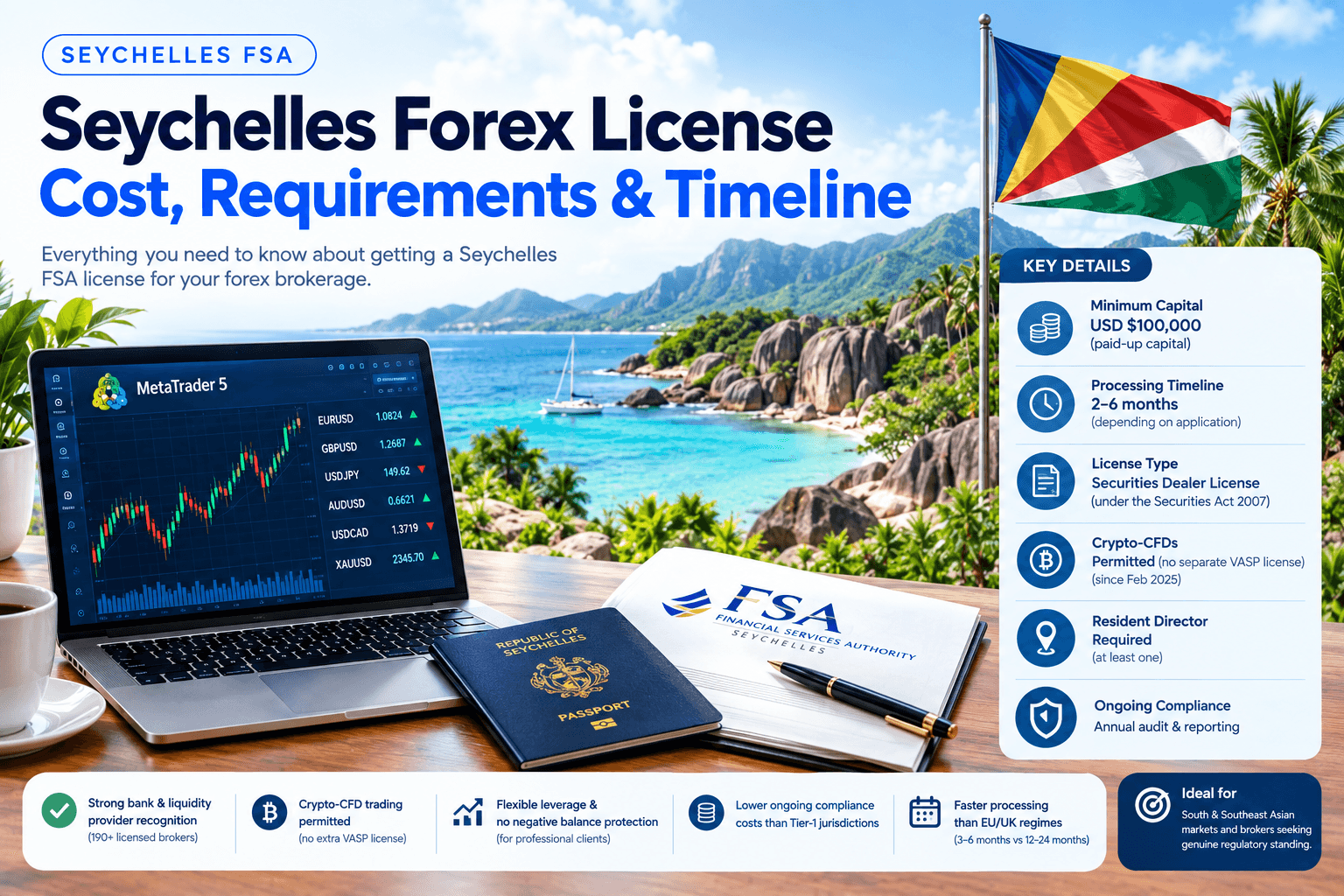
- License jurisdiction and credibility: Mauritius or Seychelles opens more doors than a bare offshore registration
- Clarity of business activity and source of funds: banks in 2026 care more about transparency than secrecy
- AML/KYC documentation quality: generic compliance frameworks are a common rejection reason
- Prior banking history: past account closures need honest disclosure, not concealment
About FX Launch Pad
Banking is where we spend the most hands-on time with clients it's the step most likely to stall a launch, not the licensing itself. Our banking introductions come from direct relationships with institutions that have a real, demonstrated risk appetite for forex. We typically set up a primary bank alongside an EMI for every client, so a delay on one side doesn't stop the brokerage from operating.
Want to know realistically which banking structure fits your license and target market? Book a free consultation.
Related Reading
- Mauritius Forex License: Real Cost, Timeline & Requirements
- Seychelles FSA License for Forex Brokers: Full Breakdown
- Offshore vs Regulated Forex License Which Fits Your Budget?
- How Long Does It Really Take to Launch a Forex Brokerage?
Frequently Asked Questions
Q-1 Why do banks treat forex brokerages as high-risk?
Ans- Forex involves high transaction volumes, cross-border payments, and leveraged trading all of which trigger stricter AML and regulatory scrutiny. Most tier-1 banks in the US, UK, and EU decline forex accounts as policy, regardless of license quality.
Q-2 Which country has the best banking for a forex brokerage?
Ans- No single answer depends on your license and target market. Mauritius offers the strongest banking weight for licensed brokers; the UAE is the fastest-growing option for those targeting the Middle East, Africa, and South Asia.
Q-3 Do I need both a bank account and an EMI?
Ans- Yes, ideally. A bank provides core stability; an EMI with forex experience often processes daily transactions faster and gives you redundancy if the bank relationship stalls.
Q-4 Can I open a forex brokerage bank account remotely?
Ans- Some UAE banks and select EMIs support partial or full remote onboarding. Most traditional banks still prefer some documented local presence, especially for a first account.
Q-5 Is offshore banking for a forex brokerage legal?
Ans- Yes, when properly disclosed and used for legitimate business purposes. The risk isn't holding an offshore account it's failing to report it to your home tax authority where required.