Every founder assumes they need both apps on day one. Most don't — and building both simultaneously on a tight launch budget is a common way to end up with two mediocre apps instead of one genuinely good one.
Here's how to actually decide which platform to build first, based on where your clients are and how your business actually works.
The Core Trade-Off in One Line
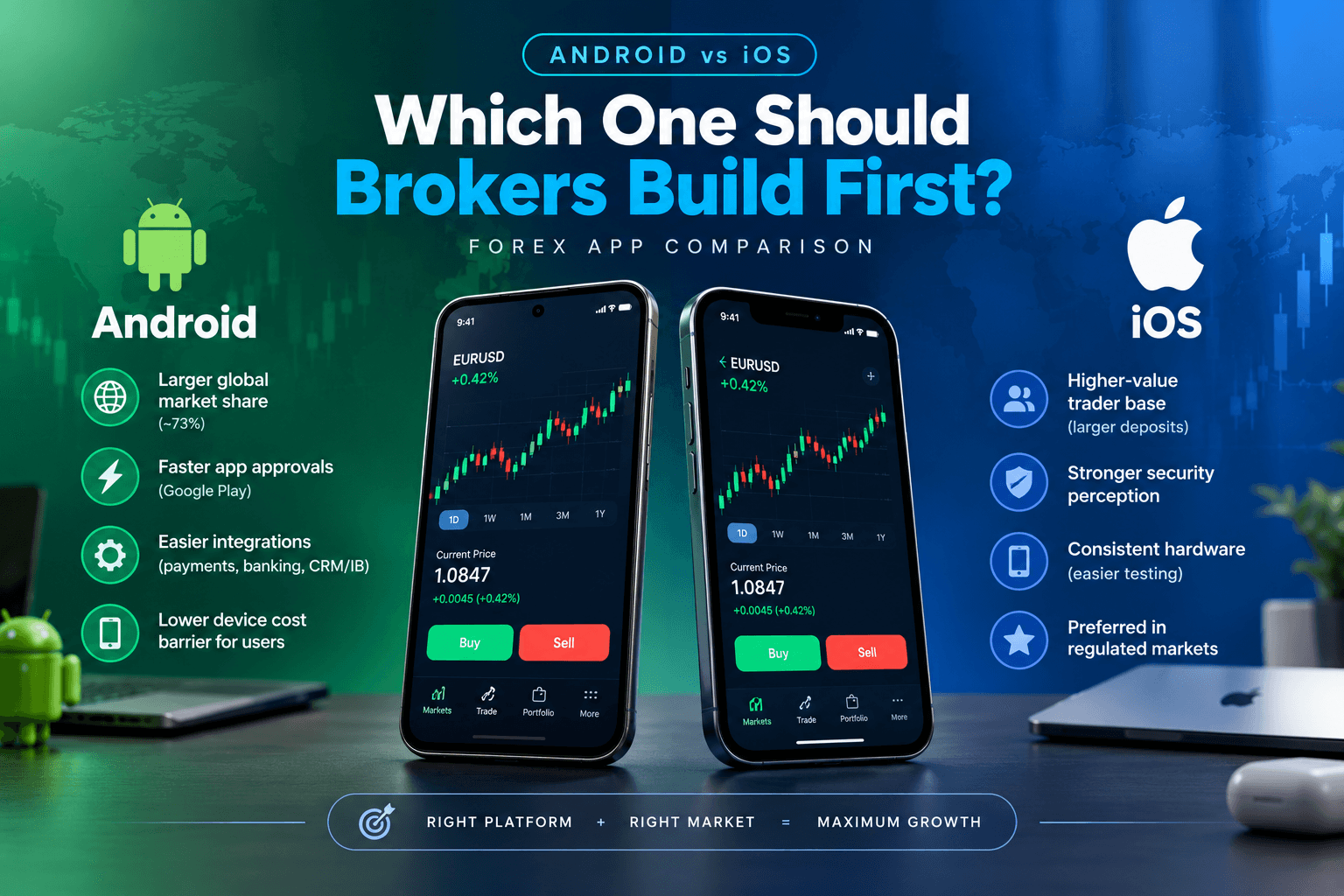
Android reaches more traders. iOS reaches higher-spending traders.
Everything else in this decision flows from that single fact. Android holds roughly 73% of global smartphone market share, driven heavily by emerging markets. iOS users, meanwhile, are consistently associated with higher-value trading activity and stronger preference for regulated platforms.
Neither platform is objectively "better." They serve different parts of your potential client base.
Why Android Usually Wins for New Brokers Targeting Emerging Markets
If your target clients are in South Asia, Southeast Asia, Africa, or Latin America, Android is very likely where most of your prospective traders already are.
Practical advantages for a broker specifically:
- Faster deployment: Google Play's review process is meaningfully less restrictive than Apple's App Store, meaning updates and fixes ship faster
- Easier CRM/IB integration: Android's more open architecture makes custom integrations with regional payment gateways, local banking APIs, and your CRM's IB tracking system more straightforward
- Lower device-cost barrier for your clients: in markets where a mid-range Android phone is the norm, this directly affects how many potential clients can actually download and use your app
The real trade-off: device fragmentation. Android runs across thousands of device models and screen sizes, which means more testing overhead to guarantee your app performs consistently particularly during high-volatility moments when lag or a crash costs a client real money, not just a bad review.
Why iOS Makes Sense If You're Targeting Higher-Value Clients
If your growth plan centers on Tier-1 markets, institutional-adjacent clients, or traders who deposit larger amounts and expect a polished, security-forward experience, iOS deserves priority.
Practical advantages:
- Higher-value user base: iOS is consistently associated with clients who trade larger amounts and gravitate toward regulated, security-conscious platforms
- Consistent hardware: a small, controlled set of device models makes testing and performance tuning genuinely simpler than Android's fragmented ecosystem
- Stronger built-in security perception: even though a well-built Android app can be equally secure, iOS carries a trust advantage with a certain type of client that shouldn't be dismissed
The real trade-off: Apple's App Store review process is stricter and slower, and financial apps in particular face additional scrutiny expect longer approval cycles for both your initial launch and every update afterward.
Quick Decision Table
Your Situation | Build First |
Targeting South/Southeast Asia, Africa, or Latin America | Android |
Targeting UK, EU, Australia, or institutional clients | iOS |
Budget-constrained first launch | Whichever matches your primary target market — not both |
Heavy IB/affiliate network with regional payment needs | Android (easier integration flexibility) |
Marketing message centers on premium/regulated positioning | iOS (stronger perceived security) |
Genuinely global target audience, moderate budget | Android first, iOS within 3–6 months |
You Don't Need Both on Day One — Here's the Honest Sequencing
Trying to launch on both platforms simultaneously with a limited budget is one of the more common mistakes we see. It usually means neither app gets the testing and polish it needs before your first real clients start using it.
A more realistic sequence:
- Launch on your primary platform first, based on where your actual target clients are
- Monitor real usage data. Are prospective clients asking for the other platform? Are you losing signups because of it?
- Build the second platform once demand justifies it, typically once you have real trading volume and revenue to fund a second, equally well-tested app
This isn't a compromise, it's how most successful brokers actually approached mobile, even ones that now support both platforms at a high standard.
What Matters More Than the Platform Choice Itself
Regardless of which platform you build first, the app needs to get a few fundamentals right, because a broken execution experience costs a client real money not just a bad app review:
- Fast, reliable order execution: especially during high-volatility news events
- In-app KYC and account registration: not a redirect to a separate mobile browser flow
- Real-time price feeds with no lag, tied directly to your liquidity and bridge setup
- A stable connection to your CRM, so account status, balances, and support are always accurate
A polished-looking app that lags during a Non-Farm Payrolls release will lose client trust faster than a plainer app that never misses an execution.
Related Reading
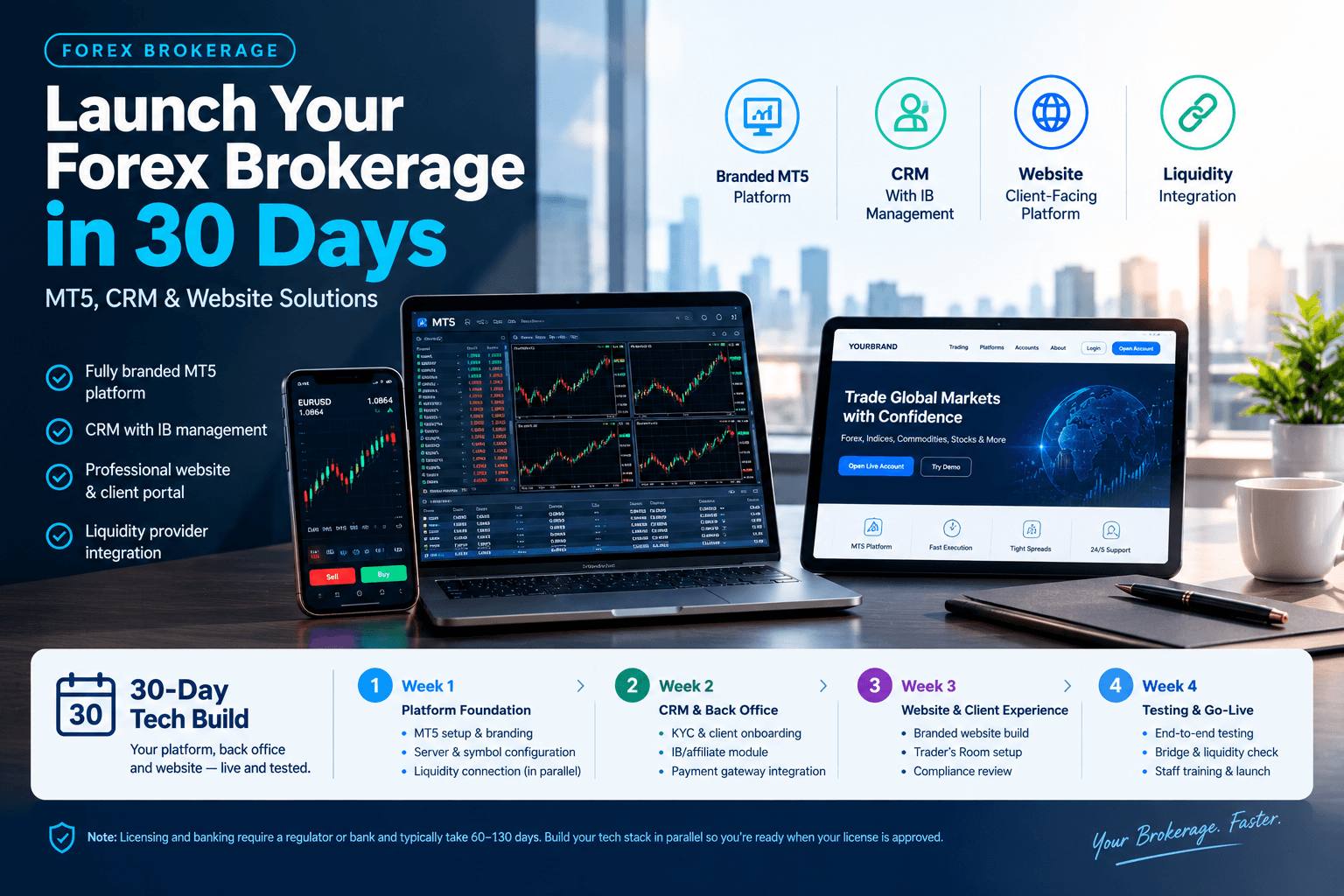
- Launch Your Forex Brokerage in 30 Days – MT5, CRM & Website Solutions
- MT5 White Label Setup Cost: A Realistic Breakdown
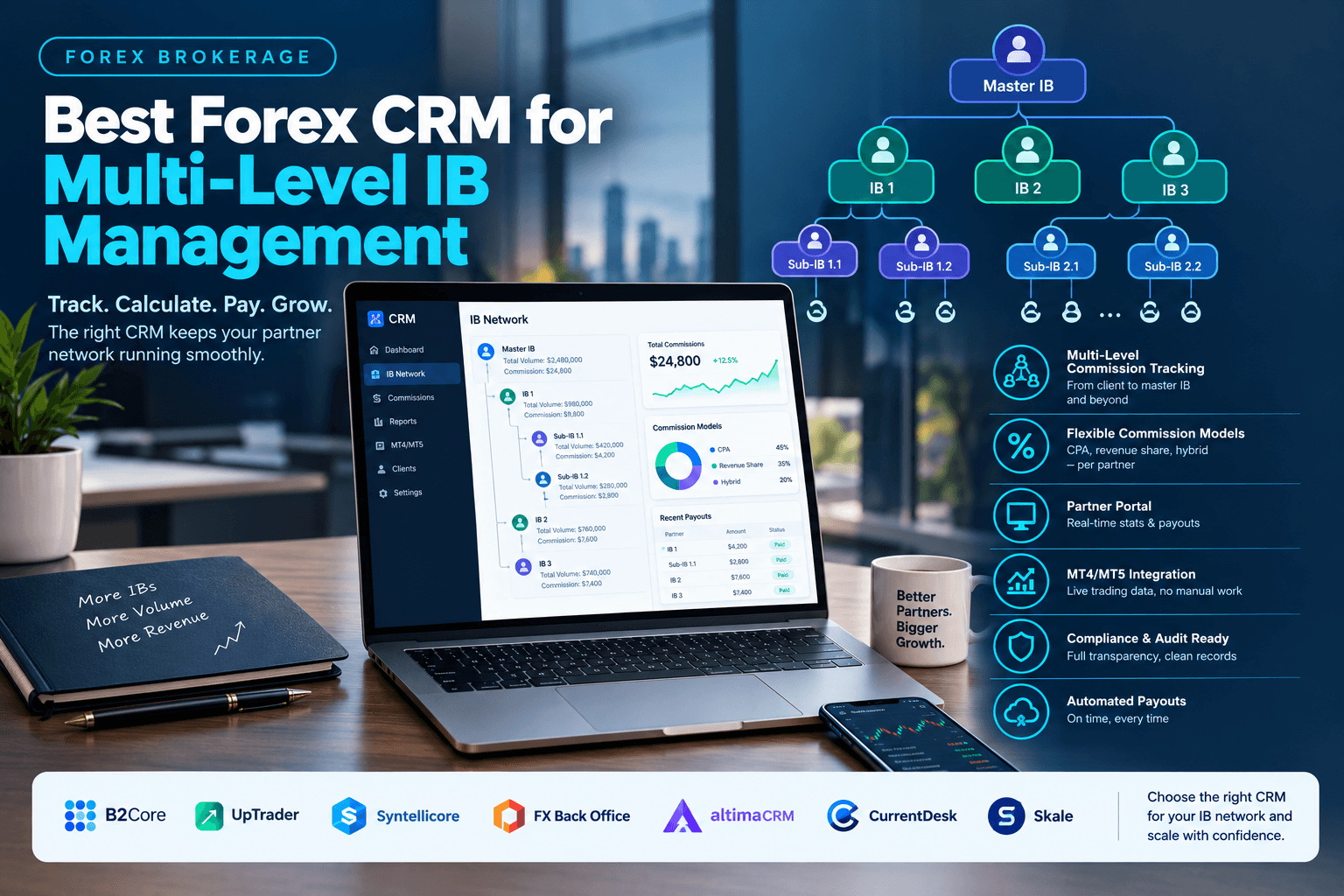
- Best CRM for Forex Brokers with Multi-Level IB Management
- Liquidity Bridge Integration Explained (for Non-Technical Founders)
About FX Launch Pad
We build the mobile experience around where a client's actual target market lives, rather than defaulting to "build both" regardless of budget because we've seen what happens when a launch budget gets split thin across two half-finished apps instead of one that actually works under pressure. Since our trading technology is developed in-house, we can connect your mobile app directly to your CRM, liquidity, and bridge setup as one coordinated system, rather than bolting a mobile client onto infrastructure that wasn't built with it in mind.
Not sure which platform fits your target market and budget? Book a free consultation and we'll map out a mobile strategy that matches your actual clients, not a generic checklist.
Frequently Asked Questions
Q-1 Should a new forex broker build an Android or iOS app first?
It depends on your target market. Android generally makes sense for brokers targeting emerging markets in Asia, Africa, or Latin America, given its larger global market share. iOS makes sense for brokers targeting Tier-1 markets or higher-value, security-conscious clients.
Q-2 Do I need both an Android and iOS app to launch a brokerage?
Not immediately. Many brokers launch on one platform first based on where their target clients are, then add the second platform once trading volume and revenue justify the additional development cost.
Q-3 Is iOS more secure than Android for a trading app?
iOS carries a stronger security perception among users, but a properly developed Android app can be equally secure. The difference is more about client perception and platform ecosystem than actual technical security when both are built correctly.
Q-4 Which platform is easier to integrate with a CRM and IB system?
Android generally offers more flexibility for custom integrations with regional payment gateways, banking APIs, and CRM/IB tracking systems, which is why many brokers targeting emerging or mixed-regulation markets favor it.
Q-5 How long does it take to build a forex trading app?
Depending on features, platform, and compliance requirements, a forex trading app can take anywhere from a few weeks for a straightforward MT5-integrated app to several months for a fully custom build with advanced features.