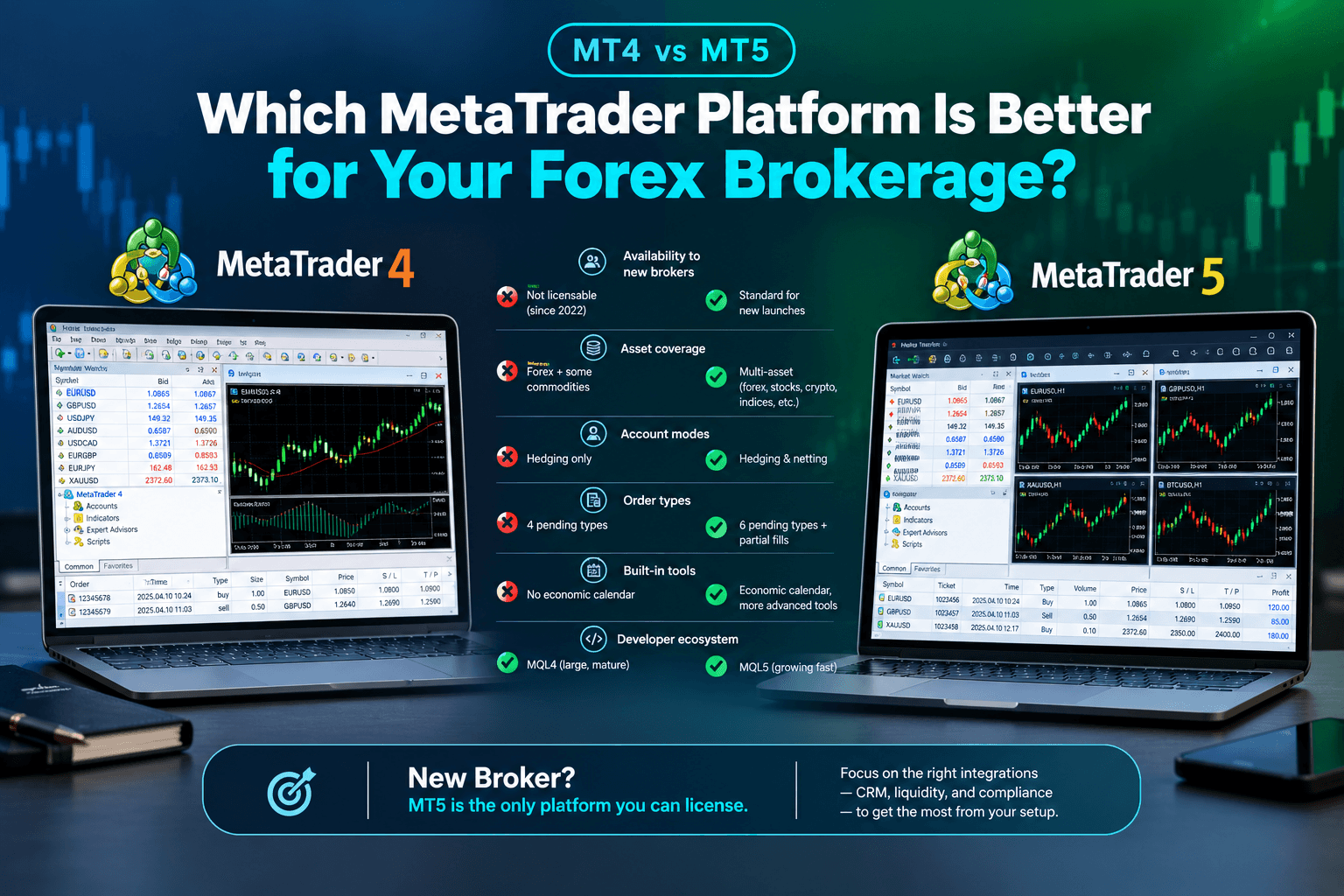
If you're a new broker weighing MT4 against MT5, here's the fact that actually settles most of the debate before we even get into features: MetaQuotes stopped issuing new MT4 licenses to brokers in 2022.
If you're launching a brokerage today, MT4 isn't a choice you get to make. It's simply not available to new licensees. This article is written for broker operators, not traders — and from that seat, the decision looks very different from the "which is better for scalping" debates you'll find elsewhere.
The Fact That Changes the Whole Conversation
For an existing broker who's run MT4 for years, this is a real migration decision with real trade-offs. For a new brokerage, there's no decision to weigh — MT5 is the only platform MetaQuotes will license you.
The market has already followed that policy. According to Brokeree's 2026 analysis of over 900 global brokerages: 68% now offer MT5, 40% still offer MT4 (largely legacy operators), and 23% run both during a transition period. Finance Magnates Intelligence data shows MT5 overtook MT4 in trading volume in Q1 2025, capturing 54.2% of combined MetaTrader volume — the crossover already happened.
So if you've been researching "MT4 vs MT5" and are still deciding, the honest framing is: you're choosing what to build on, not what your clients might prefer.
Quick Comparison Table
MT4 | MT5 | |
Availability to new brokers | ❌ Not licensable since 2022 | ✅ Standard for all new launches |
Architecture | 32-bit, single-threaded | 64-bit, multi-threaded |
Asset coverage | Forex, some commodity CFDs | Forex, CFDs, stocks, futures, options, bonds, crypto |
Order types | 4 pending order types | 6 pending order types + partial fills |
Account modes | Hedging only | Hedging and netting |
Backtesting | Single-currency | Multi-currency |
Built-in economic calendar | No | Yes |
Developer ecosystem | Massive (MQL4, 20 years of EAs/indicators) | Growing fast (MQL5 marketplace + community) |
Copy trading / social features | Third-party only | Native MQL5 community integration |
Why MT5 Is the Only Realistic Answer for a New Brokerage
Beyond the licensing issue, MT5 was built to solve the exact problems a growing brokerage runs into:
- Multi-asset from day one: If you ever want to offer crypto-CFDs, indices, or stocks alongside forex, MT5 supports it natively. MT4 was never built for this; you'd be working around the platform, not with it.
- Hedging and netting, both available: This matters directly for how you calculate margin, handle reporting, and meet different regulatory requirements across jurisdictions. MT4 locks you into hedging only.
- Execution control MT4 simply doesn't have: MT5 exposes fill policies Fill or Kill, Immediate or Cancel, Return plus partial fills. MT4 gives you a full fill, a requote, or nothing. For a broker managing execution quality and slippage disputes, that difference is operational, not cosmetic.
- A platform still being developed: MetaQuotes puts every new feature into MT5. MT4 is in maintenance mode security patches only, no new capability. Building your brokerage on a frozen platform in a market that keeps evolving is a real long-term risk, not just a problem today.
Where MT4 Still Has a Real Argument — Just Not for You
To be fair to MT4: it still handles a meaningful share of retail forex volume globally, and its MQL4 ecosystem of Expert Advisors and indicators, built over 20 years, is genuinely larger than what MT5 has built so far.
But that argument matters for existing brokers with an established MT4 client base weighing a migration not for someone launching new. If you have no legacy clients, no existing EA library locking you in, and no licensing path to MT4 in the first place, this consideration simply doesn't apply to your situation.
The Question That Actually Matters More: Integration, Not Platform
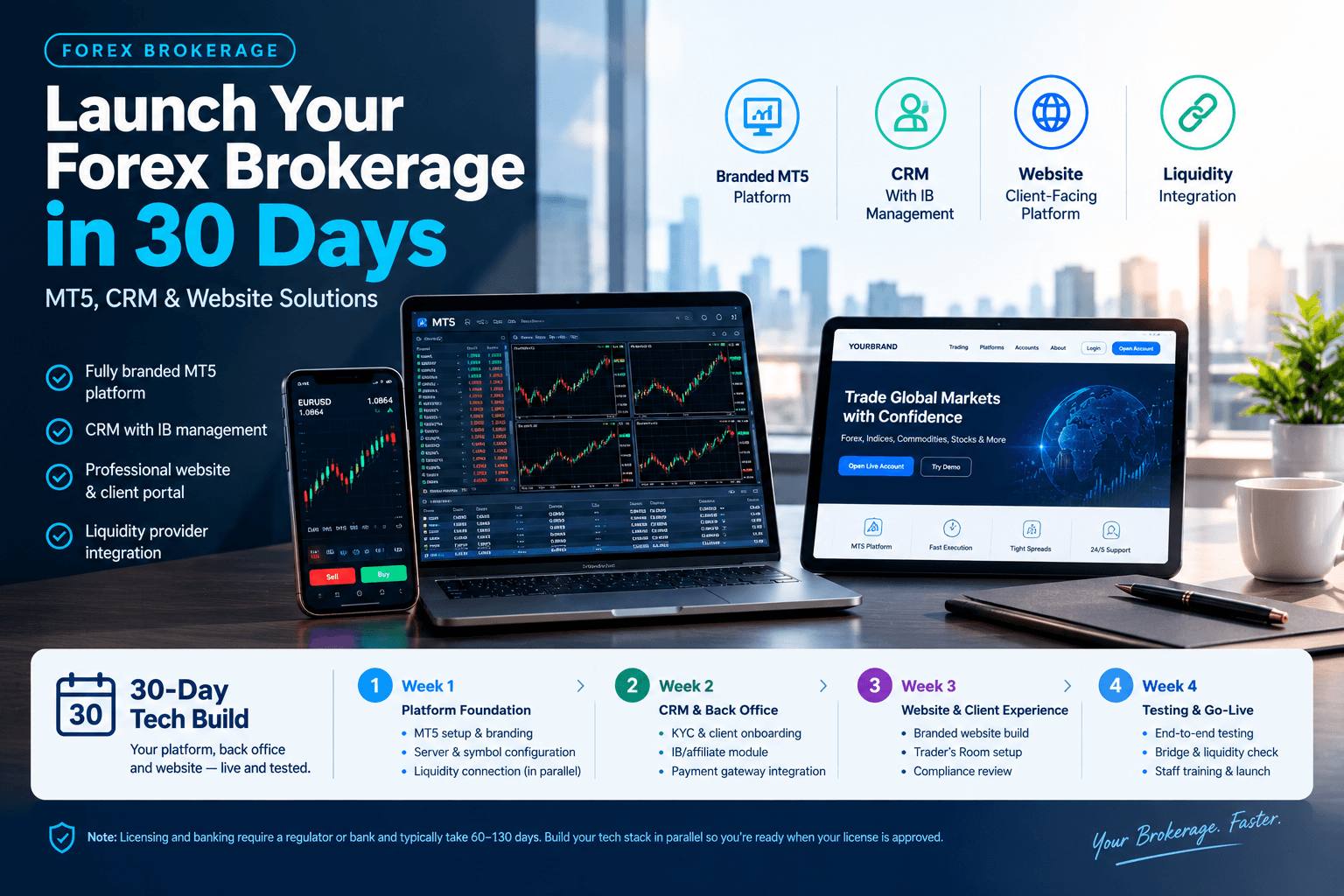
Here's what we tell every client who asks us this question: the MT4-vs-MT5 debate is largely settled for new brokers by MetaQuotes' own policy. The decision that actually shapes your business is how well your chosen platform integrates with everything around it — your CRM, your liquidity bridge, your compliance reporting.
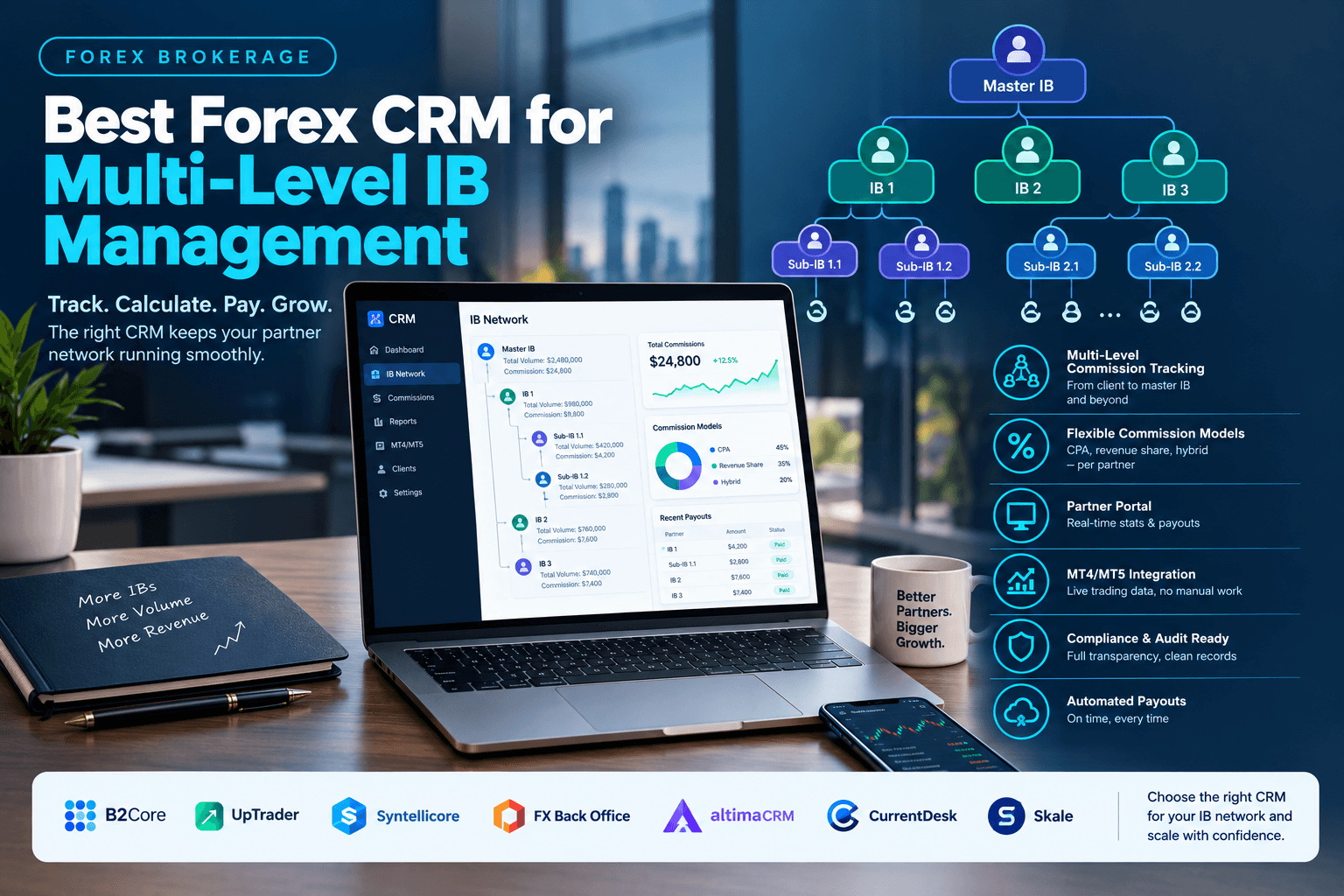
A well-integrated MT5 setup, where account data flows cleanly into your CRM's multi-tier IB tracking and your bridge configuration is properly tuned to your book model, will outperform a technically "available" but poorly configured setup every time. The platform choice is largely made for you. The integration quality is where your actual competitive advantage lives.
What This Means for Your Setup
If you're launching a new: build on MT5, full stop. There's no meaningful decision left to make on the platform question itself.
Your real decisions are downstream of that:
- Which asset classes to launch with (forex-only, or multi-asset from day one)
- Hedging, netting, or both, based on your target markets and regulatory jurisdiction
- How your CRM, bridge, and compliance reporting connect to your MT5 instance
- Whether you eventually add MT4 support later purely for client acquisition, if you're specifically targeting traders with an existing MT4 EA library
About FX Launch Pad
Every new brokerage we set up runs on MT5, simply because that's the only platform MetaQuotes licenses to new operators — but where we actually add value is making sure that MT5 instance is properly connected to your liquidity, CRM, and compliance stack from day one, since a technically correct platform choice with a poorly integrated setup underneath it still produces a mediocre client experience. Because our trading technology is developed in-house, we configure asset classes, account modes, and bridge settings around your specific business model rather than handing you a generic default setup.
If you're planning your MT5 configuration and want to make sure asset classes, account modes, and integrations are set up right from day one, book a free consultation and we'll walk through what your specific setup should look like.